
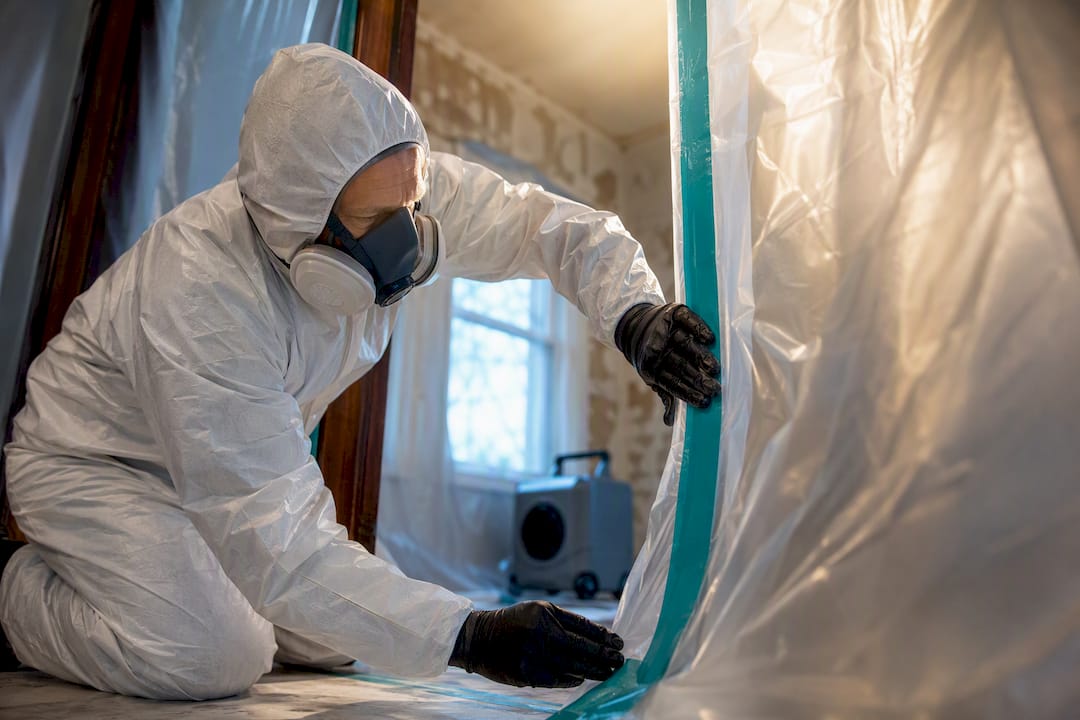
Asbestos abatement follows a fixed, regulated sequence: hazard investigation and sampling, risk classification, containment setup, controlled removal, sealed waste disposal, and clearance air testing before anyone re-enters the space. Every step is designed to keep fibres contained and confirm the air is safe before the job is called finished. The work should be led by a qualified person and, in most cases, a licensed abatement contractor.
TL;DR:
- Most asbestos jobs require hazard investigation and sampling before any removal, with sampling positive at 1% or more asbestos by weight triggering mandatory abatement.
- Containment setups demand negative pressure environments maintained with HEPA-filtered air machines, verified through continuous monitoring and visual inspections.
- Worker protection involves specialized PPE, strict decontamination procedures, and continuous use of wet methods and HEPA vacuums to prevent airborne fibre release during removal.
- Waste disposal follows a strict chain of custody with sealed, labelled containers, and licensed haulers provide documentation to ensure proper final disposal at approved sites.
- Timelines vary from one day for minor jobs to several weeks for large projects, with unexpected findings of asbestos behind walls or under floors being the primary cause of delays.
Table of Contents
- What happens during a hazard investigation and sampling?
- How is abatement work classified by risk level?
- Setting up containment and negative pressure enclosures
- What protective equipment and decontamination steps do workers follow?
- Which removal methods and techniques are used on-site?
- How is asbestos waste bagged, labelled and disposed of?
- How does air monitoring and clearance testing confirm the space is safe?
- What notification and timeline rules apply to owners and employers?
- What should you ask before hiring an abatement contractor?
- How HMJ Contracting approaches a compliant abatement project
- What happens if something goes wrong mid-abatement?
- What final cleaning and verification happen after removal?
- Contractor perspective: what actually surprises homeowners
- Get a licensed abatement estimate from HMJ Contracting
- Key regulations and guidance documents
- Sources
- FAQ
What happens during a hazard investigation and sampling?
The first move on any suspected asbestos job is not removal. It is investigation. If a homeowner or contractor suspects a material contains asbestos, work stops on that material immediately, and the area gets secured until a qualified person can assess it.
A proper hazard investigation involves representative bulk sampling, typically following NIOSH Method 9002 or an equivalently accredited protocol. The sampler takes multiple small pieces of the suspect material from different locations, since asbestos content can vary within the same wall or ceiling. Those samples go to an accredited lab for polarized light microscopy analysis.
Materials testing positive at 1% or more asbestos by weight are legally treated as asbestos-containing material, and that finding triggers a mandatory risk assessment before any invasive work proceeds. Below that threshold, different handling rules may apply, but the material still warrants caution.
A written hazard-investigation report should document:
- Exact location and extent of the suspect material
- Its friability (how easily it crumbles or releases fibres when disturbed)
- Current condition (intact, damaged, or actively deteriorating)
- Laboratory results with sample identification numbers
- Recommended risk classification for the work
Homeowners have a real role here even before a contractor arrives. Do not sand, drill, cut, or sweep any material suspected of containing asbestos. Visible dust tells you almost nothing about actual fibre risk, since asbestos fibres are microscopic and invisible to the naked eye. If you notice damaged vermiculite insulation, aging vinyl floor tile, or crumbling pipe wrap in a pre-1990 property, treat it as suspect and get it sampled before touching it. HMJ Contracting’s guide on asbestos removal warning signs walks through what to look for in older Ottawa-area homes specifically.
How is abatement work classified by risk level?
Not every asbestos job carries the same danger, and the controls required scale with how much fibre release the work could realistically cause. Regulators sort operations into low, moderate, and high-risk categories, and each tier comes with its own containment, air monitoring, and PPE requirements.
Classification depends on a handful of factors:
- Material type and friability — sprayed fireproofing releases fibres far more easily than a bonded floor tile.
- Location and accessibility — work in a confined mechanical room behaves differently than an open exterior wall.
- Disturbance likelihood — drilling, cutting, or demolition creates more fibre release than simple removal of intact panels.
A low-risk example might be removing a few intact asbestos floor tiles with minimal breakage. Moderate risk often covers activities like removing asbestos pipe insulation in sections. High risk includes disturbing sprayed or friable insulation, or any demolition work that will break apart asbestos-containing material at scale. High-risk work demands full containment, negative pressure enclosures, and continuous air monitoring, while low-risk work may only need wet methods and a HEPA vacuum on hand.
Classification is not locked in once the job starts. If workers uncover unexpected friable material behind a wall, or a supposedly bonded material starts breaking apart more than anticipated, the qualified person reclassifies the work on the spot and containment requirements ratchet up immediately.
Setting up containment and negative pressure enclosures
Once a job is classified as moderate or high risk, physical containment becomes the backbone of the entire operation. The goal is simple: create a sealed environment where fibres cannot escape into the rest of the building, and prove that seal is working through continuous negative pressure.
Containment enclosures use polyethylene sheeting of a thickness sufficient to prevent fibre penetration on walls, floors, and ceilings, with all seams taped and overlapped. For a Type 3 (high-risk) indoor job, the enclosure must maintain negative pressure of roughly 0.02 inches of water column relative to the surrounding building, achieved with HEPA-filtered negative air machines running continuously through the work.
The setup sequence generally runs:
- Shut down and seal HVAC systems serving the work area to prevent fibre migration through ductwork.
- Seal all penetrations, outlets, and openings with plastic sheeting and tape.
- Build the decontamination unit as a three-stage chamber: a dirty room, a shower or washroom, and a clean room, arranged so workers always move from dirty to clean.
- Install and test negative air machines before any asbestos-disturbing work begins.
- Verify negative pressure with a manometer or smoke test, and log readings throughout the shift.
Pro Tip: Ask your contractor to show you the negative pressure gauge reading before work starts, not just at the end of the day. A properly running enclosure should hold a stable negative reading the entire shift, and a contractor confident in their setup will not hesitate to walk you through it.
A technical breakdown of negative air containment setup covers the equipment and verification steps in more detail for readers who want the mechanics behind this stage.
What protective equipment and decontamination steps do workers follow?
Worker protection is where a lot of the abatement process’s discipline actually lives, and it is worth understanding even if you are not the one wearing the gear. Respiratory protection scales with the classification: routine moderate-risk work generally calls for a half-face or full-face respirator fitted with P100 filters, while high-risk friable removal in poorly ventilated spaces can require supplied-air respirators.
Beyond respirators, crews wear:
- Disposable full-body coveralls, taped at the wrists and ankles
- Disposable boot covers, removed and bagged before leaving the contaminated zone
- Gloves that get removed and disposed of as contaminated waste, never reused between areas
Routine on-shift cleaning does not wait until the job wraps up. Crews use HEPA vacuums and damp wiping continuously to control dust buildup within the enclosure, since dry sweeping or compressed air would send fibres airborne instead of capturing them.
Pro Tip: A worker exiting a containment area should never walk straight into a clean hallway in their work coveralls. If you see that happen on a job at your property, it is a red flag worth raising immediately.
Decontamination follows a strict one-way flow: workers vacuum visible debris off their suits in the dirty room, remove and bag disposable clothing, shower if the job calls for it, then dress in clean clothes in the clean room. Tools and equipment get HEPA-vacuumed and wet-wiped before they leave the contaminated zone, and nothing crosses back into clean space without being decontaminated first.
Which removal methods and techniques are used on-site?
The actual removal technique depends entirely on the classification assigned earlier. Provincial abatement manuals define three operational types, and each maps to a different level of fibre release risk.
- Type 1 operations cover minor, non-friable disturbances, such as removing a small section of asbestos floor tile or cutting a limited amount of asbestos cement board with hand tools using wet methods.
- Type 2 operations involve larger quantities or slightly more friable materials, like removing asbestos pipe insulation in sections without full containment, typically using wet methods and a glove bag.
- Type 3 operations are high-risk, friable-material jobs, such as removing sprayed fireproofing or extensive pipe lagging, and require full containment, negative pressure, and continuous air monitoring as covered above.
The glove bag technique is a common Type 2 method for pipe insulation: a sealed plastic bag with built-in glove sleeves is fitted around a section of pipe, allowing workers to wet, cut, and bag the insulation without exposing the surrounding area. Each glove bag gets inspected for tears or leaks before use, and disposed of as sealed waste once the section is complete.
Wet methods run through nearly every removal type, since keeping material damp during cutting or stripping keeps fibres from becoming airborne in the first place. HEPA vacuums capture what wetting misses. One rule holds across every classification without exception: compressed air is never used to clean asbestos debris, since it aerosolizes fibres instead of controlling them.
Special cases come up often enough to plan for. Outdoor work still requires wet methods and proper waste handling, even without a sealed enclosure, since wind can carry fibres just as effectively as indoor air currents. Demolition of a structure with known asbestos generally requires abatement first, though some jurisdictions permit limited exceptions for structurally unsound buildings under strict conditions. Encapsulation, where intact asbestos material is sealed rather than removed, is sometimes an acceptable alternative for stable, low-disturbance materials, though it defers rather than eliminates the long-term issue.
How is asbestos waste bagged, labelled and disposed of?
Every piece of asbestos waste generated during abatement gets treated as hazardous material from the moment it is removed until it reaches an approved disposal site. That chain of custody is not optional.
- Waste goes into sealed, leak-tight containers, typically double 6-mil poly bags or rigid labelled drums, while still wet.
- Every container carries hazard labelling identifying it as asbestos-containing waste, per COHSR container standards.
- Drop sheets and disposable coveralls get wet-packed and bagged the same way as the primary waste material.
- Waste removal happens frequently during the job rather than letting bags accumulate inside the containment area.
Once bagged, waste moves through a documented transport chain: a licensed waste hauler collects sealed containers and delivers them to a landfill or facility approved to accept asbestos-containing material. Reputable contractors keep manifests tracking every load from the site to final disposal, and property owners should expect copies of that documentation as part of their project records. If a contractor cannot produce disposal manifests after the job, that is a serious gap worth questioning.
How does air monitoring and clearance testing confirm the space is safe?
Monitoring runs on two separate tracks: air sampling during the work itself, and a distinct clearance test once removal and cleanup are complete.
During moderate and high-risk activities, daily air monitoring checks that the containment is holding and worker exposure stays within limits throughout the job, not just at the end. Clearance testing is the separate, final step that determines whether an enclosure can be dismantled and the space reoccupied. It uses NIOSH Method 7400 or an equivalent scientifically proven analytical method, and sampling continues until results meet the applicable clearance criteria.
Sample counts typically scale with enclosure size, as summarized below.
| Enclosure size | Typical minimum air samples | Purpose |
|---|---|---|
| Small (single room, glove bag work) | 3 to 5 samples | Confirm localized clearance before re-entry |
| Medium (multiple rooms or a floor) | multiple samples | Confirm consistent clearance across the enclosure |
| Large (whole building, commercial) | multiple samples, area-weighted | Confirm clearance across all distinct work zones |
A clearance certificate, issued by the qualified person or testing consultant who ran the sampling, states the analytical method used, the sample locations, the fibre concentration results, and a formal statement that the area meets clearance criteria for re-occupancy. A detailed explanation of air monitoring clearance rules breaks down how sample counts and thresholds are actually interpreted on real projects.
What notification and timeline rules apply to owners and employers?
Regulatory notification is not a formality property owners can skip. Many provinces require advance notice to the regulator, commonly at least 72 hours before abatement or demolition work that could release asbestos fibres begins.
Employer and owner duties run parallel to that notice requirement:
- Distribute the hazard investigation report to all workers who might encounter the material
- Maintain a written asbestos exposure control plan covering training, procedures, and monitoring
- Provide asbestos-awareness training to anyone working near identified material
- Keep clearance and disposal documentation on file for the property record
Timelines vary widely by scope. A single glove-bag pipe job might wrap in a day. A full single-room abatement with containment and clearance testing often runs three to five days. Whole-house projects can stretch two to three weeks depending on how much ACM is discovered mid-project, and large commercial jobs run longer still. The single biggest delay driver is undocumented friable material found after work starts, which is exactly why an asbestos management plan drafted before renovation begins reduces schedule risk considerably.
What should you ask before hiring an abatement contractor?
Picking the right contractor is the single decision that determines whether every other step in this process actually gets followed correctly. A handful of direct questions separates a compliant operator from one cutting corners.
- Ask for the contractor’s licence number, worker certifications, and proof of liability insurance before signing anything.
- Ask which accredited lab they use for sampling and clearance testing, and whether results are shared directly with you.
- Ask how often air monitoring happens during moderate and high-risk work, not just at the very end.
- Ask to see a sample clearance certificate from a past project so you know what documentation to expect.
- Ask who handles waste transport and disposal, and whether you will receive a disposal manifest.
Treat vagueness as a warning sign. A contractor who cannot describe their containment method for your specific job, or who resists sharing clearance results once testing is done, is not one to trust with a hazardous material job inside your home.
Pro Tip: A detailed, itemized quote listing sampling, containment, labour, disposal, and clearance testing as separate line items is a strong sign of a contractor who runs an organized, compliant operation. Vague lump-sum quotes make it much harder to know what you actually paid for.
Insist on a written asbestos exposure control plan and a final clearance certificate as contract deliverables, not optional extras. HMJ Contracting’s overview of safe renovation steps around asbestos covers additional questions worth raising if your project involves a broader renovation scope alongside the abatement work.
How HMJ Contracting approaches a compliant abatement project
Licensed asbestos, mould, and lead abatement for Ottawa-area properties includes certified removal crews with air quality testing and full disposal management on every job. The practical value of working with a licensed operator shows up in the handoffs a well-run project follows.
- An initial site visit and hazard-investigation sampling, so you know exactly what you’re dealing with before any pricing is finalized
- A transparent, itemized quote covering containment, removal, disposal, and clearance testing as distinct line items
- Licensed, insured crews carrying out the abatement itself according to the classification assigned to the work
- Independent clearance air testing before the enclosure comes down and the space is handed back for renovation or occupancy
HMJ Contracting maintains a 5.0-star Google rating built from hundreds of completed projects across the region…
What happens if something goes wrong mid-abatement?
Even a well-planned containment can run into problems, and a compliant crew has a defined response ready before that happens, not one improvised on the spot.
A torn enclosure or a failed negative-pressure reading triggers an immediate stop-work order on the affected area. Workers evacuate the zone, the tear or breach gets patched or the enclosure resealed, and negative pressure is re-verified with a manometer before anyone resumes work. If a fibre release is suspected outside the containment boundary, the response escalates: the surrounding area gets evacuated, HVAC systems already shut down stay shut down, and air samples are taken immediately in adjacent spaces to check whether fibres actually escaped.
Worker exposure incidents, such as a torn glove or a respirator failure, require the worker to exit through the full decontamination sequence regardless of how the shift is progressing, followed by incident documentation noting what happened, how long exposure lasted, and what corrective action followed. Serious incidents typically require reporting to the relevant provincial occupational health and safety authority within a set timeframe.
The underlying principle is straightforward: every incident, however minor, gets logged, investigated for root cause, and used to adjust procedures before work resumes. A contractor who cannot describe this process clearly, or who treats an enclosure breach as a minor inconvenience rather than a stop-work event, is not one you want managing a hazardous material job inside an occupied building.
What final cleaning and verification happen after removal?
Removal finishing the physical work is not the same as the job being done. Post-abatement cleaning is a distinct, methodical phase that has to happen before clearance testing can even begin.
Crews run a full HEPA vacuum pass across every surface inside the former containment area, including walls, floors, ledges, and any equipment left in place. That gets followed by damp wiping of hard surfaces to capture residual dust the vacuum missed, since settled fibres can still become airborne if disturbed later. Only once that two-stage cleaning is finished does the space sit for the required settling period before clearance air sampling begins, since disturbed dust needs time to settle before a sample can reflect the room’s true resting fibre concentration.
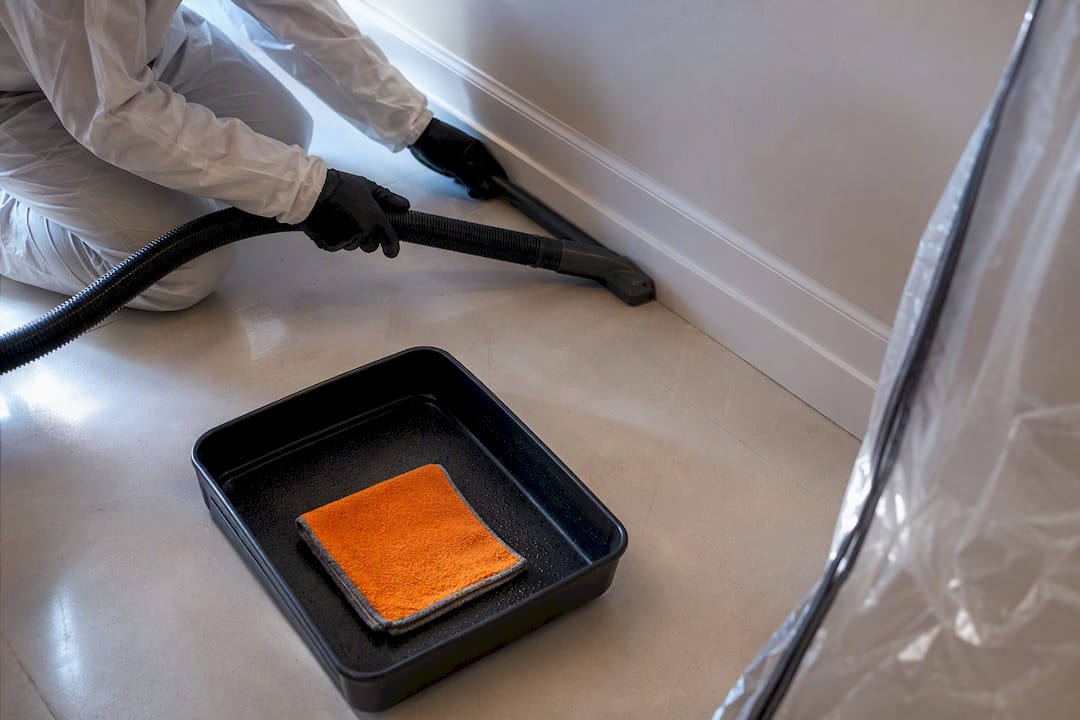
Visual inspection comes next, usually performed by the qualified person or testing consultant rather than the removal crew itself, checking for any visible debris, residue, or damaged material the cleaning pass may have missed. Only after that visual check passes does clearance air sampling proceed using NIOSH Method 7400 or an equivalent proven method, as covered earlier in this guide.
The enclosure itself does not come down until clearance results confirm the space meets criteria for re-occupancy. Polyethylene sheeting, tape, and any disposable containment materials are then removed and disposed of as asbestos waste themselves, since they were exposed to the work area throughout the job. Only once containment materials are cleared out and disposed of is the space formally handed back for renovation or normal use.
Contractor perspective: what actually surprises homeowners
The single most common surprise on these projects is not the removal itself. It is discovering hidden asbestos-containing material behind a wall or under a floor that nobody sampled ahead of time. Budget and schedule contingency exist for exactly this reason, and experienced crews build it into their planning rather than treating it as a crisis when it happens.
The homeowners who fare best are the ones who plan renovation timing around abatement and clearance windows from the outset, rather than trying to compress both into an unrealistic schedule. Paying for proper sampling and clearance testing upfront costs less, in every sense, than discovering a problem after the fact.
— Jason
Get a licensed abatement estimate from HMJ Contracting
A direct alternative to piecing together separate testing labs, removal crews, and disposal haulers for an Ottawa-area abatement project is one licensed team handling hazard investigation, containment, removal, waste disposal, and clearance testing under a single itemized quote, so clients are not coordinating multiple contractors or guessing where one company’s responsibility ends and another’s begins.

A typical project starts with a site visit where a qualified person assesses the suspect material and takes samples for lab analysis. A detailed, line-item quote covering containment, removal method, disposal, and clearance testing is provided so clients know what they are paying for before work begins. If you have a pre-1990 property with suspected asbestos, request an abatement estimate and get a licensed hazard investigation scheduled before your renovation plans move any further.
Key regulations and guidance documents
Readers and contractors working through an abatement project should keep these references on hand: the federal technical guideline on asbestos exposure management, the Canada Occupational Health and Safety Regulations on asbestos-containing material, the Alberta Asbestos Abatement Manual, and WorkSafeBC’s asbestos guidance.
This article is general information, not a substitute for advice from a qualified doctor. Consult a qualified healthcare professional about your own circumstances before acting on anything here.
Sources
- Canada
- Canada Occupational Health and Safety Regulations — Asbestos-containing Material (select sections)
- Alberta Asbestos Abatement Manual
- Asbestos - WorkSafeBC
FAQ
What does asbestos abatement include?
Asbestos abatement includes hazard investigation and sampling, risk classification, containment setup with negative pressure where required, controlled removal using wet methods and HEPA equipment, sealed waste disposal, and clearance air testing before the space is reoccupied.
How much asbestos can be removed without abatement?
Materials testing at 1% or more asbestos by weight trigger mandatory abatement precautions regardless of quantity, so there is no safe volume of confirmed ACM that bypasses proper controls. Minor, non-friable Type 1 work has lighter requirements than high-risk removal, but it is never exempt from wet methods and proper waste handling.
Can dust from asbestos be cleaned?
Yes, but only with HEPA vacuums and damp wiping. Dry sweeping or compressed air is never used, since both methods send fibres airborne instead of capturing them, and settled dust needs a clearance test to confirm the area is actually safe.
How long does an asbestos abatement take?
Timelines depend heavily on scope: a single glove-bag pipe job can finish in a day, a room-level abatement with containment and clearance testing often takes three to five days, and whole-house or commercial projects can run several weeks depending on how much material is discovered once work begins.