
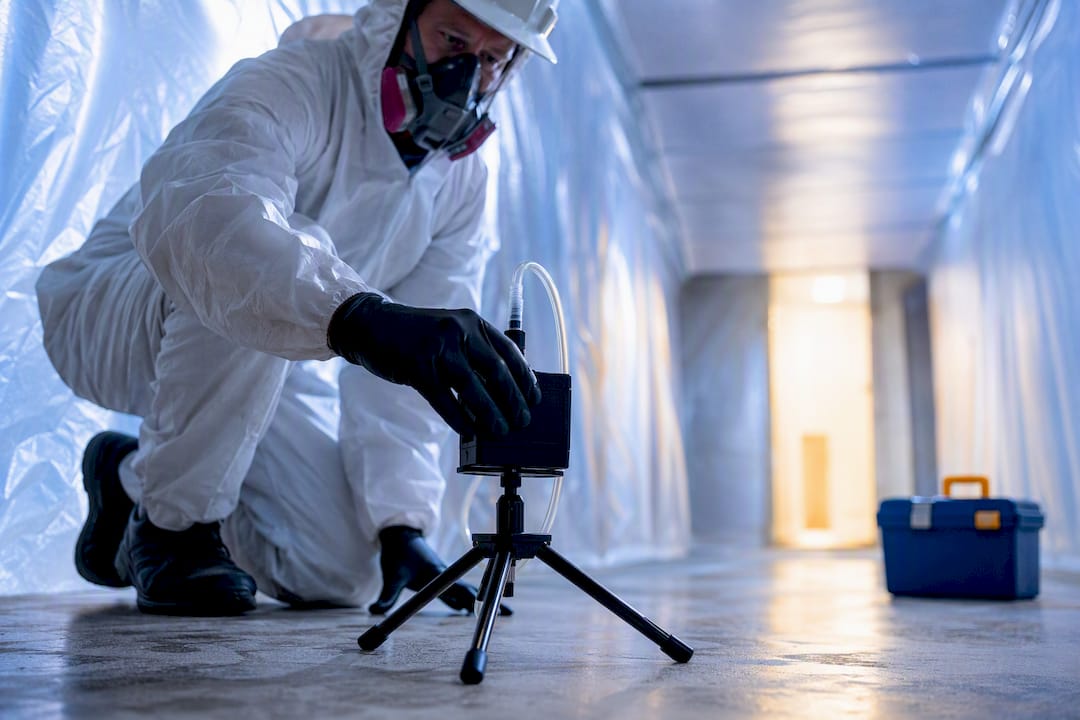
Asbestos air monitoring is the systematic sampling and lab analysis of airborne fibres to confirm exposure stays below regulated limits before, during, and after work on asbestos-containing materials. It’s required for moderate and high-risk projects, especially anything using an enclosure or running past 24 hours. The core numbers to know: the occupational exposure limit is 0.1 fibres per cubic centimetre (f/cc), a stop-work threshold typically triggers at about 0.05 f/cc, and clearance for reoccupation requires 0.01 f/cc or lower. A qualified person and an accredited lab need to be involved at every stage.
TL;DR:
- Air monitoring is required only for moderate- and high-risk asbestos work, especially when using enclosures or lasting more than 24 hours.
- Daily sampling during extended projects helps detect containment failures before fibers reach regulated exposure limits, with thresholds at 0.05 and 0.01 fibers per cubic centimeter.
- Four types of monitoring—background, occupational, daily, and clearance—serve different purposes and are essential for compliance and safety validation.
- Accurate lab analysis requires accredited labs using PCM for initial counts and TEM for species identification, with proper sample collection and handling procedures.
- Qualified, independent professionals should conduct sampling, interpret results, and oversee documentation to ensure reliable compliance and protect health.
Table of Contents
- When is asbestos air monitoring required?
- What are the different types of asbestos air monitoring?
- How is airborne asbestos analyzed in a lab?
- How many air samples do you need, and where?
- What equipment and field procedures does proper sampling require?
- What numeric thresholds and action levels apply?
- Who is qualified to perform asbestos air monitoring?
- How do you interpret a lab report and stay compliant?
- What’s the practical checklist for an asbestos monitoring project?
- How Hmjcontracting approaches monitoring and documentation
- What health and safety precautions matter during monitoring?
- What do the different asbestos fibre types mean for results?
- What are the detailed steps for collecting and shipping samples?
- What common problems come up during asbestos air monitoring?
- Which regulatory bodies govern asbestos air monitoring in Canada?
- Why does baseline air monitoring matter before abatement starts?
- Where the conventional advice on asbestos monitoring falls short
- Get certified abatement with monitoring handled properly
- Sources
When is asbestos air monitoring required?
Whether you need air monitoring at all comes down to how the work is classified. Most Canadian jurisdictions sort asbestos work into low, moderate, or high risk based on the material type, the task, and how much fibre disturbance the work is likely to cause.
Low-risk work generally covers small-scale, non-friable jobs: drilling a few holes in cement board, removing a handful of intact floor tiles, or minor repairs that don’t grind, cut, or abrade asbestos-containing material. Moderate risk includes larger removals of non-friable material, or short-duration work on friable material using wet methods and basic containment. High risk covers friable asbestos removal, mechanical demolition of asbestos-containing structures, and any work generating visible dust despite controls.
Monitoring becomes mandatory once a project crosses into moderate or high risk and uses an enclosure or clean room, or once the job runs longer than 24 hours. At that point, a qualified person must conduct daily air sampling for the duration of the work, not just at the start and finish.
The regulatory logic here is straightforward: short jobs with minimal disturbance carry a lower probability of releasing fibres in concentrations that matter, so the burden of proof for compliance is lighter. Extended enclosure work carries cumulative risk, and daily numbers are the only way to catch a containment failure before it becomes an exposure incident.
A few triggers commonly used to sort work into these categories:
- Material friability (friable insulation and sprayed fireproofing rank higher risk than bonded cement products)
- Method of disturbance (grinding and sanding generate more airborne fibre than wetted hand removal)
- Duration and enclosure use (anything sealed off and running multiple days needs daily verification)
- Occupancy status (occupied buildings during work raise the stakes for worker and bystander exposure)
Reclassification matters too. A job that starts as low-risk repair can escalate the moment hidden friable material turns up behind a wall or ceiling. When that happens, work should stop immediately, the area reassessed, and the project reclassified to moderate or high risk before continuing, which usually means bringing in monitoring that wasn’t part of the original plan. Homeowners tackling renovation work should read when air monitoring becomes necessary during renovations before assuming a “small job” stays small once demolition starts.
What are the different types of asbestos air monitoring?
Not every sample serves the same purpose. Four distinct monitoring types cover a project from planning through reoccupation, and mixing them up leads to compliance gaps.
-
Pre-abatement/background sampling. This establishes the fibre concentration in a space before any disturbance begins. It’s collected in areas surrounding the planned work zone, and its value is comparative: without a background number, you have no way to tell whether elevated readings during work came from the job or from an unrelated pre-existing condition. Background samples are typically taken days before mobilization, once the space is in its normal, undisturbed state.
-
Worker exposure (occupational) sampling. This measures what people doing the work actually breathe. Samples are collected in the breathing zone, the space within roughly 30 centimetres of the nose and mouth, over a full shift or as a short-term exposure limit (STEL) sample for peak-activity periods. Employers must sample the breathing zone of the most highly exposed workers and compare results against the OEL or threshold limit value (TLV) that applies in the province where the work happens.
-
Daily/abatement monitoring. Once work is underway inside an enclosure, daily samples verify that containment is holding. This isn’t about worker exposure, it’s about catching a tear in the poly sheeting or a failed negative-air unit before fibres migrate into occupied space. Results get compared against the internal action level and the stop-work threshold, and a bad reading stops the job cold until the containment issue is fixed.
-
Clearance sampling. This is the last checkpoint before anyone dismantles the enclosure or reoccupies the space. Aggressive sampling techniques disturb settled dust deliberately, so the test can’t be fooled by fibres that simply haven’t been stirred up yet. A pass here is the greenlight for demolition of the containment and return to normal use.
Each type answers a different question, and skipping one to save time on a schedule usually means the project owner is flying blind on exactly the question that matters most at that stage.
How is airborne asbestos analyzed in a lab?
Two analytical methods dominate asbestos air sampling, and they measure different things. Getting the distinction right matters when you’re reading a lab report and deciding whether a number means the job is clean or needs a second look.
Phase contrast microscopy (PCM), analyzed under NIOSH Method 7400, is the primary and most widely used method for both occupational and clearance sampling. It’s fast, relatively inexpensive, and gives same-day or next-day turnaround in most labs. PCM counts fibres longer than 5 micrometres with a length-to-width (aspect) ratio of at least 3:1, scanning a set number of fields, typically up to 100, under the microscope. The catch: PCM can’t distinguish asbestos fibres from other fibrous material, like fibreglass or gypsum fibre, that happens to meet the same size and shape criteria.
Transmission electron microscopy (TEM), under NIOSH Method 7402, is the confirmatory method. TEM identifies fibre mineralogy directly, so it resolves the ambiguity PCM leaves behind. It’s used when PCM results come back elevated or borderline, when a low-count confirmation is needed for a sensitive clearance decision, or when a client or regulator specifically requires species-level identification.
Fast fact: Under PSPC’s Standard on Asbestos Management, if PCM samples exceed the applicable threshold, TEM analysis by NIOSH 7402 becomes the required follow-up step, not an optional extra.
Lab accreditation isn’t a paperwork formality. It’s the difference between a defensible result and a number nobody can vouch for. Before trusting a report:
- Confirm the lab holds current accreditation for asbestos fibre counting (PCM and, where relevant, TEM)
- Verify participation in a recognized external quality control program, which cross-checks counting consistency between analysts and labs
- Ask whether the lab counts fibres per the NIOSH criteria of length over 5 μm and aspect ratio above 3:1, the same rule set referenced throughout Canadian membrane filter method guidance
- Request the lab’s method detection limit and how it handles field blanks
An unaccredited lab can hand you a clean-looking number that means nothing under scrutiny, which is a costly discovery to make after reoccupation.
How many air samples do you need, and where?
Sample counts aren’t discretionary, they scale with the physical size of the work area. The rule most Canadian guidance leans on is straightforward once you know it:
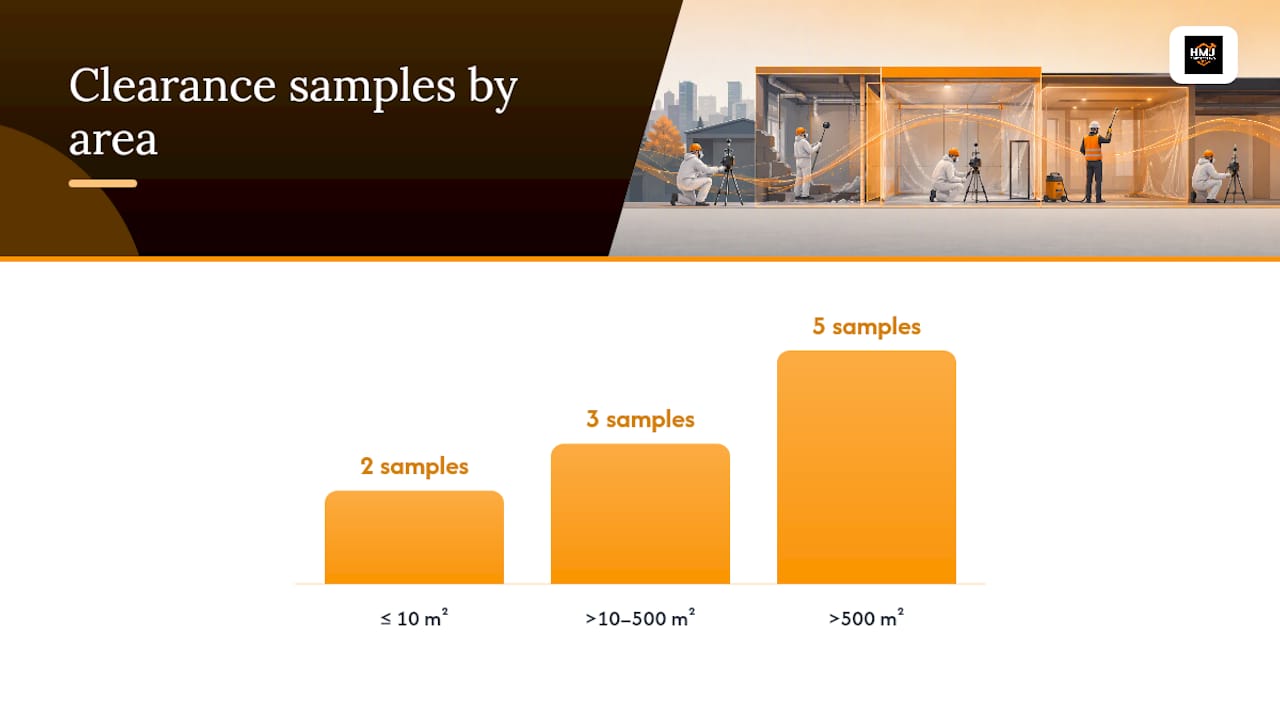
- 2 samples for enclosures or work areas of 10 square metres or less
- 3 samples for areas larger than 10 up to 500 square metres
- 5 samples for areas exceeding 500 square metres
This “2/3/5 rule” applies to clearance sampling inside the enclosure, and the logic scales sensibly: a bigger space has more places for a containment breach or missed contamination to hide, so more sample points are needed to make the “all clear” credible.
Location matters as much as count. A defensible sampling plan typically places samples in four zones:
| Location | Purpose |
|---|---|
| Clean room / decontamination unit | Confirms the transition zone workers pass through hasn’t been contaminated |
| Inside the enclosure | Verifies the work area itself meets clearance criteria before teardown |
| Outside, adjacent to the enclosure | Catches any leakage into occupied or public space during work |
| Worker breathing zone | Measures actual personal exposure during active work, separate from area sampling |
Sample volume is where a lot of field crews cut corners without realizing it. For clearance sampling by PCM, many provincial regulations specify a minimum of roughly 2,400 litres of air drawn through each filter. Pull less air than that and you risk under-loading the filter, which can produce a false pass simply because there wasn’t enough air volume to capture a representative fibre count. Pump flow rates for this kind of sampling generally run in the 1 to 10 litres per minute range, calibrated before and checked periodically during collection, with the specific rate and run time chosen to hit that target volume without overloading the filter with background dust.
Frequency follows the risk classification discussed earlier. Daily sampling applies for any enclosure job running more than 24 hours, collected at the same time each day so trends are comparable. Full-shift sampling covers occupational exposure for workers inside the containment, run for the length of their actual shift rather than a fixed clock time. STEL sampling supplements this during short bursts of high-disturbance activity, like initial gross removal, where peak exposure could exceed the full-shift average by a wide margin.
What equipment and field procedures does proper sampling require?
The equipment list for asbestos air sampling is short, but every piece has to work correctly, because a bad calibration or a contaminated cassette invalidates the entire sample, even if the lab analysis is flawless.
A standard field kit includes:
- Sampling pumps, calibrated to deliver a known, steady flow rate throughout the collection period
- Mixed cellulose ester (MCE) filter cassettes, typically 25mm, with the correct pore size for fibre capture and a conductive cowl to reduce electrostatic loss of fibres
- Field calibrators (rotameters or electronic calibrators) to verify pump flow before deployment and check it hasn’t drifted afterward
- Field blanks, unopened cassettes carried alongside the real samples and analyzed the same way, to catch contamination introduced by handling rather than by air
Calibration isn’t a one-time task. Pumps should be checked against a calibrator immediately before deployment and again at the end of the sampling run; a flow rate that drifts more than about 5% between the two checks throws the reported air volume, and therefore the fibre concentration, into question.
Pro Tip: Run at least one field blank per sampling event, not per project. Cassettes handled on different days or by different crew members pick up different background contamination, and a single blank from week one won’t catch a problem that started in week three.
Clearance sampling specifically uses aggressive, or forced-air, technique: leaf blowers or fans agitate settled dust on horizontal surfaces before and during sample collection. This isn’t overkill, it’s the only way to make sure a clearance pass reflects fibres that could actually become airborne again once containment comes down, rather than fibres that happened to stay put during a quiet test.
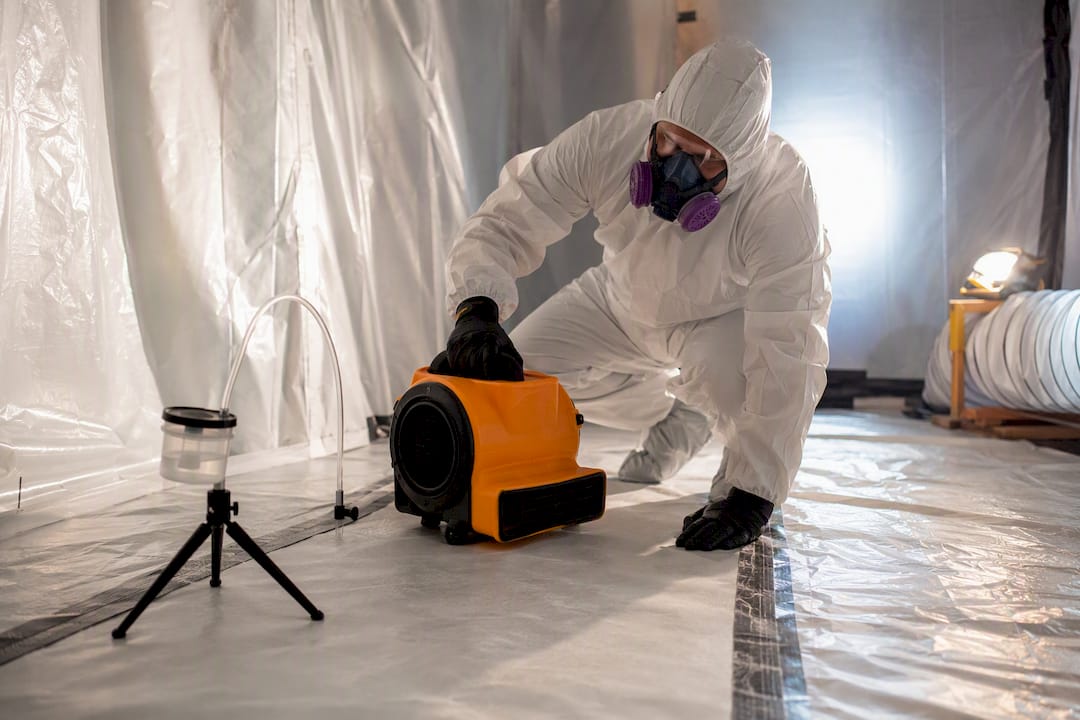
Chain of custody closes the loop. Every sample gets a unique ID at the point of collection, a signed field log noting location, time, flow rate, and duration, and a sealed, labelled container for transport. Samples should go to the lab promptly, ideally within a day or two, in a rigid case that prevents the cassette from cracking or the filter from shifting in transit.
What numeric thresholds and action levels apply?
Three numbers govern almost every decision on an asbestos monitoring plan, and knowing which one applies to which situation prevents a lot of confusion on-site.
The occupational exposure limit (OEL), sometimes called the threshold limit value (TLV) depending on the jurisdiction, sits around 0.1 fibres per cubic centimetre as an 8-hour time-weighted average. This is the regulatory ceiling for what a worker can be exposed to over a full shift, and it’s the benchmark every full-shift breathing-zone sample gets compared against.
Below that ceiling sits a practical safety margin many qualified persons build into their monitoring plans. Using roughly 50% of the OEL, about 0.05 f/cc, as an internal action level lets a project trigger additional controls, or stop work outright, before the legal limit is actually breached. This half-OEL figure is also the commonly used stop-work threshold for daily abatement monitoring.
Clearance sits at a stricter number entirely: 0.01 fibres per cubic centimetre, measured by PCM, is the pass criterion most regulations use for reoccupation. TEM confirmation may be layered on for a borderline result or where the client demands species-level certainty before signing off.
- 0.1 f/cc — OEL/TLV, 8-hour TWA for occupational exposure
- 0.05 f/cc — common internal action level and stop-work trigger
- 0.01 f/cc — clearance pass criterion by PCM
The sequence matters: a reading above 0.05 f/cc during active work halts the job and triggers a containment inspection. A reading above 0.1 f/cc on a worker exposure sample is a regulatory breach requiring immediate corrective action and likely reporting. A clearance sample above 0.01 f/cc means the space stays sealed, the source of contamination gets identified, and re-cleaning and re-testing happen before anyone steps back in.
Who is qualified to perform asbestos air monitoring?
The “qualified person” isn’t a formality on a form, it’s the individual whose competence determines whether the entire sampling exercise holds up under scrutiny. That person needs working knowledge of sampling strategy design, correct field technique, and the ability to interpret lab results against the applicable regulatory thresholds, not just collect a filter and mail it off.
Independence matters just as much as competence. Keeping the monitor separate from the abatement contractor preserves the integrity of the results. A monitor with a financial stake in the project passing clearance quickly has an incentive, even unconsciously, to sample less aggressively or interpret borderline results generously. The cleanest arrangement has the monitoring service reporting to the property owner or a neutral third party, not to the crew doing the removal.
Before trusting a lab or monitor, run through a short verification checklist:
- Confirm the lab’s current accreditation status for the specific analytical method being used
- Ask for proof of external quality control program participation, not just a claim of it
- Verify the monitor has no financial or contractual relationship with the abatement contractor
- Request sample chain-of-custody documentation for a past project as a sanity check
Record-keeping obligations follow from there. Results must be posted in a conspicuous location within 24 hours of receipt, and copies provided to the workplace health and safety committee where one exists. Retention periods vary by jurisdiction and record type, sometimes one year for routine monitoring logs, sometimes far longer for exposure records tied to long-latency disease risk, so check the specific retention rule that applies before discarding anything.
How do you interpret a lab report and stay compliant?
A lab report isn’t just a single number, and reading it as one is where a lot of misinterpretation happens. The raw fibre count gets converted to fibres per cubic centimetre by dividing the counted fibres by the analyzed filter area and the total air volume sampled, which is exactly why an under-volumed sample (see the 2,400 litre clearance minimum above) can distort the final concentration even when the counting itself was done correctly.
Field and lab blanks factor into that math too. A blank with an unusually high count suggests contamination during handling rather than genuine airborne fibre, and a competent lab will flag it and may recommend rejecting the affected samples rather than reporting a misleading result.
TEM confirmation changes the conclusion, not just the confidence. A PCM result sitting right at 0.01 f/cc is ambiguous; TEM analysis under NIOSH 7402 can confirm whether the counted fibres are actually asbestos, which either clears the space with certainty or identifies a genuine problem PCM alone couldn’t resolve.
Administrative duties don’t end when the lab emails the report:
- Post clearance and exposure results in a conspicuous, accessible location within 24 hours
- Provide copies to the workplace health and safety committee or worker representative
- Retain sampling records for the period specified by the applicable regulation
- Escalate to the regulator, and halt work, if any result exceeds the stop-work or clearance threshold and can’t be immediately explained by a field or lab error
What’s the practical checklist for an asbestos monitoring project?
Turning all of the above into something usable on an actual job comes down to four phases, each with its own short list of non-negotiables.
-
Before work starts: Classify the risk level honestly, based on material friability and disturbance method, not on schedule pressure. Hire a qualified person independent of the abatement crew. Finalize the lab and sampling plan, including sample counts under the 2/3/5 rule and background sampling if the space’s baseline condition is unknown.
-
During work: Keep daily monitoring records for any enclosure job running past 24 hours. Collect breathing-zone samples for the most exposed workers each shift. Verify containment daily rather than assuming yesterday’s seal still holds.
-
Clearance and reoccupation: Run aggressive sampling to dislodge settled dust before testing. Confirm results meet the 0.01 f/cc clearance criterion by PCM before dismantling containment. Post results within the required window.
-
After work wraps up: Retain all sampling files for the retention period the applicable regulation specifies. Provide copies to the health and safety committee. Keep chain-of-custody documentation on file in case a dispute or reoccupation question comes up later.
| Phase | Key action | Who’s responsible |
|---|---|---|
| Before work | Classify risk, hire qualified person | Owner/contractor |
| During work | Daily and breathing-zone sampling | Qualified person |
| Clearance | Aggressive sampling, ≤0.01 f/cc pass | Independent monitor |
| After work | Retain records, notify committee | Owner/contractor |
Homeowners planning a renovation that might disturb older materials should read through signs that suggest asbestos removal is needed first before this checklist becomes urgent mid-project.
How Hmjcontracting approaches monitoring and documentation
Jason’s professional credentials and years of experience inform how abatement projects are structured around documented, independent air monitoring rather than treating it as a box to check at the end.
Every abatement quote is itemized, so homeowners can see exactly where monitoring, containment, and disposal costs sit in the total rather than finding them buried in a lump sum. Transparently, qualified persons and accredited labs run sampling independently of the removal crew, which avoids the conflict-of-interest problem that undermines results when the same party doing the removal is also grading its own work.
Final clearance documentation is handed to clients as part of project closeout, giving homeowners and property managers a paper trail that shows the space met the 0.01 f/cc criterion before reoccupation, not just a verbal assurance that the job is done.
Clients usually experience a defined timeline agreed upfront, temporary access restrictions to the work zone while containment is active, and a handover package once clearance passes. Anyone weighing a renovation that might involve legacy materials can get a sense of what to expect from how asbestos affects renovation planning before the first wall comes down.
What health and safety precautions matter during monitoring?
Air monitoring doesn’t happen in isolation from the broader safety plan, it’s one control layer among several, and treating it as the only line of defence is a mistake.
Workers collecting samples inside an active containment need the same personal protective equipment as the abatement crew: a properly fitted respirator rated for asbestos fibre, disposable coveralls, and decontamination through the clean room airlock on exit, not a quick brush-off at the doorway. Cross-contamination between the “dirty” work area and the “clean” side of the enclosure is one of the most common ways monitoring itself introduces risk rather than measuring it.
Negative-air pressure inside the enclosure needs continuous verification, not just a start-of-day check, since a failing fan or a torn duct can silently reverse the pressure differential and push contaminated air outward. Manometers or pressure gauges mounted at the enclosure boundary give a visual, ongoing readout that a daily air sample alone won’t catch in real time.
Sample collection itself carries a smaller but real risk: handling cassettes with contaminated gloves, or opening a filter cassette outside the controlled area, can both compromise the sample and expose the person handling it. Cassettes should be capped, bagged, and only opened at the point of deployment inside the work zone.
Bystander and occupant protection matters too, particularly for work in occupied buildings. Signage, physical barriers, and clear communication about restricted zones prevent someone unfamiliar with the project from wandering into an active enclosure boundary during a sampling run.
What do the different asbestos fibre types mean for results?
Not all asbestos fibres behave the same way in the air or carry the same regulatory weight, and a lab report that just says “fibres detected” without context can be misread.
Chrysotile is the most commonly encountered asbestos type in Canadian buildings, found in older vermiculite insulation, cement products, and some flooring materials. It tends to occur in curly, flexible fibre bundles, which affects how readily it becomes airborne compared to the straighter amphibole types.
Amosite and crocidolite, the two main amphibole asbestos types, are straighter and more needle-like. They’re associated with higher-risk applications historically, like pipe insulation and some sprayed fireproofing, and some jurisdictions apply extra scrutiny when TEM analysis identifies amphibole fibres specifically, given their different behaviour in the lung.
Here’s where PCM’s limitation becomes practical rather than academic: PCM counts any fibre meeting the size and shape criteria, chrysotile, amphibole, or a non-asbestos fibre like fibreglass, without telling you which one it is. A PCM result showing elevated fibre counts on a site with known fibreglass insulation nearby might be counting the wrong material entirely. That’s precisely the scenario where TEM’s mineralogical identification earns its cost, confirming whether the counted fibres are asbestos at all, and if so, which type, before anyone treats the number as a genuine exposure concern.
What are the detailed steps for collecting and shipping samples?
Getting a sample from the air pump to a defensible lab result depends on a sequence that’s easy to describe and easy to get wrong under time pressure.
Start with pump calibration against a known-flow calibrator immediately before deployment, recording the pre-sample flow rate in the field log. Mount the cassette at the correct sampling location, breathing zone, enclosure interior, or clean room, oriented downward or at a slight angle to reduce gravitational settling bias, and start the pump, noting the exact start time.
Run the sample for the duration needed to hit the target volume, roughly 2,400 litres for clearance sampling by PCM, checking periodically that the pump hasn’t stalled or the tubing hasn’t kinked. At the end of the run, record the stop time and recalibrate the pump to check for flow drift.
Immediately cap the cassette, label it with a unique sample ID, location, date, start and stop time, and total volume, and place it in a rigid, padded shipping container. Field blanks travel in the same container, handled identically apart from never being opened to sample air.
Complete a chain-of-custody form listing every person who handled the samples from collection to lab receipt. Ship or hand-deliver to the lab promptly, ideally within a day or two, avoiding extreme heat or physical shock in transit that could dislodge fibres from the filter surface before analysis.
What common problems come up during asbestos air monitoring?
A handful of recurring issues account for most of the disputes and do-overs on asbestos monitoring projects, and most are preventable with attention to detail rather than expensive equipment.
Under-volumed clearance samples are probably the most frequent error. A crew in a hurry cuts the sampling run short, the filter never reaches the roughly 2,400 litre target, and the reported concentration looks artificially low simply because too little air was analyzed. The fix is procedural: calculate run time from target volume and flow rate before starting, and don’t stop early regardless of schedule pressure.
Pump flow drift is the second common culprit. A pump running below its calibrated rate under-samples without anyone noticing until the post-run calibration check flags the discrepancy, at which point the sample may need to be discarded and repeated.
Contaminated field blanks point to a handling problem, usually cassettes opened too early, stored near dusty surfaces, or handled with gloves that touched other surfaces first. When blanks come back elevated, the whole sampling event’s credibility is in question, not just the blank itself.
Using a lab without verified accreditation is a pitfall that shows up long after the fact, usually when a result gets challenged. Insisting on written proof of accreditation and external QC participation before the project starts avoids a costly re-test later.
Finally, sampling in the wrong location, missing the clean room or skipping adjacent-space checks, produces technically valid numbers that answer the wrong question.
Which regulatory bodies govern asbestos air monitoring in Canada?
Several overlapping frameworks shape asbestos air monitoring depending on where the work happens and who’s doing it, and knowing which applies avoids relying on the wrong standard.
Federally regulated workplaces fall under the Canada Occupational Health and Safety Regulations (COHSR), which set out exposure control requirements for federal employees and federally regulated industries. Work on federal properties specifically follows the Public Services and Procurement Canada Standard on Asbestos Management, which sets out the analytical methods, lab accreditation, and quality control requirements referenced throughout this guide.
Provincial occupational health and safety regulators set the rules for most workplaces outside federal jurisdiction, and requirements vary by province, including specific clearance sample volumes like the roughly 2,400 litre minimum found in some provincial designated substance regulations. Anyone managing a project should confirm which provincial regulator has authority over the specific worksite rather than assuming national uniformity.
South of the border, the U.S. Occupational Safety and Health Administration (OSHA) and Environmental Protection Agency (EPA) set analogous but distinct standards; their thresholds and methods, while similar in spirit to NIOSH-based Canadian guidance, shouldn’t be assumed to apply directly to Canadian work. Municipal bylaws can add further requirements, particularly around demolition permits and public notification, layered on top of provincial and federal rules.
Why does baseline air monitoring matter before abatement starts?
Skipping the background sample is one of the most common shortcuts on tight-budget projects, and it’s also one of the costliest to skip when a dispute arises later.
Background, or pre-abatement, sampling establishes what the air in and around the work zone actually contains before any disturbance happens. Without that number, a contractor has no defence if a post-work sample comes back elevated and someone claims the work caused contamination that was, in fact, already present from a decades-old source unrelated to the current project.
Background sampling also validates the monitoring plan itself. If baseline readings in “clean” adjacent areas come back unexpectedly high, that’s a signal something in the building, maybe deteriorating insulation elsewhere, maybe a ventilation path nobody accounted for, needs investigating before work proceeds, not after.
For insurance and liability purposes, a documented baseline is often the single piece of paper that determines whether a contractor or property owner bears responsibility for a contamination claim. It’s collected typically a few days to a week before mobilization, under normal, undisturbed conditions, using the same PCM methodology as the rest of the project’s sampling plan so results are directly comparable across the project timeline.
Where the conventional advice on asbestos monitoring falls short
Most guidance on this topic treats monitoring as a compliance checkbox: hit the sample counts, get a number under the threshold, move on. That framing misses the actual point of the exercise. Air monitoring is a control validation tool, not a paperwork requirement, and the projects that go sideways are almost always the ones where someone treated the daily sample as a formality rather than as the only real-time signal that containment is still working.
The other blind spot is independence. Plenty of contractors offer to “handle the testing” as part of a bundled quote, and on paper that looks efficient. In practice, a monitor with a financial stake in the job passing quickly has a built-in incentive problem, even when nobody intends anything dishonest. If there’s one place homeowners and property managers should spend a bit more scrutiny, it’s confirming the person reading the pump and the lab analyzing the filter have no stake in the abatement contractor’s bottom line.
Prioritize the qualified-person and lab-accreditation questions before the schedule questions. A fast clearance on a shaky sample is worse than a slower one you can actually trust.
— Jason
Get certified abatement with monitoring handled properly
Hmjcontracting is the alternative to piecing together separate contractors and testing services for asbestos work in Ottawa: one licensed team manages the removal, coordinates qualified air monitoring, and hands you documented clearance results, so you’re not left chasing three different companies to prove the job was done safely.

Reach out for a free estimate and you’ll get an itemized quote that separates abatement, containment, and monitoring costs clearly, not bundled into a number you can’t verify. Every project closes out with documented clearance reports showing results met the pass criteria before reoccupation, giving you a paper trail rather than a verbal assurance. If you’re planning a renovation on an older Ottawa property and suspect asbestos-containing material is involved, book a consultation for certified abatement services and get the monitoring plan built into the project from day one, not added as an afterthought.
Sources
Several government and technical references anchor the thresholds and procedures covered above. Start with the Technical guideline to asbestos exposure management programs for sampling counts, stop-work thresholds, and posting requirements. The PSPC Standard on Asbestos Management covers analytical methods and lab accreditation expectations for federal properties. NIOSH Methods 7400 and 7402 define the PCM and TEM counting rules referenced throughout, detailed in the NIOSH membrane filter method technical report. Provincial clearance volume specifics appear in instruments like O. Reg. 278/05. For site-specific interpretation, consult a qualified industrial hygienist, since exact thresholds and retention periods vary by province.
This article is general information, not a substitute for advice from a qualified doctor. Consult a qualified healthcare professional about your own circumstances before acting on anything here.
- Technical guideline to asbestos exposure management programs
- NIOSH technical report: membrane filter method for evaluating airborne asbestos fibers