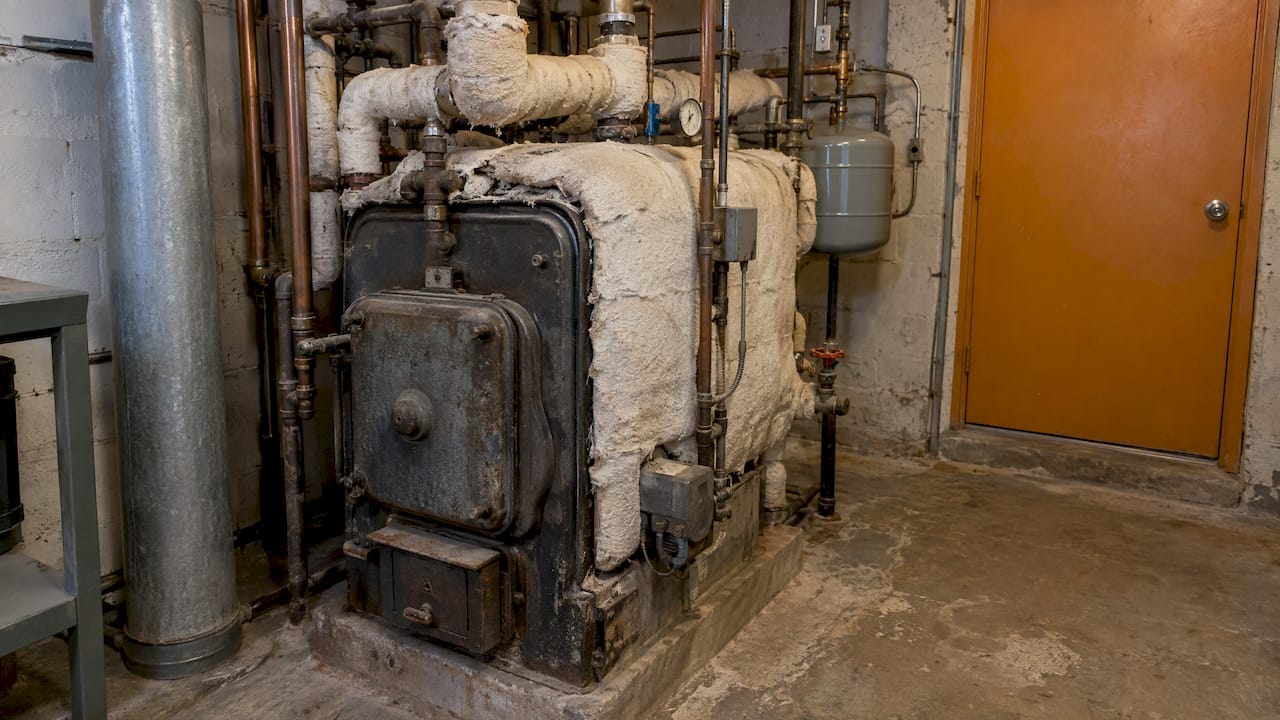
If your home has an older boiler wrapped in white, grey or papery insulation, treat that insulation as asbestos until a lab says otherwise. Age and appearance cannot confirm it, and disturbing it is the real danger. The safe route is a lab test on a sample taken by a qualified person, then removal by a licensed abatement contractor if the result is positive. We carry out this work for homes and commercial buildings in Ottawa and the surrounding area.
TL;DR
- Boilers, hot water and steam piping, and tanks were commonly insulated with asbestos-containing material, especially in buildings built before 1990.
- You cannot confirm asbestos by looking at it. Only laboratory analysis of a proper sample can.
- Undisturbed, intact insulation is far less of a concern than insulation that is cut, damaged or crumbling. Do not sand, scrape or tear it.
- Test before any boiler replacement, renovation or demolition, and use a licensed abatement contractor if the material contains asbestos.
- Our published pricing starts at $300 to $600 for testing and lab analysis, and $1,500 to $3,500 for small Type 1 or 2 abatement jobs.
Table of Contents
- Why boilers and pipes were insulated with asbestos
- Where to look in a boiler room
- Can you tell by looking?
- The health risk, and when fibres are released
- What to do if you suspect asbestos around your boiler
- How professional removal works
- What it costs in Ottawa
- Property managers and commercial owners
- Our perspective
- Get the boiler room assessed
- FAQ
- Sources
Why boilers and pipes were insulated with asbestos
Asbestos resists heat and fire, so for decades it went into thermal insulation. Employment and Social Development Canada states that before 1990 asbestos was mainly used to insulate buildings and homes against cold, noise and fire, so buildings from that period likely contain some form of it. By the end of 2018, products containing asbestos were prohibited from being imported, sold or used in Canada, with limited exclusions. That ban does nothing for the insulation already in your basement.
If your house has a gravity-fed hot water or steam heating system, a large old boiler or a furnace room with wrapped pipes, it is worth assuming the insulation is suspect. Ottawa has many homes in this category, from older central neighbourhoods to rural properties in Renfrew County.
Where to look in a boiler room
Alberta’s asbestos bulletin TB-020 lists thermal insulation on hot water and steam piping, ductwork, boilers, pressure vessels and other mechanical equipment among the common asbestos-containing materials. In a typical older house, that means:
- the boiler jacket or the covering around the boiler shell
- pipe wrap on supply and return lines, often a corrugated or plaster-like covering
- insulation on elbows, valves and fittings, which is often a lumpy, hand-applied coating
- hot water tank wrap
- ductwork wrap near the furnace
- gaskets and flue connections
The ESDC page specifically warns that removing insulation around hot water pipes and tanks is a life-threatening hazard when it contains asbestos. For a closer look at one common component, see our guide to spotting asbestos pipe wrap in homes built before 1990.
Can you tell by looking?
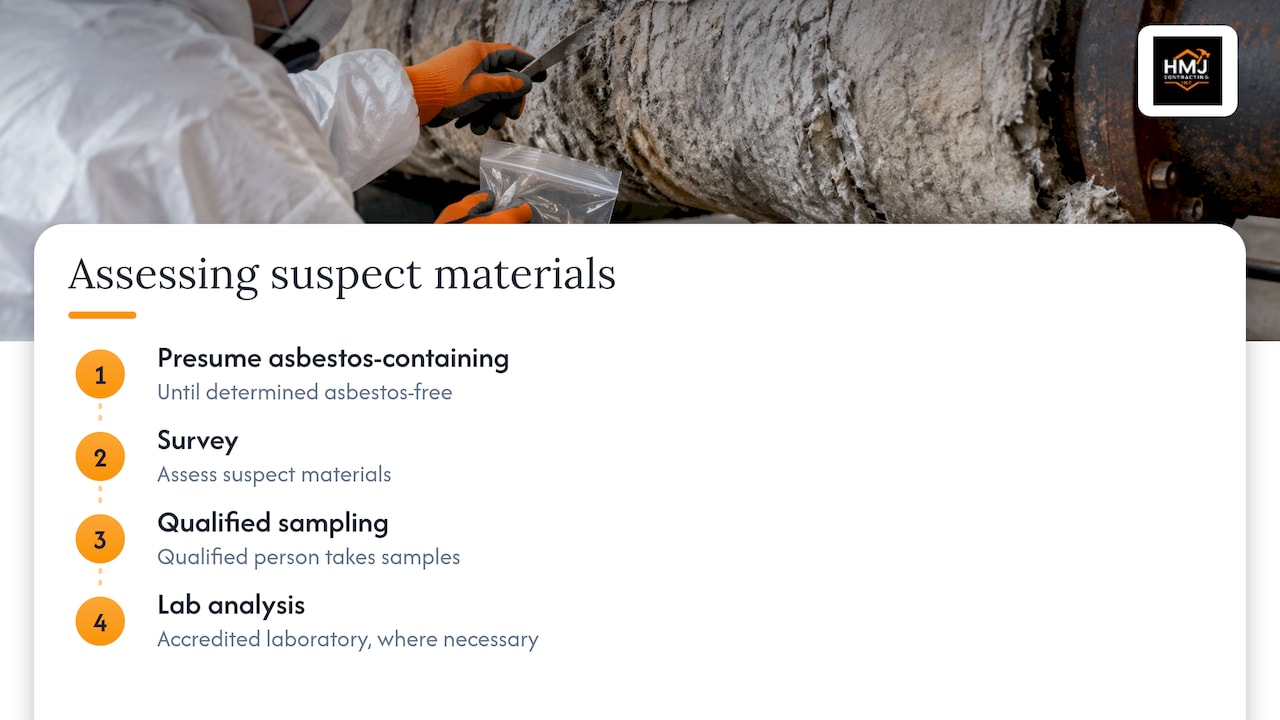
No. White, grey or brown fibrous wrap can be asbestos, but fibreglass, mineral wool and calcium silicate look similar. Age is a clue, not proof. Government guidance in Saskatchewan states that any material likely to contain asbestos is considered asbestos-containing until determined to be asbestos-free.
Alberta’s guidance says suspect materials should be assessed through a hazardous building materials survey and, where necessary, laboratory analysis before they are disturbed. Samples should be taken by a qualified and competent person and sent to an accredited laboratory.
What the lab result means
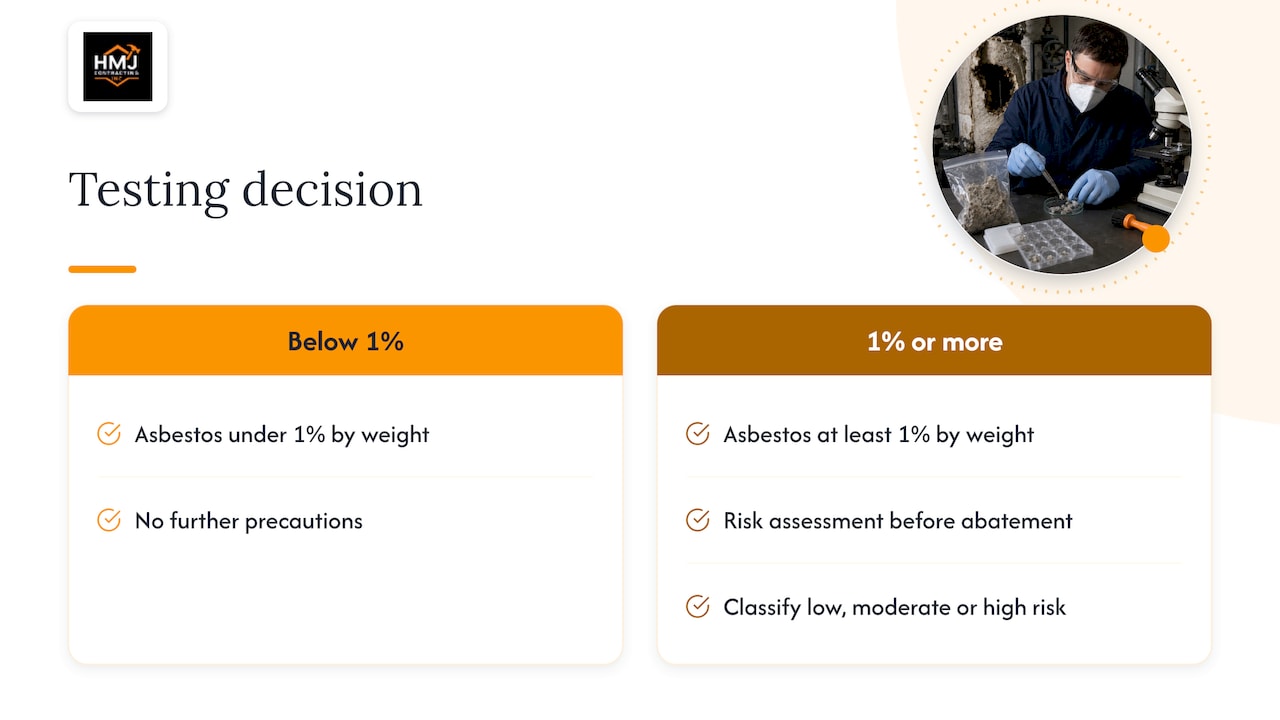
ESDC’s technical guideline explains that material testing under 1% asbestos by weight needs no further precautions, while 1% or more triggers a risk assessment that classifies the work as low, moderate or high risk before abatement begins. Rules differ by province, so see how thresholds play out locally in our piece on Ottawa asbestos surveys and the 0.5% result.
Why sampling is not a quick DIY job
Taking a sample means cutting into the material, which is exactly what releases fibres. In Prince Edward Island, for example, the workers’ compensation board requires that a competent person collects suspect samples wearing a negative-pressure half-face respirator, with measures to prevent fibre release, and that bulk samples go to an accredited laboratory. That is the standard a careful sampler follows anywhere. Our testing and lab analysis is published at $300 to $600, and it keeps the sampling in trained hands.
The health risk, and when fibres are released
ESDC states that inhaling airborne fibres can cause asbestosis, mesothelioma and lung cancer, that smoking more than doubles the likelihood of lung cancer, and that cancers can take decades to develop after first exposure.
The risk comes from disturbance. Fibres are released when friable material (material that crumbles easily by hand) is cut, drilled, abraded, sanded or vibrated, or when pipe insulation is removed. Material sealed behind walls or tightly bound in products does not release airborne fibres. The Region of Waterloo’s heritage guide says that undisturbed asbestos products typically keep indoor fibre levels the same as outdoors, and that fibres become a hazard when products are cut, damaged or deteriorated.
Boiler rooms are a special case because insulation there ages with heat, vibration and the occasional knock from servicing. Crumbling or torn wrap is the sign to stop and act.
What to do if you suspect asbestos around your boiler
- Leave it alone. Do not sand, scrape, pull off wrap or vacuum debris with a household vacuum. If something has already been disturbed, follow our first-hour steps for disturbed asbestos.
- Keep people and pets out of the area and shut off forced-air circulation near it if debris is visible.
- Tell anyone coming to the house. Plumbers, HVAC technicians and renovators need to know before they touch the boiler room. Health Canada’s guidance stresses that contractors and occupants should be made aware of asbestos before entering spaces where it is present.
- Get the material tested before any repair, boiler replacement or renovation. Health Canada says to verify that materials likely to be disturbed do not contain asbestos before renovations, remodelling, demolitions or additions, and that laboratory testing is needed unless the source is known.
- If the result is positive, hire a licensed abatement specialist. The same guidance says a qualified asbestos removal specialist should repair or remove the material before work begins, and that encapsulation or isolation may be permitted in some situations.
If you are replacing a boiler, the order matters: test and, if needed, abate first, then replace. Mixing the two is how insulation gets torn off by people who do not know what it is. This sequencing is covered in our 6 steps to safe asbestos renovation.
How professional removal works
A licensed contractor does not just pull the wrap off. The process described by the regulators looks like this:
- Hazard investigation and risk classification. A qualified person assesses the material and classifies the work. In New Brunswick, for instance, minor removal of under 30 square feet of friable material and applying tape or sealant to boiler or pipe insulation are Moderate Risk operations.
- Containment. The work area is enclosed and kept under negative pressure so fibres do not travel into the rest of the house.
- Removal. Workers wear respirators and protective clothing and keep the material wet to limit dust.
- Waste handling. Asbestos waste must be sealed, labelled and taken to a facility that meets local requirements. Ottawa owners can read the specifics in our guide to asbestos disposal rules under O. Reg. 278/05.
- Clearance air testing. Before an enclosure comes down, air samples must meet established limits. We explain the figure in 0.01 f/cc clearance and Canadian air monitoring rules.
For a full walk-through, see how a licensed contractor runs the abatement process. Homeowners finishing the job should also receive a clearance certificate.
On a boiler job, keeping the abatement and the follow-on work under one roof helps. We handle abatement, demolition and renovation, along with permit management, debris hauling and post-job documentation, so the person who removes the insulation is part of the same plan as the person who replaces the boiler room finishes.
What it costs in Ottawa
Boiler insulation is usually a Type 1 or 2 job (small, lower-risk work) unless it spreads across a whole basement. Our published ranges, read from our site, are:
| Service | Published price |
|---|---|
| Testing and lab analysis | $300 to $600 |
| Small Type 1 or 2 jobs | $1,500 to $3,500 |
| Vermiculite attic removal | $5,000 to $15,000 |
| Whole-home or Type 3 work | No published price |
We give itemized, line-by-line quotes and free estimates, so you see what testing, containment, removal, disposal and clearance each add. Rules vary by province, and Ontario has its own requirements, so the final scope depends on what the lab finds. Federal context is in our summary of Canada’s asbestos ban, SOR/2018-196.
Property managers and commercial owners
If you manage an older building, the duty is broader than one boiler. The Saskatchewan guidance describes the common model: building owners and employers keep an inventory of all asbestos-containing material, inspect it for damage and address damage through abatement, encapsulation or enclosure. Ontario applies its own rules, but the practice is the same: know what you have, record it, and manage it before trades arrive. Our list of five records to demand before commercial abatement work helps with that.
Our perspective
Most boiler-room problems we are called to start the same way: someone replaced a part or tore out old wrap before knowing what it was. The cost of testing is small next to the cost of cleaning a contaminated house.
We have worked in Ottawa homes for over 25 years, and our approach is to test first, quote line by line, contain the work and clear it with air monitoring. When the next step is a new boiler room, a finished basement or a strip-out, the same crew can carry on under one roof. That keeps the safety steps in the right order and the paperwork in one place.
If you have an older boiler and are unsure what is wrapped around it, call us before anyone touches it.
Jason
Get the boiler room assessed
Our abatement team is licensed and insured, and we give free estimates, typically within 24 hours. Testing, removal, disposal and post-job documentation are covered in one itemized quote. See our abatement services or contact us through hmjcontracting.com.

If the work leads on to a new finish, we also handle renovations and demolition, and we haul away the debris.
FAQ
How can I tell if my boiler has asbestos?
You cannot tell by sight. Age helps: buildings from before 1990 likely contain some asbestos. Only a lab analysis of a sample taken by a qualified person gives a real answer. Until then, treat the wrap as asbestos-containing and leave it alone.
Is asbestos boiler insulation dangerous if I don’t touch it?
Intact, undisturbed material that is sealed or tightly bound does not release airborne fibres. The risk rises when it is damaged, crumbling or disturbed by repairs. If the wrap is torn or flaking, have it assessed before anyone works nearby.
Can I replace my boiler without removing the insulation?
Not until the insulation has been tested. Health Canada’s guidance says to verify that materials likely to be disturbed do not contain asbestos before renovations. If the result is positive, abatement comes first, then the boiler work.
Does 50-year-old insulation contain asbestos?
It may. Age alone does not decide it, because fibreglass and other materials were also used. The lab result does. Homes from before 1990 are the ones to test before any work.
Sources
- Asbestos, Canada.ca (ESDC)
- Technical guideline to asbestos exposure management programs
- TB-020 Asbestos Management, Alberta
- Guide to Asbestos Management, PEI
- Asbestos, Workers Compensation Board PEI
- Understanding, Identifying and Handling Asbestos, Saskatchewan
- Code of Practice for Working with Materials Containing Asbestos, New Brunswick
- Indoor Air Quality Professionals guidance, Health Canada
- Asbestos, Mold and Lead Abatement Practical Guide, Region of Waterloo