
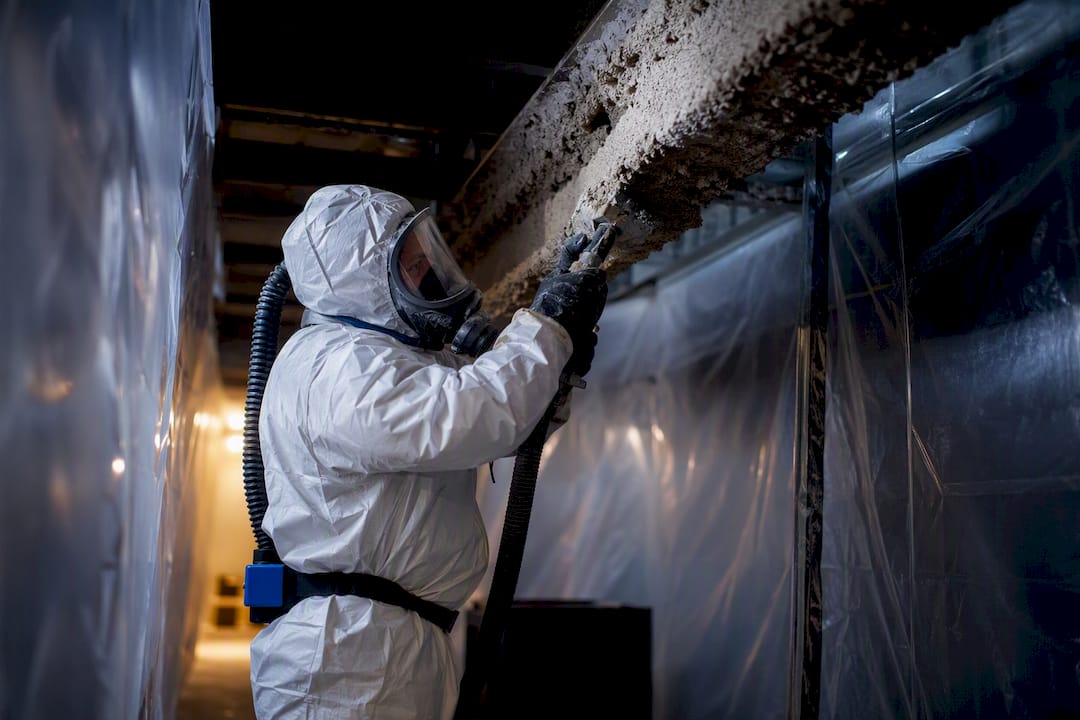
Encapsulate only if the asbestos-containing material is intact, stable, and won’t be disturbed by renovation, demolition, or sale. Remove it if it’s damaged, friable, scheduled for disturbance, or if provincial regulation requires it. When either condition is unclear, a qualified person needs to test and assess the material before you do anything else. A qualified contractor handles that assessment and the licensed abatement work that follows.
TL;DR:
- Encapsulation is suitable only for stable, undamaged asbestos material in low-traffic areas and requires a documented management plan with periodic inspections.
- Proper encapsulation involves industrial sealants applied by trained professionals after lab confirmation, as ordinary paint is ineffective and can loosen fibres.
- Removal is mandatory for deteriorated, damaged, or disturbed asbestos, especially before renovation, demolition, or sale, with strict containment and clearance procedures.
- Ongoing risks with encapsulation include delayed detection of damage and significant emphasis on inspections, while removal offers a permanent fix without future monitoring obligations.
Table of Contents
- Asbestos encapsulation vs removal: a quick comparison
- What is asbestos encapsulation, and why isn’t paint enough?
- How does professional asbestos removal actually work?
- When do regulations require removal instead of encapsulation?
- What drives the cost and timeline of each option?
- What ongoing risks come with leaving asbestos encapsulated?
- How does a licensed contractor assess and remediate asbestos?
- Do you need an ongoing asbestos management plan?
- Encapsulation vs removal: weighing the long-term trade-offs
- What can go wrong during encapsulation or removal work?
- What happens to asbestos waste after removal?
- Two property scenarios: encapsulation or removal?
- What to do next if you suspect asbestos
- Ready for a professional asbestos assessment?
- Sources
- FAQ
Asbestos encapsulation vs removal: a quick comparison
Before you weigh contractor quotes, it helps to see both options side by side. Encapsulation seals asbestos-containing material (ACM) in place with a specialized coating. Removal physically extracts it from the building. Neither is automatically “better.” The right choice depends on the material’s condition and what you plan to do with the space.
- Encapsulation: Lower upfront cost, less disruption, faster turnaround, but it’s a containment measure, not a fix. It requires an ongoing management plan and periodic inspection.
- Removal: Higher cost and longer project timeline, but it eliminates the hazard permanently. No future monitoring obligation once clearance testing confirms the space is clean.
- Disruption: Encapsulation can often happen with minimal demolition; removal usually means containment barriers, negative air pressure, and temporary loss of use of the space.
- When removal wins: Planned renovation, demolition, property sale, visible damage, or material in a high traffic or high disturbance zone.
Provincial guidance treats encapsulation, enclosure, and removal as distinct, formal abatement approaches, not casual alternatives you pick based on price alone, according to the Alberta asbestos abatement manual.
What is asbestos encapsulation, and why isn’t paint enough?
Encapsulation means applying a specialized sealant directly over intact asbestos-containing material to lock fibres in place rather than extracting the material. There are two main product types: penetrating sealants, which soak into porous materials like sprayed-on fireproofing to bind fibres internally, and bridging sealants, which form a tough surface film over the material, similar in concept to a shrink wrap. These are industrial coatings engineered for specific substrates and mechanical stress, not something you pick up at a hardware store.
A professional encapsulation job typically follows this sequence:
- Bulk sampling and lab confirmation of the material type and asbestos percentage.
- Site containment and access restriction before any surface work begins.
- Cleaning and light surface prep without abrading or disturbing fibres.
- Sealant application by trained applicators using proper PPE.
- Post-job documentation, including product data and photos, for the property file.
Ordinary house paint does not qualify as encapsulation. CCOHS specifically warns that painting often fails to prevent material from becoming friable, and the act of brushing or rolling can loosen fibres rather than seal them, according to CCOHS.
Pro Tip: If a contractor offers to “paint over” suspected asbestos without testing it first, get a second opinion. Encapsulation without lab confirmation of the material is a guess, not a plan.
How does professional asbestos removal actually work?
Removal, often called abatement, physically extracts the asbestos-containing material from the property rather than sealing it in place. It’s the method regulators require when material is damaged, when it sits in a path of disturbance, or when a building is headed for renovation or demolition.
Containment scales to the size and risk of the job:
- Glove bag method: Used for small runs of pipe insulation. The bag is sealed around the pipe, fibres are HEPA vacuumed, and the interior is cleaned before the bag comes off, a process spelled out in Canadian workplace regulation SOR-86-304.
- Enclosure with negative pressure: Used for larger areas. Plastic sheeting seals the workspace, and negative air units pull air through HEPA filtration so fibres can’t migrate to occupied space.
- HEPA vacuuming throughout: Standard practice for surface cleanup at every stage, not just at the end.
Before anyone reoccupies the space, the enclosure undergoes aggressive air sampling, using fans to stir up any settled fibres, so clearance testing reflects a worst-case scenario rather than a falsely calm reading, per the Alberta asbestos abatement manual. Clearance sampling typically follows Method 7400 or an equivalent fibre-counting protocol before the barriers come down.
When do regulations require removal instead of encapsulation?
Encapsulation has real limits, and Canadian guidance draws clear lines around when it’s no longer an option. A qualified person, not a homeowner’s gut feeling, has to make this call, and Health Canada is direct on the point: don’t disturb suspected asbestos yourself, and bring in a specialist for testing before any work begins, per Health Canada.
The red lines that push a project toward removal include:
- Friable or deteriorated material. Once asbestos is crumbling or damaged, sealing over it isn’t a safe long-term option in most provincial frameworks.
- Planned renovation or demolition. If the work will disturb the material, sealing it beforehand doesn’t prevent exposure once the sledgehammer or saw shows up.
- Property sale. Buyers, lenders, and insurers increasingly want documented remediation, not a management plan they’ll inherit.
- Regulatory restriction on the product itself. Ontario’s guidance notes that certain spray-applied materials and some thermal insulation with elevated asbestos content are restricted from encapsulation entirely, according to the Ontario guide to asbestos regulation.
- High-traffic or accessible locations. A basement pipe wrap behind a locked mechanical room is a different risk profile than the same material in a hallway ceiling kids can reach.
Here’s a detail most owners don’t expect: air testing alone can’t make this decision. Industry guidance is blunt that fibres are rarely airborne unless the material has already been disturbed, so a clean air sample doesn’t mean the material is safe long term, notes the Alberta manual. A qualified assessor has to physically inspect the material’s condition, location, and the work planned around it. Air sampling verifies after the fact. It doesn’t replace judgment beforehand.
What drives the cost and timeline of each option?
Quotes for asbestos work vary widely because so many variables stack on top of each other. The core cost drivers are accessibility (a crawlspace costs more to work in than an open basement), total surface area, the level of containment required, disposal fees at a licensed facility, and labour hours for trained abatement staff.
- Small, contained jobs like sealing a single pipe run or a small vermiculite pocket can often be scheduled within days.
- Full enclosure work involving Type II or Type III containment takes longer: setup, active removal, cleanup, and clearance sampling can stretch a project to a week or more depending on scope.
- Vermiculite attic removal tends to run longer than a single-room job simply because of the volume of material and the need for careful containment around joists and wiring.
Pro Tip: Ask every contractor for an itemized quote that separates testing, containment setup, labour, disposal, and clearance sampling as line items. A one-line lump sum quote makes it impossible to compare bids or spot what’s missing. Also ask what happens if hidden material turns up mid-project. A contingency line, rather than a surprise change order, tells you the contractor has done this before.
What ongoing risks come with leaving asbestos encapsulated?
Encapsulation isn’t a one-time fix you can forget about. It’s a containment strategy that leaves the hazardous material in the building, which means it comes with obligations that removal simply doesn’t carry. Abatement guidance is clear that removal offers a permanent solution, while encapsulation and enclosure are temporary measures requiring an active management plan and future re-evaluation, according to the NT/NU code of practice.
A proper management plan should include:
- Scheduled visual inspections, at minimum annually, checking the sealed material for cracking, peeling, or water damage.
- A log of every inspection, dated and photographed, kept with the property records.
- Access restrictions around the encapsulated area, especially if it sits near HVAC returns, storage, or high-traffic zones.
- A trigger list for re-evaluation, including any renovation near the material, visible sealant failure, or a change in building occupancy.
If any of those triggers appear, the encapsulated area needs a fresh professional assessment, not a quick touch-up coat. Encapsulation genuinely is the lowest-cost immediate control for stable, inaccessible ACM, but that’s a conditional statement, not a permanent one, and it only holds as long as the management plan stays active, per CCOHS.
How does a licensed contractor assess and remediate asbestos?
A property owner’s job isn’t to diagnose asbestos. It’s to recognize when to call someone who can. A proper assessment starts with a visual survey and bulk sampling of suspect materials, sent to a lab for fibre-type and percentage confirmation before anyone decides between encapsulation and removal.
From there, the contractor sets containment and PPE requirements based on the classification of the work, generally referred to as Type I through Type III operations depending on disturbance risk and material friability. HEPA-filtered vacuums and negative air units control airborne fibres throughout, and every stage gets documented.
- Bulk sampling and lab-confirmed classification of the material
- Containment barriers and PPE matched to the job’s risk type
- HEPA vacuuming and negative air pressure during active work
- Itemized quote outlining scope, testing, and disposal
- Permits, clearance air sampling reports, and disposal manifests on file
Licensed contractors should provide itemized quotes and a clear scope that names the clearance testing method and disposal route used. That documentation is what separates a compliant job from a handshake agreement, and it’s the paper trail you’ll want if you ever sell the property.
For a walkthrough of what this looks like project to project, HMJ Contracting’s asbestos abatement process breaks down each stage from initial testing through final clearance report.
Do you need an ongoing asbestos management plan?
If you choose encapsulation, or if you have ACM elsewhere in the building that isn’t being touched right now, you need a written asbestos management plan. This isn’t paperwork for its own sake. It’s the record that shows a future buyer, insurer, or contractor exactly what’s in the building, where it is, and what condition it was in at last inspection.
A workable plan identifies every known or suspected ACM location, its condition at the time of assessment, and the date of the next scheduled inspection. It also names who’s responsible for monitoring it, whether that’s a property manager, a facilities team, or the owner directly. For a rental property or commercial building, this matters even more, since tenants and staff have a right to know what’s on site and where access is restricted.
Monitoring doesn’t mean re-testing the air every few months. It means a visual check for cracking, water staining, or physical damage to the sealant or enclosure, logged with photos and dates. If a pipe wrap that was encapsulated five years ago now shows a crack near a joint, that’s the trigger to call a contractor back out, not to wait for the next scheduled review.
Renovation plans complicate this further. If you’re planning any interior work down the road, even years out, that plan should flag every ACM location before a contractor picks up a tool. HMJ Contracting’s guide on renovating around asbestos safely walks through how testing and containment get built into a renovation schedule from day one, rather than discovered mid-demolition.
Encapsulation vs removal: weighing the long-term trade-offs
The honest comparison isn’t “which is cheaper.” It’s “which matches what you actually plan to do with this building.” Encapsulation wins on upfront cost and disruption. You keep the material in place, avoid a full containment teardown, and get back to normal use faster. But you’re trading a smaller bill now for an open-ended commitment: inspections, record-keeping, and the possibility that removal becomes unavoidable later anyway if the material degrades or the space gets renovated.
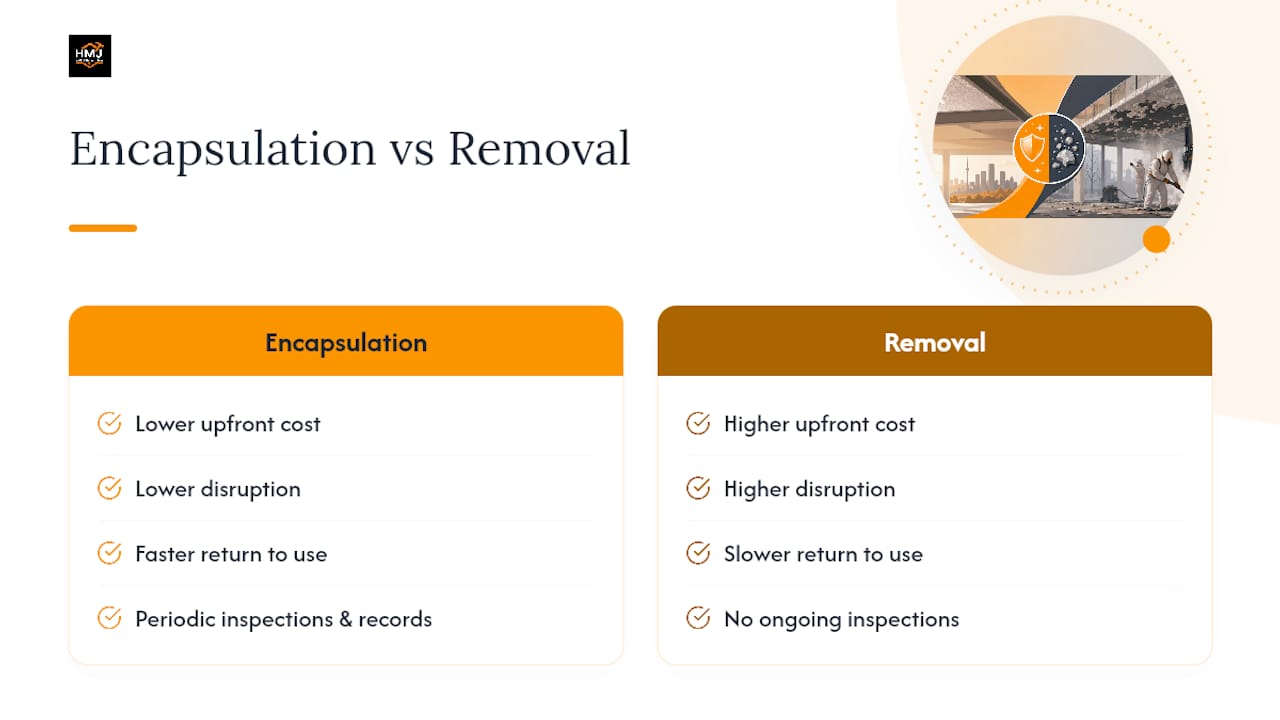
Removal wins on permanence. Once a space passes clearance air sampling, the hazard is gone and the management plan closes. No more annual inspections, no more asking a future buyer’s lawyer to review your asbestos file. That certainty costs more upfront and takes longer, and it usually means the space is unusable during the work.
The health and safety angle cuts the same way. Encapsulated material poses low risk as long as it stays intact and undisturbed, but every year it remains in the building is another year where a plumber, electrician, or a homeowner’s DIY project could accidentally breach it. Removal takes that possibility off the table entirely, but the removal process itself is the highest-risk moment for fibre release if containment isn’t done correctly. Neither option is risk-free. The real question is whether you’re comfortable managing risk indefinitely or you’d rather pay once to eliminate it.
What can go wrong during encapsulation or removal work?
Each method carries its own failure points, and knowing them helps you spot a contractor cutting corners. During encapsulation, the biggest risk is applying sealant to material that’s already too damaged to hold it. Bridging sealants need a reasonably intact surface to adhere to; spraying or rolling coating onto crumbling material can flex fibres loose during application rather than locking them down. Regulators also restrict spray-applied sealants on certain deteriorated thermal insulation for exactly this reason, per Ontario’s guidance.
During removal, the risk profile shifts to containment failure. A poorly sealed enclosure, a negative air unit that isn’t rated for the space, or rushed glove bag technique on pipe insulation can all release fibres into occupied areas. This is precisely why workplace regulation specifies exact procedures for glove bag sealing, interior cleaning, and HEPA evacuation before the bag ever comes off, under SOR-86-304.
There’s also a building systems risk that applies to both methods: HVAC contamination. If ductwork runs near or through the work area, disturbed fibres can travel through the building’s air system far beyond the original room. Sealing off return vents and, where relevant, consulting on air handling precautions before work starts is a step worth confirming with your contractor, and it’s the kind of detail indoor air quality specialists flag when HVAC systems intersect with any construction disturbance.
What happens to asbestos waste after removal?
Removed asbestos doesn’t go in a regular construction dumpster. It’s classified as designated hazardous waste, and Canadian workplace regulation sets specific procedures for how it must be bagged, labelled, and transported before disposal, under SOR-86-304. Material typically goes into double-bagged, sealed containers marked with hazard labelling, then transported to a landfill licensed to accept asbestos waste, with a manifest documenting the chain of custody from your property to final disposal.
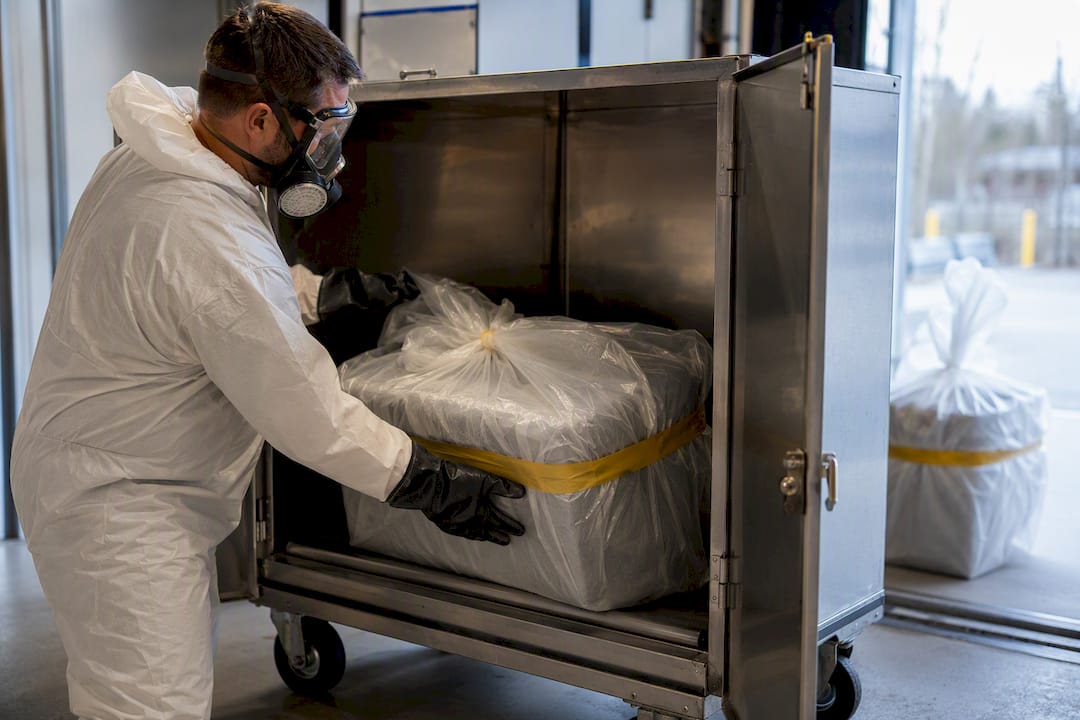
This paperwork matters more than most owners realize. If you ever sell the property or face a compliance question, a disposal manifest is proof the material left the site legally rather than being dumped or, worse, left in a garage. A contractor who can’t produce that documentation after a removal job is a contractor you shouldn’t have hired.
The environmental angle extends beyond the landfill trip. Poor containment during removal doesn’t just risk occupant exposure. It risks releasing fibres into the broader air and soil around the property, particularly during exterior work like removing old siding or roofing shingles containing asbestos. That’s part of why negative air pressure and HEPA filtration aren’t optional extras. They exist to keep fibres from leaving the containment zone at all, whether that’s into your living room or into the yard next door.
Two property scenarios: encapsulation or removal?
Consider a commercial building owner with sprayed fireproofing on structural beams in a mechanical penthouse. The material tests positive for asbestos but shows no visible damage, and the space is accessed only by maintenance staff a few times a year. This is a textbook encapsulation candidate: low disturbance risk, restricted access, and no planned work in that area. A bridging sealant, applied by a licensed contractor with a documented management plan and annual inspection, is a proportionate response that avoids an expensive, disruptive full removal for material that does not threaten anyone.
Now consider a homeowner planning a kitchen renovation in a house built in the 1960s. Vermiculite insulation sits in the attic above, and the renovation plan includes running new electrical through that attic space. Here, encapsulation doesn’t solve the problem. The moment an electrician pulls cable through vermiculite, fibres release regardless of any prior sealant. This scenario calls for removal before renovation begins, not as an afterthought once work has already started.
The difference between these two cases isn’t the material. It’s what’s going to happen to the space next. That’s the single most useful filter for any property owner staring down a remediation decision: not “what does the material look like today,” but “what’s going to touch it in the next few years.”
What to do next if you suspect asbestos
If you’re staring at a suspicious material and wondering which way to go, my honest advice is simple: don’t guess, and don’t let a paint quote talk you out of proper testing. Encapsulate only when a qualified assessor confirms the material is stable and undisturbed; remove it when it’s damaged or in the path of planned work. Three things to do right now: restrict access to the area, avoid disturbing the material yourself, and book a professional assessment before you sign any contract. HMJ Contracting can handle that assessment and quote the work honestly from there.
— Jason
Ready for a professional asbestos assessment?
HMJ Contracting is the alternative to guessing your way through an asbestos decision. Instead of piecing together advice from forums or trusting a contractor who wants to sell you a coat of paint, you get a licensed assessment, lab-confirmed testing, and a transparent, itemized quote before any work starts.

Abatement services typically cover the full range property owners need: testing and lab analysis, small Type 1 or 2 jobs, vermiculite attic removal, and whole-home Type 3 work, each scoped with a detailed quote rather than a vague estimate. Every job includes clearance sampling and disposal documentation, so you have a paper trail if you ever sell or refinance. Experienced contractors often back their work with clean, communicative crews who show up when they say they will. If you’re ready to know what’s in your building and get a clear quote, request a quote through the abatement services page for details.
This article is general information, not a substitute for advice from a qualified doctor. Consult a qualified healthcare professional about your own circumstances before acting on anything here.
Sources
FAQ
Does asbestos always need to be encapsulated or removed?
Not always. Intact, undisturbed asbestos-containing material in a low-access area can sometimes be left alone with a documented management plan and regular inspection. Health Canada’s guidance is that the danger comes from disturbance, so material in good condition that nobody is going to touch may not require immediate action, according to Health Canada.
Can asbestos be encapsulated with regular paint?
No. CCOHS warns that ordinary house paint often fails to prevent the material underneath from becoming friable, and the application process itself can loosen fibres, per CCOHS. Proper encapsulation uses industrial penetrating or bridging sealants applied by trained professionals after lab testing.
Is it better to remove asbestos flooring or cover it over?
If the flooring is intact and won’t be disturbed, covering or encapsulating it is often the lower-cost, lower-disruption option. If you’re planning renovation work that involves cutting, sanding, or lifting the flooring, removal is the safer route since covering it does nothing once the material is physically disturbed.
What does “encapsulated asbestos” actually mean?
Encapsulated asbestos is material that has been sealed in place with a specialized coating rather than physically removed from the building. The asbestos fibres remain in the structure, contained under the sealant, which is why encapsulation requires an ongoing management plan and periodic inspection rather than a one-time fix.
How much does asbestos removal cost compared to encapsulation?
Costs vary by scope, but small contained jobs like testing and lab analysis run $300 to $600 CAD, while small Type 1 or 2 abatement jobs typically fall between 1500 and 3500 CAD, and vermiculite attic removal runs 5000 to 15000 CAD depending on volume and access. Encapsulation is generally less expensive than full removal for the same material, since it avoids extraction and disposal costs, though exact pricing depends on the contractor’s assessment.