
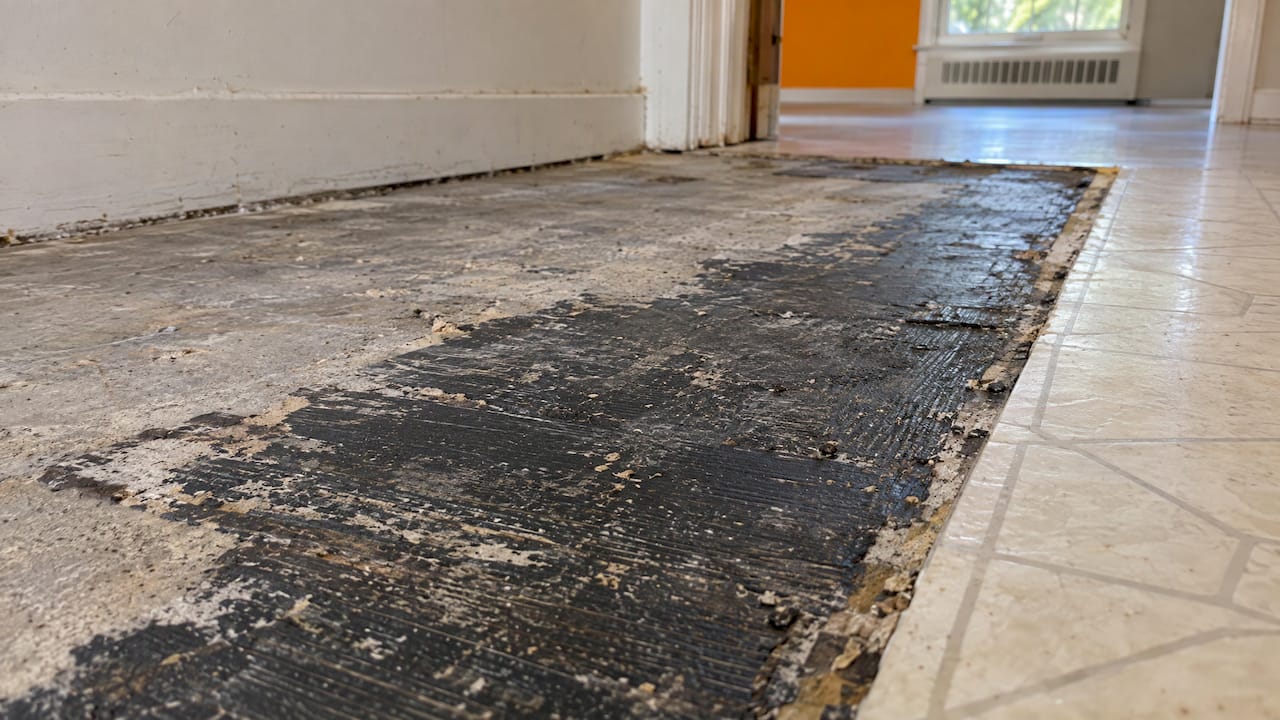
If your home was built before the 1980s and you are lifting old vinyl, linoleum or tile, the black or brown glue underneath may contain asbestos. You cannot tell by looking. A lab test settles it, and if the mastic is positive, the safe way to remove it is wet, by hand and with contained waste. In Ottawa, we test the material first through our abatement service and then remove it if the floor is part of your renovation.
TL;DR
- Mastic is the adhesive under resilient flooring. Black mastic and “cutback” adhesive are asphalt-based glues from older installations, and some contain asbestos.
- Appearance proves nothing. Only laboratory analysis can rule asbestos out.
- Undisturbed, sealed material in good condition poses no significant health risk. Scraping, sanding, grinding and demolition are what release fibres.
- Official guidance calls for wet methods, hand tools, HEPA cleanup and sealed waste bags. Power sanding or dry scraping is never acceptable.
- Testing in Ottawa costs 300 to 600 CAD with us, far less than a surprise stop-work on a renovation.
Table of Contents
- What asbestos floor mastic is
- Can you tell by looking at it?
- Is it dangerous?
- How asbestos mastic is tested
- What the safe options are
- Black mastic removal: what it takes and what it costs
- Asbestos in drywall joint compound
- Why the ban does not help you
- Who this matters most to
- Our approach to mastic
- Book testing and a written quote
- Our view on mastic
- FAQ
- Sources
What asbestos floor mastic is
Mastic is the glue that holds floor coverings down. Under vinyl tile, sheet vinyl, linoleum, ceramic tile and parquet in older houses, it is often a thick black, dark brown or yellowish layer. “Cutback adhesive” is the same idea: an asphalt-based glue thinned with solvent so it could be spread with a trowel. The thinner evaporated and left the hard, tar-like layer you find today.
Official Canadian guidance says some of these products contained asbestos. The Northwest Territories removal guidelines list vinyl-asbestos tile, asphalt tile, some asphaltic cutback adhesives and the backings of many sheet vinyl floors among the materials that contained asbestos. Workers’ compensation guidance in Manitoba says resilient floor tile, including its adhesive or mastic, is assumed to contain asbestos if made before 1980 unless a lab proves otherwise.
That is the key point for owners of older homes. Mastic is a layer people forget about. The tile can be replaced, covered or already gone, and the glue is still on the subfloor.
Where it turns up
- Kitchens and bathrooms with old sheet vinyl or 9-inch and 12-inch floor tiles
- Basements where tile was glued straight to the concrete slab
- Under carpet, where earlier flooring was never removed
- Under hardwood or laminate that was added over an older floor
- Commercial units with several generations of flooring stacked on top of one another
If you want the tile side of this, our guide on asbestos floor tile removal covers when to act and when to wait.
Can you tell by looking at it?
No. The same Manitoba guide states that asbestos cannot be ruled out by sight, because products can look identical with or without it. A black mastic can be asbestos-free, and a thin, harmless-looking layer can be positive.
The same rule applies to the floor tile above it. The Northwest Territories guidelines say that unless you are positively certain a product is non-asbestos, you must assume it contains asbestos. That assumption is what contractors and inspectors work from until a result comes back.
So the useful questions are not “does it look like asbestos?” They are these:
- How old is the flooring, and was it installed before 1980?
- Is the floor going to be disturbed by your project?
- Has a lab tested the mastic itself, and not only the tile?
Is it dangerous?
Health Canada says that breathing asbestos fibres can cause lung cancer, asbestosis, mesothelioma and other diseases. It also says that material that is undisturbed, sealed or tightly bound and in good condition does not pose a significant health risk. Fibres are released when material is drilled, sawed, sanded, scraped, removed or broken apart during renovation and demolition.
That is why mastic matters more than its size suggests. Removing it means scraping, which is exactly the kind of disturbance that releases fibres. A homeowner who pries up a vinyl floor and starts grinding the black residue off the slab with a floor sander turns a stable material into airborne dust that spreads through the house and its ductwork.
If you have already disturbed it
Stop work, keep people and pets out of the room, and shut off forced-air systems that could move dust. Our guide on what to do when asbestos has been disturbed walks through the first hour. Then call us for an estimate; we respond to estimate requests within 24 hours.
How asbestos mastic is tested
Testing is the only step that replaces guessing with a fact. Canadian regulators set out how it should be done.
Who collects the sample. Manitoba’s guidance requires bulk sampling by a person holding a valid asbestos certificate, wearing a fit-tested respirator, lightly misting the material, disturbing it as little as possible and keeping each sample in its own labelled container. The federal technical guideline calls for a hazard investigation by a qualified person before any work starts, with representative bulk samples.
Who analyses it. The sample goes to an accredited laboratory. The Manitoba guide accepts accreditation by AIHA, NVLAP or CALA, the Canadian Association for Laboratory Accreditation. Public Services and Procurement Canada’s asbestos management standard names polarized light microscopy as the usual method and notes transmission electron microscopy is used in some cases, such as vinyl floor tile.
Why layers matter. Floor tile and its mastic are often found stuck together. Manitoba’s guide specifically says to make sure the lab reports separable layers individually, so a negative tile result is not mistaken for a negative mastic result. This is a common point where a cheap, quick test goes wrong.
What counts as positive. The federal guideline treats less than 1% asbestos by weight as negative and 1% or more as positive, which then requires a risk assessment before invasive work. Thresholds differ by jurisdiction. Ontario’s O. Reg. 278/05, the rule that governs asbestos on construction projects here, defines asbestos-containing material as 0.5% or more by dry weight.
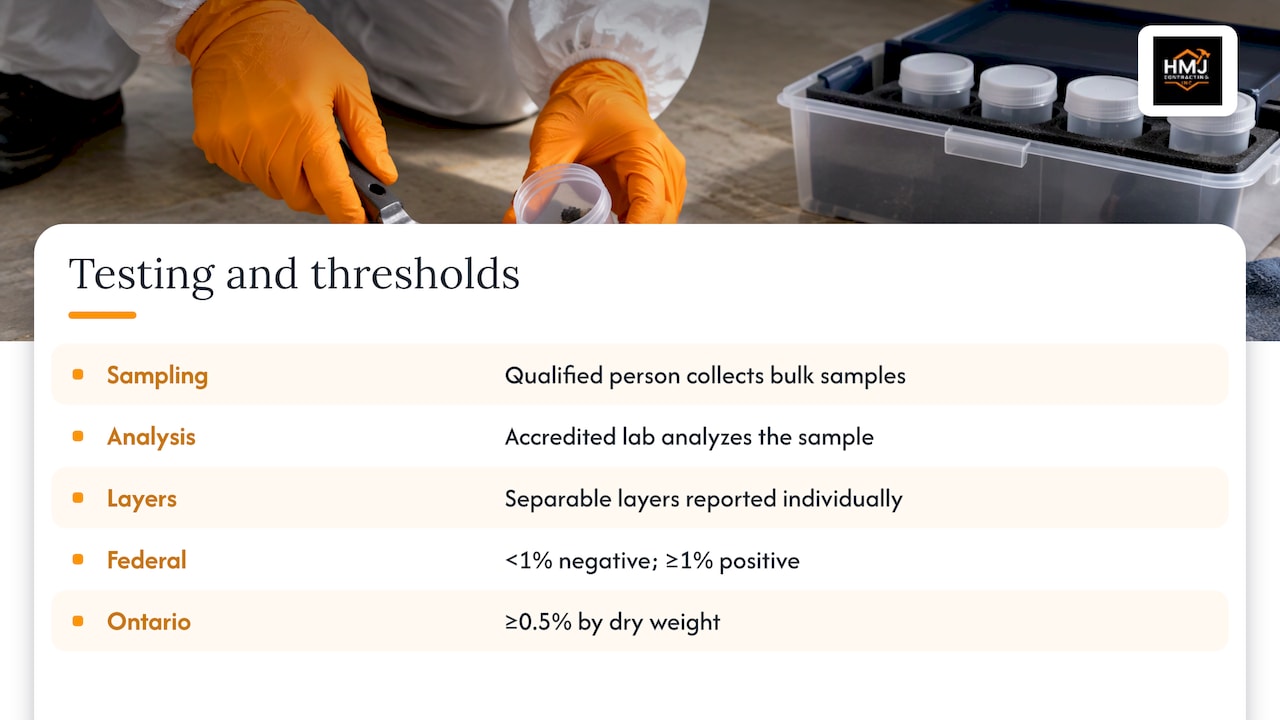
Our testing and lab analysis is priced from 300 to 600 CAD. Mastic, tile, drywall joint compound and plaster can be sampled in the same visit, so you know what is in the whole room before a contractor opens a wall.
What the safe options are
Canadian guidance describes three paths, and the right one depends on your plans for the floor.
Leave it undisturbed
If the floor is staying exactly as it is, intact material in good condition is not a significant risk, according to Health Canada. This is a real option for a finished basement floor you are not touching. It stops being an option the moment a renovation involves lifting the floor, levelling the slab, running new plumbing through it or demolishing the room.
Encapsulate or cover
Encapsulation means sealing the material so fibres cannot escape. The guidance is demanding. Prince Edward Island’s workers’ compensation guide says a liquid sealant must not be applied where the material cannot carry its own weight plus the sealant, and Saskatchewan’s abatement manual requires that the sealant penetrate and bind the fibres. Covering mastic with a new floor also leaves it in the building for the next owner and every future repair. Our comparison of encapsulation versus removal sets out how that choice plays out for Canadian homes.
Remove it
Removal is the right call when the floor is part of the work. Official procedures are consistent across provinces, and they show why this is not a weekend task:
- Wet the tile and mastic first and keep them wet. Saskatchewan’s manual says asbestos-containing material must be handled and removed only when wet.
- Use non-powered hand tools such as scrapers and trowels. The Northwest Territories guidelines specifically prohibit sanding, dry scraping, drilling, sawing and bead blasting of resilient flooring and cutback adhesive.
- Put debris directly into asbestos waste containers or heavy-duty impermeable bags at least 0.15 mm (6 mil) thick, labelled and sent to an authorized landfill.
- Clean with a HEPA vacuum or wet mopping. Dry sweeping is not permitted.
- Complete a walk-through inspection before any sealant is applied to the remaining surface.
More aggressive methods, such as sanding or cutting the adhesive with high-speed equipment, move the job into the higher Type 2 or Type 3 classes, which call for HEPA-equipped tools and stricter controls. Manitoba’s guide sets this out, and Ontario sorts asbestos work into Types 1, 2 and 3 under its own regulation. Type 3 work also requires notice to the Ministry of Labour and workers trained in an approved abatement program.
Black mastic removal: what it takes and what it costs
Black mastic is stubborn. It is hard, sticky and bonded to the slab or subfloor, so removing it by hand while keeping it wet takes time and discipline. The mistakes that cause trouble are predictable: scraping it dry because it is quicker, using a grinder to “finish” the slab, sweeping the dust, or putting scrapings in ordinary garbage bags.
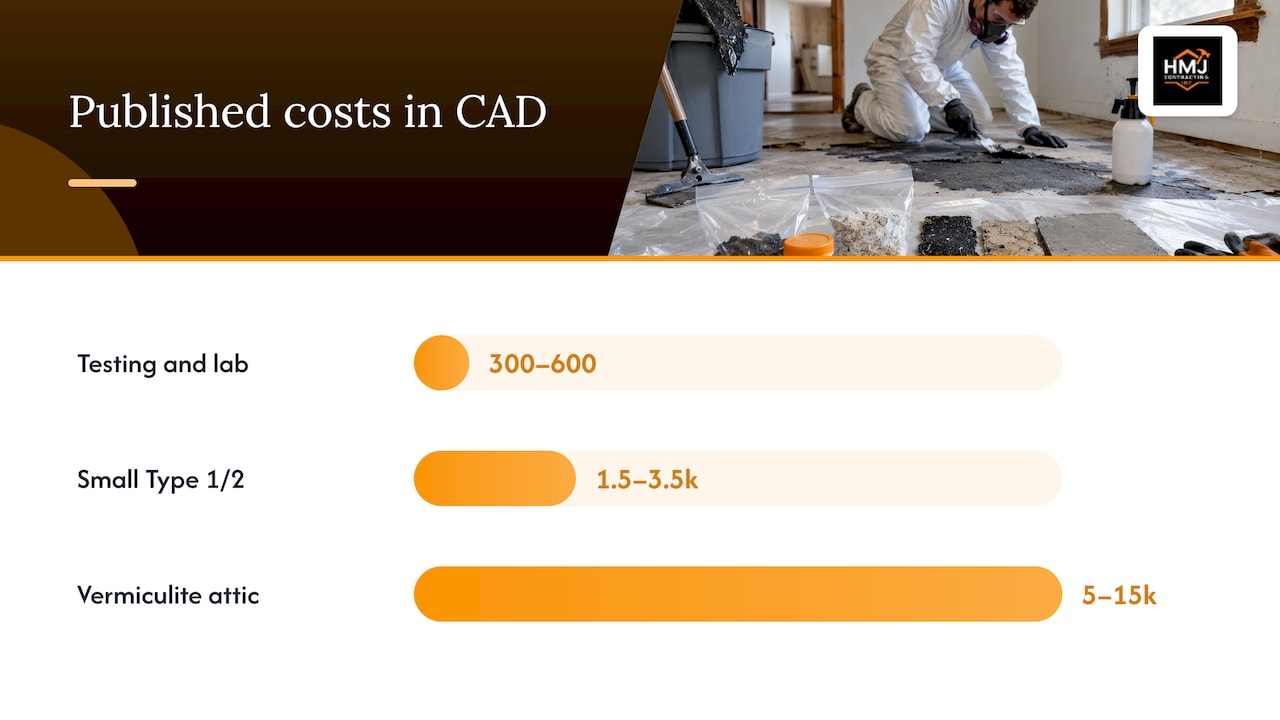
Our published pricing gives you a realistic frame for Ottawa-area work:
| Work | Published range |
|---|---|
| Testing and lab analysis | 300 to 600 CAD |
| Small Type 1 or 2 jobs | 1,500 to 3,500 CAD |
| Vermiculite attic removal | 5,000 to 15,000 CAD |
| Whole-home or Type 3 work | No published price, quoted per project |
A single kitchen or bathroom floor with black mastic usually sits in the small-job category, but we price after we have seen the room and the lab results. Our quotes are itemized line by line, so you can see what testing, removal, waste handling and documentation each cost.
Asbestos in drywall joint compound
Drywall comes up often alongside mastic because both appear in the same 1970s renovation. Walls are not usually the problem. The joint compound used on the seams may contain asbestos, and sanding a taped wall is a classic way to spread it.
Ontario’s O. Reg. 278/05 classifies removing less than 1 m² of drywall with asbestos-containing joint-filling compound as a Type 1 operation and 1 m² or more as Type 2. The area is counted across a room even if the work is split into smaller jobs. For Type 1, the rule requires the material to be wetted before and during work, a wetting agent added to the water, drop sheets that are not reused, and cleanup with a HEPA vacuum or damp mopping. Compressed air is not allowed for cleaning dust.
Manitoba’s guide adds that joint compound is batch-mixed and may not be uniform, so one sample can miss it. When we test a room, that is one reason to sample more than one spot.
Planning to open a wall? Read how asbestos affects renovation plans first, and for the full order of work see our six steps to safe asbestos renovation.
Why the ban does not help you
Canada banned asbestos on December 30, 2018. The prohibition covers import, sale and use, but not asbestos already installed in buildings. That is why a 1960s kitchen floor is still governed by occupational health and safety rules today. If your house, rental or commercial unit predates the 1980s, the ban changed what gets installed, not what is already under your floor.
Who this matters most to
- Homeowners with older houses who are lifting carpet or vinyl and meet black glue.
- New buyers planning a first renovation, who should test before demolition, not after.
- Property managers turning over units, where several layers of flooring are common and documentation matters.
- Commercial owners who need records showing the work met safety regulations.
Our approach to mastic
We are a licensed and insured abatement contractor, and we run abatement, demolition and renovation under one roof. For a floor, that means one team handles the testing, the removal, the debris hauling and the post-job documentation, and then the new floor goes down without a handoff between trades. We also manage permits and use air quality testing as part of our service.
If the old floor is part of a larger plan, our demolition and renovation teams can sequence the work so the contaminated layer is dealt with before anything else is built on top of it. Debris that is not hazardous can go to our junk removal service.
Book testing and a written quote
If you are standing in a room with black glue on the floor, the next step is a lab result. We offer testing and lab analysis for 300 to 600 CAD, and removal quotes come itemized so you see every line before you sign. Start at our abatement page to request an estimate.

Ottawa homeowners with older properties often ask us about connected materials too. See our guides on asbestos in Ottawa homes and the signs you may need removal before renovating.
Our view on mastic
Most of the mastic calls we get start the same way. Someone has lifted a corner of an old floor, found a black layer and wondered whether it matters. Our answer is that it is a fair question and it has a clean answer: test it.
What we want owners to understand is that the floor is rarely the expensive part. The expensive part is finding out halfway through a renovation, with the tile up and the crew waiting. A lab result before the project starts lets us price the work properly, schedule it in the right order and keep your family out of the dust.
That is why we put testing, abatement, demolition and renovation under one roof, and why our quotes are itemized line by line. With 25+ years working in this area and a 5.0-star Google rating, we want you to be able to see what you are paying for and who is doing the work.
If you suspect asbestos mastic, leave it alone and call us. We will tell you what it is and what the job involves.
Jason
FAQ
What does asbestos mastic look like?
It is usually black, dark brown or yellowish and tar-like, found under old tile, sheet vinyl or linoleum. Appearance cannot confirm or rule out asbestos, because products look the same with or without it. Only laboratory analysis can tell you.
Is asbestos mastic hazardous if I leave it alone?
Health Canada says undisturbed, sealed or tightly bound material in good condition does not pose a significant health risk. The risk comes when it is scraped, sanded, drilled or broken apart. If your plans involve the floor, test first.
Can I seal or cover black mastic instead of removing it?
Guidance allows encapsulation where the material is sound enough to carry the sealant, and the sealant must penetrate or bridge the material. Whether it fits your floor depends on its condition and your plans. We can assess both when we test.
How much does testing cost in Ottawa?
Our testing and lab analysis is priced from 300 to 600 CAD. Removal for small jobs is 1,500 to 3,500 CAD, and larger projects are quoted after an assessment.
Sources
- WCB Manitoba, Asbestos Management (February 2026)
- Northwest Territories, Asbestos Removal and Disposal guidelines
- Health Canada, Asbestos and your health
- ESDC, Technical guideline to asbestos exposure management programs
- Public Services and Procurement Canada, Standard on Asbestos Management
- Ontario, O. Reg. 278/05 Designated Substance, Asbestos
- WCB PEI, Asbestos
- Saskatchewan Asbestos Abatement Manual (2021)
- Asbestos in Canada: the 2018 ban, exposure limits and the law