
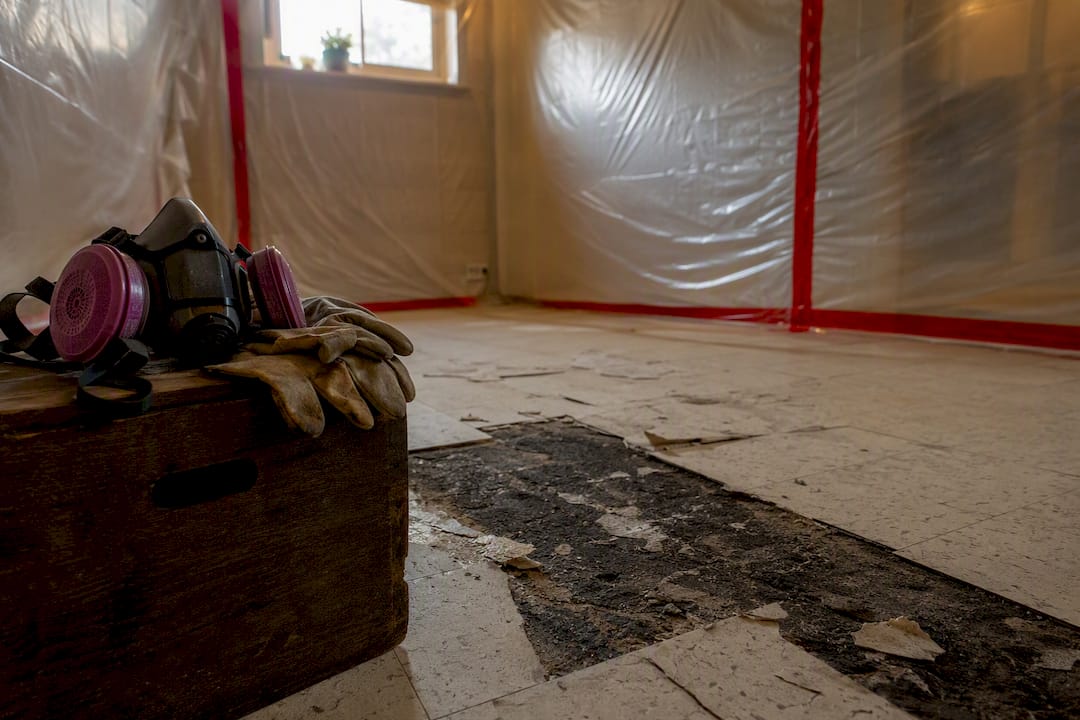
If your floor tiles are intact, undisturbed, and not part of a renovation plan, leaving them alone or covering them is usually safer than removing them yourself. Asbestos becomes dangerous only when its fibres get into the air and into your lungs, and intact, non-friable tiles generally pose low short-term risk left undisturbed. If the tiles are cracked, chipped, or about to be sanded, drilled, or torn out for a reno, that calculation changes fast.
Here’s what to do right now if you suspect asbestos flooring:
- Stop all work that could disturb the tiles. No sanding, no dry sweeping, no pulling up corners to peek underneath.
- Arrange professional sampling rather than guessing from appearance alone.
- Contact a licensed abatement contractor, such as HMJ Contracting, if the sample confirms asbestos and the work will disturb it.
Pro Tip: If the work area is larger than a small patch or requires aggressive tools, Ontario’s O. Reg. 278/05 may automatically classify the job as Type 2 or Type 3, which triggers mandatory licensed abatement, not a weekend DIY project.
Key takeaways
Safe asbestos floor tile removal depends on correct testing, matching the work to Ontario’s Type 1/2/3 classification, and hiring a licensed contractor who documents every step from survey to clearance.
| Point | Details |
|---|---|
| Leave intact tiles alone | Undisturbed, non-friable tiles pose low short-term risk and often don’t need removal. |
| Request the right test | Ask for TEM specifically when vinyl tiles are suspected, since PLM alone can miss bound fibres. |
| Match tools to classification | Power tools or larger areas can push a Type 1 job into Type 2 or Type 3 under O. Reg. 278/05. |
| Demand documentation | Insist on a written abatement plan, waste manifests, and clearance testing before re-occupation. |
| Hire licensed abatement for removal | HMJ Contracting provides itemized quotes, TEM/PLM coordination, and full clearance documentation for Ottawa-area jobs. |
Table of Contents
- How do you identify and test for asbestos floor tiles?
- Should you remove asbestos tiles or leave them in place?
- What Ontario regulations govern asbestos floor tile removal?
- What does a professional asbestos tile abatement job actually involve?
- How much does asbestos floor tile removal cost?
- What should you ask an asbestos abatement contractor before hiring?
- How is asbestos tile waste disposed of safely?
- How does HMJ Contracting document a safe abatement job?
- What are the symptoms of asbestos exposure and what should you do?
- Why testing method matters more than most guides admit
- Get a documented, licensed asbestos tile removal quote
- Sources
How do you identify and test for asbestos floor tiles?
Older flooring gives off a few tells. Nine-by-nine inch tiles are the classic warning sign, though 12x12 tiles from the same era can also contain asbestos. Floors installed before the 1980s, and in some cases up to 2000, deserve suspicion. Layered tiles (one floor glued directly over another) and a brittle, black, crumbly adhesive underneath are both common red flags in Ottawa-area homes built or renovated in that window.
None of that is proof, though. Visual identification is a guess, and a costly one to get wrong in either direction. Homeowners should confirm whether materials contain asbestos before renovating and hire trained professionals to test and remove them rather than relying on appearance. A qualified assessor collects bulk samples using controlled methods that limit fibre release, something a homeowner pulling up a tile with a screwdriver cannot guarantee.
Once the sample reaches the lab, the method matters:
- Polarized Light Microscopy (PLM) handles most bulk building material samples and is the standard first pass.
- Transmission Electron Microscopy (TEM) is often necessary for vinyl floor tiles specifically, because asbestos can be tightly bound within the vinyl matrix in ways PLM may miss.
- Always ask which method the lab will use, and request TEM outright if your flooring is vinyl composite.
The report will come back with a friability rating and a percentage of asbestos content. A low percentage in a non-friable material still counts as asbestos-containing, legally and practically, but it changes how urgently you need to act. Check our guide to pre-renovation warning signs for a fuller identification checklist.
Should you remove asbestos tiles or leave them in place?
Asbestos only threatens your health once fibres become airborne. That single fact drives almost every decision in this guide. A tile sitting under a rug, undisturbed for twenty years, is a fundamentally different hazard than the same tile being cut with a circular saw.
Several conditions push the decision toward removal:
- Tiles are visibly cracked, crumbling, or lifting at the edges.
- You’re planning renovations that involve cutting, sanding, or drilling through the flooring.
- The material shows clear signs of degradation from moisture or age.
- A management program would need ongoing monitoring that costs more, over time, than a one-time removal.
That last point matters more than most homeowners realize. Federal guidance on asbestos management suggests proactive removal can make sense when the quantity involved is small enough that removal negates an ongoing management burden, rather than leaving a homeowner tracking condition indefinitely.
If none of those triggers apply, alternatives exist. Encapsulation seals the tile surface with a specialized coating, cheap and fast, but it doesn’t solve the problem if the floor gets disturbed later. Covering with new flooring (laminate, engineered hardwood, new vinyl) is often the most budget-friendly route and doubles as a renovation upgrade. Targeted enclosure works for small, isolated damaged sections without triggering a whole-room project.
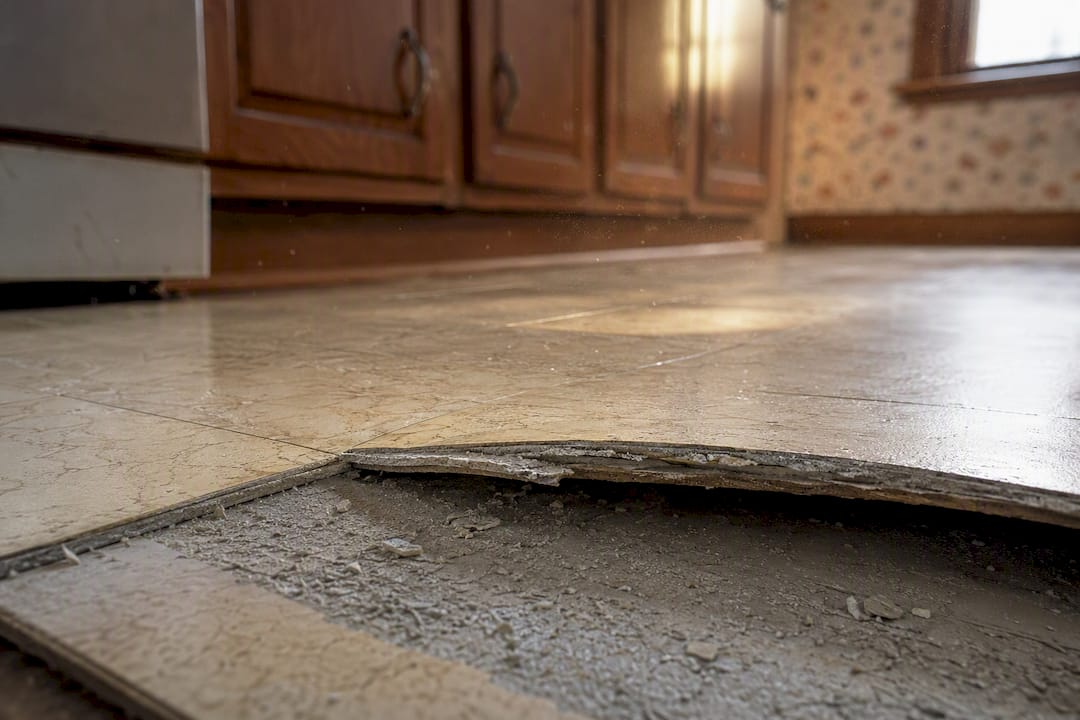
Scale changes everything regulatorily, too. A small area, sometimes under 7.5 square metres, may fall under different procedural rules than a full-room tear-out, which shifts training, notification, and containment requirements considerably.
What Ontario regulations govern asbestos floor tile removal?
Ontario classifies asbestos work into three types under O. Reg. 278/05, and which type applies depends less on the material itself than on how it’s being disturbed. Type 1 covers low-risk activities like removing small amounts of undamaged material using minimal force. Type 2 involves larger quantities or activities more likely to release fibres, such as removing tiles with power tools. Type 3 covers the highest-risk work, generally large-scale removal or work on heavily damaged, friable material, classified according to relevant regulatory guidelines.
The same floor tile can require completely different procedures depending on tool choice, wetting method, and the size of the area disturbed. Dry-scraping a large floor with a power scraper can push a job into Type 3 territory that hand-removal of a small wetted patch would never reach.
Owners carry responsibilities before a single tile comes up. Regulatory guidance requires that an examination be completed before tendering the work, with the results shared with prospective contractors so bids reflect the actual scope and classification. Larger operations also carry notification requirements to the Ministry of Labour before work begins.
Here’s why this matters to you as a homeowner rather than just a contractor’s paperwork problem:
- Skipping the examination means you’re tendering blind, and contractors may under-bid or over-bid based on guesswork.
- Hiring a contractor doesn’t remove your liability if the classification and paperwork weren’t handled correctly upfront.
- A written abatement plan tied to the correct Type classification is what keeps your project compliant and your household safe once removal starts.
Once you hire someone, that contractor becomes subject to the same occupational health regulations, which is exactly why you want documentation, not a handshake. Our guide on how asbestos affects renovation plans walks through this in more detail.
What does a professional asbestos tile abatement job actually involve?
A properly run abatement job follows a sequence, and every step exists because skipping it raises fibre exposure risk.
- Site survey and sampling plan. The contractor confirms what’s there, coordinates PLM or TEM testing as needed, and drafts a written abatement plan matched to the Type classification.
- Notifications and permits. Depending on scope, this means filing with the Ministry of Labour before any tile comes up.
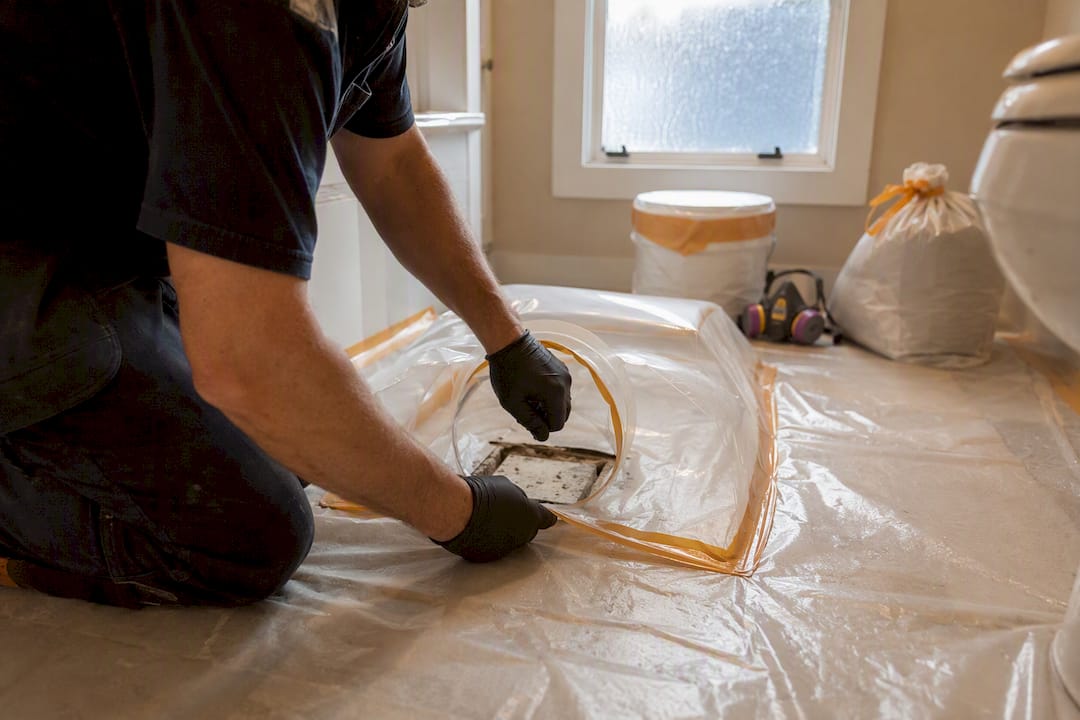
- Containment setup. Plastic sheeting seals the work zone, and negative air pressure units keep fibres from migrating into the rest of the home.
- Wet removal. Tiles are kept damp throughout to suppress dust, using hand tools rather than aggressive power equipment wherever possible.
- HEPA filtration throughout. HEPA-filtered vacuums and air scrubbers run continuously during active removal, not just at cleanup.
- Waste bagging and labelling. Material goes into sealed, labelled asbestos waste bags immediately, not left piled for end-of-day cleanup.
- Post-job visual inspection, followed by clearance air testing where required before the containment comes down.
- Documentation handoff. Waste manifests and clearance results get filed for your records, useful for future sale disclosures or renovation permits.
Industry guidance is blunt on this point: DIY abatement is rarely safe because inadequate containment doesn’t just risk your health, it can spread contamination into HVAC systems and adjacent rooms, turning a one-room problem into a whole-house remediation bill.
Pro Tip: Ask your contractor whether they use glove-bag methods for isolated pipe or small-tile removals versus full containment for room-scale jobs. The answer tells you whether they’re scaling procedure to risk correctly, or applying one approach regardless of scope.
How much does asbestos floor tile removal cost?
Costs vary widely because the variables compound. Room size is the obvious one, but the number of tile layers underneath matters just as much. A single layer over a slab is a different job than three layers stacked over decades of flooring updates, each with its own adhesive to deal with.
Several line items drive the final number beyond square footage:
- TEM testing fees, higher than standard PLM because the analysis is more technical and time-intensive.
- Containment setup, including plastic sheeting, negative air machines, and sealing doorways and vents.
- HEPA filtration equipment rental or operation during the job.
- Hazardous waste tipping fees at approved disposal facilities, which run higher than standard construction debris.
- Post-clearance air testing, an added cost but one that protects you if a dispute arises later.
Adhesive removal difficulty deserves its own mention. Black, brittle mastic that’s bonded hard to concrete over fifty years takes considerably more labour than adhesive that lifts cleanly with the tile.
When you’re comparing itemized quotes, look for these line items broken out individually rather than bundled into one lump figure. A quote that separates testing, containment, labour, and disposal lets you negotiate scope (maybe you don’t need clearance testing for a closet-sized job) without cutting corners on the parts that actually protect your health.
What should you ask an asbestos abatement contractor before hiring?
Before signing anything, ask to see the paperwork, not just hear assurances.
- Request licences and certificates for the specific worker types the job requires under the applicable classification.
- Ask which testing method they’ll use on your samples, and whether they’ll request TEM automatically for vinyl tile.
- Get the written abatement plan in advance, not after the containment is already up.
- Confirm insurance proof and ask directly how they’ll meet Type 2 or Type 3 requirements if your job qualifies.
- Ask about the disposal chain: which facility receives the waste, and whether you’ll receive a copy of the manifest.
- Clarify the re-occupation timeline and whether clearance air testing is included or billed separately.
Red flags show up fast in these conversations. A contractor who can’t name their testing lab, who quotes a price without ever asking your tile size or layer count, or who brushes off questions about waste manifests is one to walk away from. Ask for references tied to jobs similar in scale to yours, not just a general testimonial list.
Pro Tip: A contractor who insists on seeing a lab report before quoting, rather than pricing off a phone description, is usually the one following the classification rules properly. Our health and safety plan guide covers what a compliant plan should include.
How is asbestos tile waste disposed of safely?
Asbestos waste follows a strict chain from your floor to final disposal. Tiles and adhesive get double-bagged in labelled, puncture-resistant asbestos waste bags on-site, then transported by licensed haulers to approved disposal facilities. Ordinary landfill drop-off doesn’t apply here; check your local transfer station rules before assuming otherwise, since acceptance procedures vary by municipality.
A few things worth insisting on:
- Manifests for every load, documenting quantity, origin, and disposal facility.
- Licensed transport only, since unlicensed hauling is both a legal and contamination risk.
- Keep the paperwork permanently, not just for your records but for future buyers or home inspectors who will ask.
Re-occupation isn’t automatic once the visible mess is gone. A proper job includes a visual clearance inspection and, depending on the classification, air testing before containment comes down. Demand copies of that clearance documentation before moving furniture back in. For guidance on handling the broader waste stream from a renovation, see our renovation waste reduction guide.
How does HMJ Contracting document a safe abatement job?
HMJ Contracting builds its abatement work around documentation, not shortcuts. Every job includes a survey report, coordinated PLM or TEM testing depending on the flooring type, and a written abatement plan matched to the correct Type classification before any tile comes up.
What you should expect to receive:
- A detailed survey report identifying material condition and extent.
- Test coordination with an accredited lab, including TEM when vinyl composition is suspected.
- A written abatement plan outlining containment, tools, and classification.
- Waste manifests documenting the full disposal chain.
- Post-job clearance documentation confirming the space is safe to re-occupy.
HMJ Contracting also provides transparent, itemized quotes rather than a single bundled figure, and carries a 5.0-star Google rating built on hundreds of completed projects.
Pro Tip: When comparing two quotes side by side, line up their itemized categories against each other. If one contractor’s quote is missing testing method, containment approach, or disposal fees entirely, that gap is worth asking about directly.
What are the symptoms of asbestos exposure and what should you do?
Asbestos exposure symptoms rarely show up immediately. The fibres cause damage over years or decades, not hours, which is exactly why acute removal-day exposure feels deceptively harmless in the moment. That doesn’t mean a disturbance event should be ignored.
If you suspect you inhaled disturbed asbestos dust during a removal attempt, the immediate first-aid steps are straightforward:
- Leave the area immediately and get to fresh air.
- Remove and bag contaminated clothing rather than shaking it out, which re-releases fibres.
- Avoid touching your face until you’ve washed your hands and exposed skin thoroughly.
- Do not re-enter the space until it has been professionally assessed and, if needed, decontaminated.
There’s no first-aid treatment that removes inhaled fibres from your lungs. Short-term coughing or throat irritation from a dusty disturbance usually resolves on its own, but the real concern is long-term: asbestos exposure is linked to diseases that take twenty to forty years to appear, including asbestosis and mesothelioma. A single accidental disturbance is not the same risk profile as years of occupational exposure, but any suspected significant exposure event is worth mentioning to your doctor for your medical record, and worth having the space professionally tested before anyone re-enters.
Why testing method matters more than most guides admit
Most articles on this topic treat PLM as the default and stop there. That’s an incomplete answer for vinyl tile specifically, and it’s the gap that causes the most costly mistakes. A homeowner who gets a “no asbestos detected” PLM result on vinyl composite tile may be looking at a false negative, not a clean floor, because the fibres can sit bound in the matrix in a way standard microscopy doesn’t reliably catch.
The conventional advice, “get it tested,” undersells the decision that follows: which test. That single choice determines whether you make a removal decision on solid ground or on a report that missed the problem.
The other place conventional wisdom falls short is treating removal as the automatically responsible choice. It isn’t. Intact tiles left alone are frequently the lower-risk option, and Health Canada’s own guidance backs that. The homeowner’s job is triage, not automatic demolition: test correctly, understand the classification your specific job would trigger, then choose removal, encapsulation, or covering based on what your renovation plans actually require. When removal is the right call, that’s the moment to bring in licensed abatement, not before, and not as a default.
— Jason
Get a documented, licensed asbestos tile removal quote
HMJ Contracting is the direct route to a compliant asbestos floor tile removal in Ottawa: one contractor who handles testing coordination, the written abatement plan, containment, disposal, and post-job clearance documentation under a single itemized quote, instead of you piecing together a lab, a hauler, and a demolition crew separately.

That matters most when your job crosses into Type 2 or Type 3 territory, where paperwork gaps become compliance problems, not just inconveniences. HMJ Contracting’s abatement services cover the survey, sampling coordination, containment, and clearance testing in one scope, with a 5.0-star Google rating built on hundreds of completed Ottawa-area projects. If your renovation also touches mould or other hazards, the full services overview shows how those get bundled into one project rather than three separate contracts.
Request a free, itemized quote today and get a written scope before any tile comes up.
This article is general information, not a substitute for advice from a qualified doctor. Consult a qualified healthcare professional about your own circumstances before acting on anything here.
Sources
- Asbestos and your health — Health Canada
- Regulation respecting asbestos on construction projects and in buildings and repair — Ontario
- Asbestos testing services — Paracel Labs