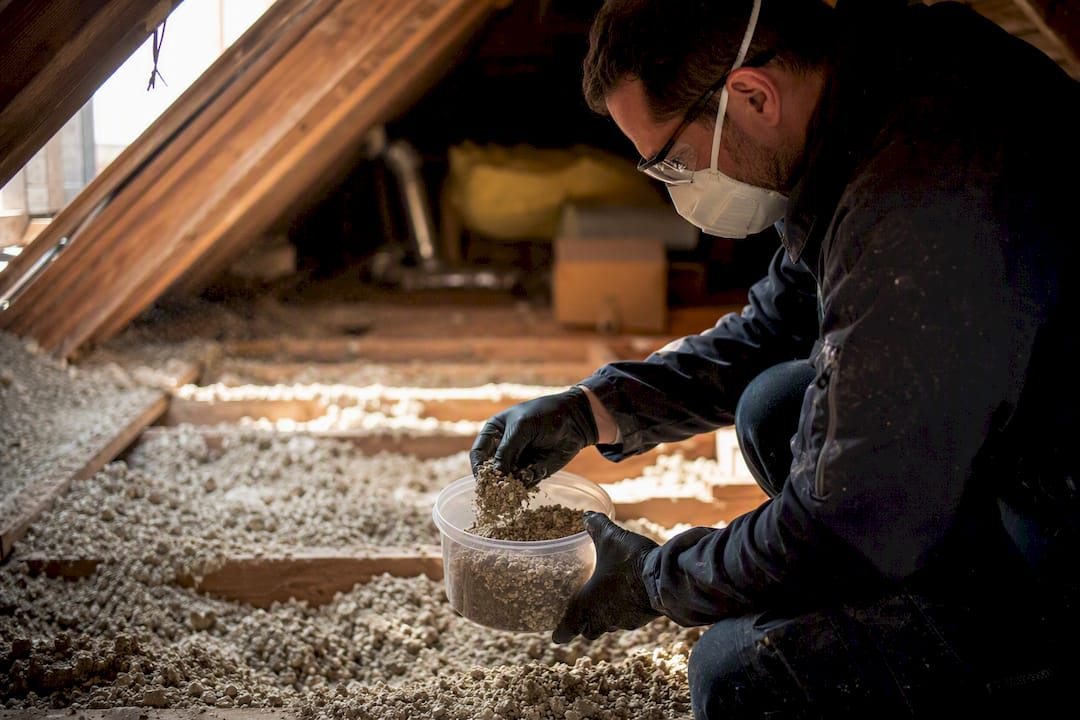
If your home has loose-fill vermiculite installed before 1990, assume it could be contaminated with asbestos and do not disturb it. Health Canada, CCOHS, and the EPA all give the same instruction.
- Do not touch, sweep, or vacuum the material.
- Restrict attic access, especially for children and pets.
- Arrange professional testing before any renovation or cleanup begins.
Bottom line: a large majority of the vermiculite sold across Canada between the 1920s and 1990 came from the Libby, Montana mine(https://publications.gc.ca/collections/collection_2010/sc-hc/H13-7-4-2009-eng.pdf), a site now known for tremolite asbestos contamination.
Key Takeaways
Assume any loose-fill vermiculite installed before 1990 may contain asbestos, leave it undisturbed, and confirm status through accredited bulk-sample lab testing before any renovation work begins.
| Point | Details |
|---|---|
| Assume contamination first | Treat pre-1990 loose-fill vermiculite as a presumed asbestos risk until a lab result proves otherwise. |
| Never self-sample or vacuum | Disturbing the material yourself releases fibres; only accredited testers and HEPA-equipped crews should handle it. |
| PLM testing is the standard | Bulk samples analyzed by polarized light microscopy give a defensible, lab-confirmed answer. |
| Removal requires certified abatement | Containment, negative air pressure, PPE, and independent clearance testing are standard steps for licensed crews. |
| Hmjcontracting offers local certified abatement | Ottawa homeowners can get an itemized quote, licensed removal, and post-job clearance documentation through Hmjcontracting’s abatement service. |
Table of Contents
- What is vermiculite insulation and how did asbestos get into it?
- How can you recognize vermiculite insulation safely?
- What health risks come from asbestos fibres in vermiculite?
- What should you do right now to limit exposure?
- How is vermiculite tested for asbestos?
- When does vermiculite insulation actually need to be removed?
- What does vermiculite removal cost, and are there grants available?
- Asbestos-containing vermiculite vs asbestos-free vermiculite: what’s the real difference?
- How should asbestos-contaminated vermiculite be disposed of?
- What are safe alternatives to vermiculite insulation?
- What regulations govern asbestos in vermiculite insulation?
- What I’ve learned handling vermiculite jobs across Ottawa
- Certified vermiculite abatement from Hmjcontracting
- Sources
What is vermiculite insulation and how did asbestos get into it?
Vermiculite is a lightweight, mica-like mineral that expands when heated, which made it a popular loose-fill insulation for attics and wall cavities across older homes. Poured or blown between joists, it looks like small grey-brown pebbles, often sold under the brand name Zonolite.
The trouble started at the source. For most of the twentieth century, the Libby mine in Montana supplied the bulk of the vermiculite ore used in North America, and that deposit ran through a seam of tremolite asbestos. Ore extracted, processed, and shipped from Libby carried asbestos fibres into insulation bags sold coast to coast.
- Not every vermiculite product is contaminated. Some deposits, including certain sources used after the Libby mine closed in 1990, tested clean.
- Homes insulated before 1990 are the ones where the risk is real enough to warrant caution.
- The brand name Zonolite is now closely tied to the Libby contamination issue in public health literature.
Age and origin, not appearance alone, decide whether a bag of vermiculite was ever safe.
How can you recognize vermiculite insulation safely?
Vermiculite typically shows up as loose, pebble-like granules in the attic, sometimes topping up older fibreglass or cellulose batts installed decades earlier. The texture resembles aquarium gravel: light grey to gold-brown, glossy, and accordion-shaped when you look closely at individual pieces.
- Check the attic hatch first, since that is where loose-fill often gets sifted or disturbed during past inspections.
- Look for a granular, shimmering texture rather than the fluffy look of fibreglass batts.
- Note your home’s construction or insulation date. Pre-1990 installations carry the highest plausible risk.
- Treat any recent attic work, storage, or wiring changes as a red flag that increases urgency.
Visual identification only gets you so far. Vermiculite from a clean source and vermiculite from Libby ore look identical to the naked eye, which is exactly why EPA guidance tells homeowners to assume contamination rather than guess from appearance. A lab is the only way to know for certain.
What health risks come from asbestos fibres in vermiculite?
Inhalation is the hazard, not skin contact. Asbestos fibres released into the air can lodge deep in lung tissue, and government publications link long-term exposure to mesothelioma, asbestosis, and lung cancer.
- Latency runs long: symptoms from these diseases can take decades to appear after exposure.
- Risk scales with dose. Concentration, duration, and frequency of exposure all matter more than a single brief encounter.
- Undisturbed vermiculite sealed behind drywall or sitting quietly in an attic generally poses lower immediate risk, according to CCOHS, which notes there’s no clear evidence of a health risk when the material stays put.
The real danger comes from disturbance, not simple presence. Renovation work, attic storage, sifting through insulation to run wiring, or a household vacuum passed over the surface can all release fibres that would otherwise stay contained.
What should you do right now to limit exposure?
Act on containment before you think about removal. These steps buy you time to arrange testing without raising your risk in the meantime.
- Stop touching, sweeping, or vacuuming the material immediately, even if it looks harmless.
- Keep children and pets out of the attic and treat it as off limits until testing is complete.
- Seal obvious sifting points: the attic hatch, recessed light fixtures, baseboards near ceiling lines, and electrical outlets on top-floor walls.
- Pause any planned renovation, wiring, or insulation top-up work that would disturb the attic.
- Contact an accredited testing service or abatement contractor rather than attempting to sample the material yourself.
Pro Tip: If you must enter the attic before testing is arranged, stay on boards or joists rather than walking directly on the insulation. Loose-fill vermiculite is highly friable, and even light foot traffic can release fibres that settle into living spaces below.
Households considering a renovation should read up on signs that often signal asbestos testing is needed before booking any contractor work.
How is vermiculite tested for asbestos?
Bulk sampling is the accepted method: a small physical sample of the insulation, collected carefully to avoid disturbing the surrounding material, gets sent to an accredited laboratory. Homeowners should not attempt this themselves. Improper sampling technique can release fibres and produce an unreliable result.
- Labs analyze bulk samples using polarized light microscopy (PLM), the standard method referenced in Health Canada’s technical guidance.
- Turnaround time varies by lab, though many facilities return PLM results within a few business days.
- A proper chain of custody, from sample collection through lab submission, keeps the report defensible if you later need it for disclosure or renovation planning.
A negative result still deserves a second look if only one sample was tested, since vermiculite contamination isn’t always uniform throughout an attic. A positive result means the next call is to a certified abatement contractor, not a general handyman. CCOHS is explicit that removal work belongs to trained professionals once asbestos is confirmed.
When does vermiculite insulation actually need to be removed?
Removal isn’t automatic just because vermiculite tests positive for asbestos. Contractors weigh a few factors: the material’s condition, whether you’re planning renovation work that will disturb it, how friable the sample is, and whether the space is occupied living area or a sealed attic that nobody touches.
When removal is the right call, licensed abatement crews follow a structured process:
- Set up containment around the work area to stop fibres from migrating into living spaces.
- Run negative air pressure equipment so air flows inward, not outward, during the job.
- Wear full personal protective equipment, including respirators rated for asbestos work.
- Remove the material under controlled conditions, then perform HEPA vacuum cleanup on every surface.
- Dispose of contaminated waste according to hazardous material regulations.
- Bring in an independent air clearance test once the work is done, confirming fibre counts are back within acceptable limits before anyone re-enters the space.
Pro Tip: Ask any contractor for their clearance testing protocol before signing a contract. A reputable abatement crew will always include independent air testing as a final step, not an optional add-on.
What should you expect as a homeowner? A written, itemized quote that breaks down containment, removal, disposal, and testing separately. A realistic timeline. Proof of permits where required. Post-job documentation you can keep for future sale disclosures. Hmjcontracting operates on exactly this model across the Ottawa area, with licensed abatement crews, a 5.0-star Google rating, and hundreds of completed projects behind that track record.
What does vermiculite removal cost, and are there grants available?
Cost depends on a handful of variables that shift from job to job, so treat any flat number you see online with skepticism until a contractor has actually seen your attic.
- Attic size and accessibility drive labour hours more than almost anything else. A cramped, low-clearance attic takes longer to work in than an open one.
- Contamination extent matters too. A full attic of loose-fill costs more to remove and dispose of than a partial installation confined to one section.
- Disposal requirements add cost, since asbestos-contaminated material must go to a licensed hazardous waste facility rather than standard landfill.
Get a written, itemized quote before agreeing to anything, and confirm that independent air clearance testing is included in the scope rather than billed as an extra. There’s no guaranteed federal grant covering vermiculite abatement in every case, so check your provincial or municipal government’s home renovation and health-safety programs directly for what’s currently available in your area. Homeowners planning a larger project should also review how asbestos findings can affect renovation timelines before finalizing a budget.
Asbestos-containing vermiculite vs asbestos-free vermiculite: what’s the real difference?
The mineral itself, vermiculite, is not the hazard. Pure vermiculite is chemically inert and was never classified as a health risk on its own. The danger comes entirely from what got mixed in during mining, and that distinction matters more than most homeowners realize.
Vermiculite ore from the Libby, Montana mine ran through a natural seam of tremolite, a type of amphibole asbestos. As that ore was crushed, processed, and bagged for sale, asbestos fibres became embedded throughout the finished product, often at concentrations too fine to detect visually. That’s the material sold widely under the Zonolite brand and installed in millions of North American attics between the 1920s and 1990, when the Libby mine ceased operations.
Vermiculite mined from other deposits, including some sources used more recently, doesn’t carry that same contamination. Asbestos-free vermiculite looks identical: the same grey-gold, pebbly, accordion-shaped granules. There’s no colour difference, no texture cue, and no smell that separates a contaminated bag from a clean one.
This is precisely why laboratory testing exists as a category of professional service rather than a homeowner task. A PLM analysis on a properly collected bulk sample is the only reliable way to tell asbestos-containing vermiculite from the asbestos-free version. Age and brand history give you a probability, not a diagnosis. If your attic insulation predates 1990, or you simply don’t know when it was installed, treat it as presumptively contaminated until a lab says otherwise.
How should asbestos-contaminated vermiculite be disposed of?
Disposal isn’t a homeowner task, and it isn’t something you can handle through a regular waste pickup or a trip to the municipal dump. Once vermiculite tests positive for asbestos, it falls under hazardous waste handling rules, and that changes everything about how it leaves your property.
Certified abatement contractors bag contaminated material in sealed, labelled containers designed specifically for asbestos waste, typically heavy-duty polyethylene bags rated for hazardous material transport. Those bags get sealed on-site, inside the containment zone, before they’re ever moved through the rest of the house. This step alone prevents the kind of fibre release that happens when contaminated material gets dragged loose through a hallway or stairwell.
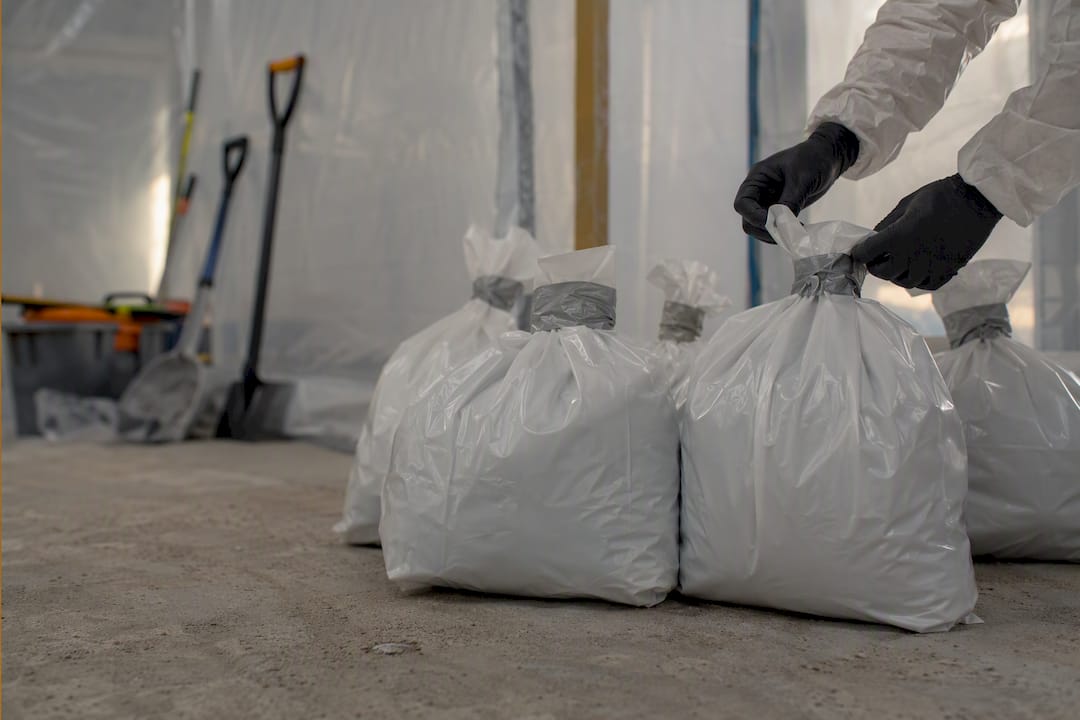
From there, waste is transported to a licensed hazardous waste disposal facility, not a standard landfill. Provincial and municipal regulations govern exactly which facilities can accept asbestos waste, and contractors handling the removal are responsible for using an approved site and keeping manifest documentation that tracks the material from your home to final disposal.
That documentation matters for you as the homeowner. A proper disposal record, along with the post-job clearance air test, forms part of the paper trail you’ll want if you ever sell the property or need to prove the work was done to code. Ask your contractor upfront whether disposal manifests and clearance reports are included in their standard package, since some itemize this separately. A contractor who treats disposal as an afterthought rather than a documented, regulated step is one to avoid regardless of price.
What are safe alternatives to vermiculite insulation?
Homeowners removing contaminated vermiculite need to replace it with something, and the good news is that modern insulation options outperform old loose-fill vermiculite on both safety and thermal efficiency.
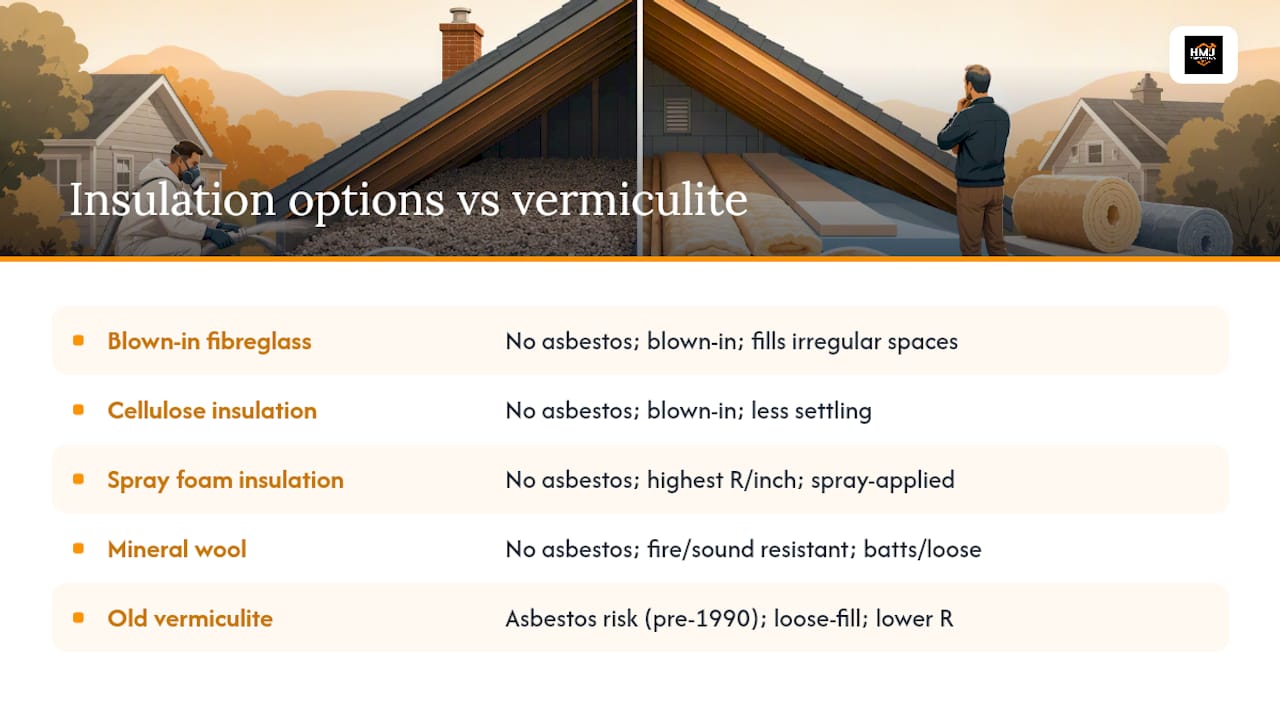
Blown-in fibreglass is one of the most common replacements. It installs quickly using equipment similar to what vermiculite once required, fills irregular attic spaces well, and carries no asbestos risk since it’s manufactured from spun glass fibres rather than mined ore.
Cellulose insulation, made primarily from recycled paper treated with fire retardant, is another widely used substitute. It offers strong coverage in attics with irregular joist spacing and tends to settle less over time than older fibreglass products.
Spray foam insulation costs more upfront but delivers a higher R-value per inch and creates an air seal that loose-fill materials can’t match. It’s a common choice for homeowners doing a full attic renovation alongside abatement work, since the same crew can often handle removal and reinstallation in a single project window.
Mineral wool (rock wool) batts or loose-fill offer strong fire resistance and sound dampening, making them a reasonable option where those properties matter more than raw cost.
None of these materials carry the asbestos risk tied to pre-1990 vermiculite, and all of them are widely available through insulation contractors across Canada. The right choice usually comes down to attic access, budget, and whether the abatement crew doing your removal also handles insulation reinstallation as part of the same job.
What regulations govern asbestos in vermiculite insulation?
Regulatory oversight for asbestos in vermiculite comes from a mix of federal health guidance, workplace safety law, and provincial or municipal rules, and homeowners are often surprised there isn’t one single law that covers the whole process.
Health Canada and CCOHS issue the guidance that shapes how vermiculite is handled in Canadian homes, recommending testing before disturbance and professional abatement when asbestos is confirmed. That guidance isn’t a criminal statute, but it forms the basis most provincial workplace safety regulators point to when setting rules for contractors doing removal work.
Where legal obligation kicks in is on the contractor side. Anyone hired to remove asbestos-containing material, including contaminated vermiculite, typically must follow provincial occupational health and safety regulations covering asbestos abatement, worker protection equipment, and waste handling. These rules exist to protect workers doing the physical removal, and they indirectly protect homeowners by requiring documented, controlled procedures rather than ad hoc removal.
In the United States, the EPA and OSHA play the equivalent roles: EPA guidance addresses homeowner-facing identification and safety advice, while OSHA regulations govern how asbestos abatement work is legally conducted on job sites. Local building departments in both countries may layer on permit requirements for renovation work that involves known hazardous materials.
None of this amounts to a requirement that every homeowner test their attic on a set schedule. What it does mean is that once you know or suspect contamination, and especially once you plan to disturb the material through renovation, the legal and safety framework strongly favours hiring a licensed abatement contractor over doing the work yourself.
What I’ve learned handling vermiculite jobs across Ottawa
Every vermiculite job starts the same way: a homeowner who found grey pebbles in their attic and doesn’t know what they’re looking at. Realistic timelines matter here. Testing typically takes a few days, and if abatement is needed, the actual removal window depends on attic size and access, not just square footage.
The biggest misconception is that a shop vac and a weekend will handle it. It won’t, and it makes the problem worse. Documentation and clearance testing aren’t paperwork for paperwork’s sake. They’re what protects you at resale and what proves the job was done right. If you’re unsure what you’re dealing with, request an on-site inspection before you touch anything.
Certified vermiculite abatement from Hmjcontracting
Hmjcontracting is the direct route to certified removal for Ottawa homeowners who don’t want to gamble on a DIY attic cleanup or an unlicensed handyman. Every abatement job comes with a written, itemized quote up front, so you know exactly what containment, removal, and disposal will cost before work begins.

Where Hmjcontracting differs from a general renovation crew is the full loop: licensed abatement technicians handle the removal itself, then independent post-job air clearance testing confirms your home is safe before anyone moves back into the space. That documentation stays with you, useful for future sale disclosures or peace of mind. Backed by a 5.0-star Google rating and hundreds of completed local projects, the team also handles insulation replacement and renovation work afterward, so you’re not coordinating three different contractors for one job. If your attic tested positive, or you suspect it might, request a quote for certified abatement and get an on-site assessment scheduled.
Sources
- It’s your health — Vermiculite insulation containing amphibole asbestos (Health Canada publication)
- Vermiculite insulation containing asbestos — Canadian Centre for Occupational Health and Safety (CCOHS)
- Protect your family from asbestos-contaminated vermiculite insulation — U.S. EPA
- Vermiculite insulation containing tremolite asbestos — Government of Canada (Employment and Social Development Canada / Health Canada guidance)
Contact your provincial workplace safety authority for region-specific abatement contractor requirements.
This article is general information, not a substitute for advice from a qualified doctor. Consult a qualified healthcare professional about your own circumstances before acting on anything here.