
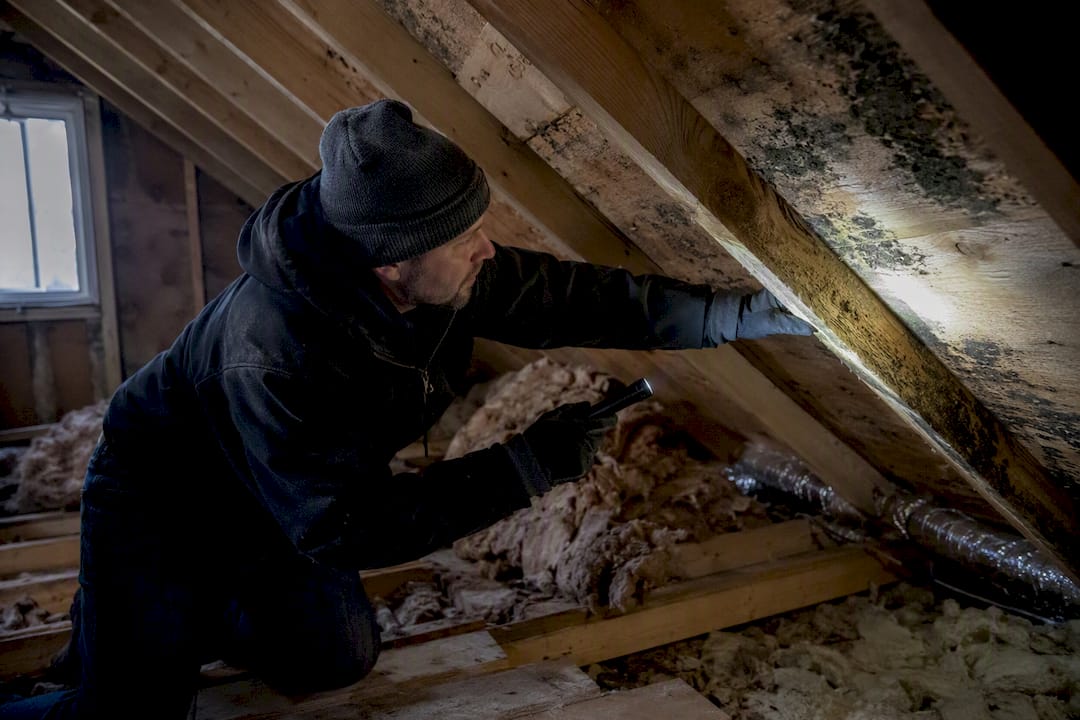
Yes, attic mould can be removed, but scrubbing it away without fixing the moisture source is a waste of a weekend. The real fix starts with cutting off whatever is feeding the growth, then assessing how much material is affected before you touch anything.
Right away, you should:
- Stop adding moisture: fix running exhaust fans, check for roof or plumbing leaks, and keep the attic hatch closed.
- Limit access and avoid disturbing mouldy insulation or sheathing, which can send spores into your living space.
- Run a dehumidifier or improve airflow where it’s safe to do so without kicking up dust.
If the affected patch is bigger than roughly a moderate-sized area, is coming back repeatedly, or you suspect your ductwork is contaminated, it’s time to call a licensed abatement contractor rather than tackle it yourself.
Pro Tip: Before you climb up with a flashlight, check your bathroom exhaust vents from outside the house. If you can’t find where they terminate, there’s a decent chance they’re dumping warm, moist air straight into your attic.
Key Takeaways
Attic mould remediation only works long term when moisture correction and physical cleanup happen together, not one without the other.
| Point | Details |
|---|---|
| Fix the moisture first | Identify and stop the source before any cleaning, since mould returns without it. |
| Know the size threshold | Patches over a moderate-sized area call for professional assessment, per Health Canada. |
| Skip the bleach | Use unscented detergent and water for small areas; avoid bleach and fungicides. |
| Air-seal and re-ventilate | Seal ceiling penetrations and restore soffit-to-ridge airflow to prevent recurrence. |
| Choose certified crews | HMJ Contracting offers itemized quotes, certified abatement, and post-job verification for Ottawa-area attics. |
Table of Contents
- What is attic mould and why does it matter for your health?
- How do you spot and assess attic mould?
- What causes attic mould in the first place?
- How do professionals remediate attic mould?
- Can you clean small areas of attic mould yourself?
- What building fixes stop attic mould from coming back?
- What do attic mould remediation costs and timelines look like?
- Frequently asked questions about attic mould remediation
- Sources
What is attic mould and why does it matter for your health?
Mould is a fungus that needs moisture, a food source (wood, paper-faced insulation, dust), and a surface to grow on, and attics hand it all three. Cold roof sheathing meets warm, humid house air rising through gaps, and condensation forms exactly where you can’t see it. According to Health Canada, mould can begin growing within 48 hours of sustained moisture exposure, which is faster than most homeowners realize.
The health concerns are real but not identical for everyone:
- Eye, nose, and throat irritation in otherwise healthy occupants.
- Worsened asthma symptoms and increased respiratory sensitivity.
- Elevated risk for infants, older adults, and anyone who is immunocompromised.
Health Canada’s guidance is notably practical here: it recommends against routine air testing or trying to identify the exact mould species, since neither changes what you should actually do, which is find the moisture and clean what’s visible.
How do you spot and assess attic mould?
A proper inspection tells you whether you’re dealing with a weekend project or a job for licensed pros. Work through it methodically:
- Look for visible signs. Black or greenish staining on roof sheathing, white fuzzy growth on framing, discoloured or matted insulation, and frost or condensation on nail tips in winter are all red flags.
- Follow your nose. A persistent musty smell often means active growth even before you can see it clearly.
- Measure the area. Health Canada draws the line at a single patch larger than a moderate-sized area as the point where professional assessment becomes the safer call.
- Check for recurring patterns. Staining near the same soffit vent or hatch every winter points to a structural cause, not a one-off event.
Bring a flashlight, a moisture meter if you have one, an N95 respirator, and gloves. Don’t dry-brush mould (it aerosolizes spores) and don’t reach for bleach on porous wood.
Pro Tip: Step only on the ceiling joists when you’re in the attic. Loose insulation hides the drywall underneath, and it will not hold your weight.
What causes attic mould in the first place?
Almost every attic mould case traces back to one of three building problems, and identifying which one applies to your house is half the remediation work.
- Poor ventilation. When soffit vents are blocked by insulation or the path to the ridge vent is obstructed, humid air has nowhere to go and condenses on the coldest surface it can find.
- Air leakage from the house below. Recessed lighting, plumbing stacks, wiring penetrations, and an unsealed attic hatch all let warm, moisture-laden air escape upward. Natural Resources Canada points to these gaps as the main pathway that drives attic condensation.
- Direct water intrusion. Roof leaks, ice dams, and bathroom or kitchen exhaust fans that terminate in the attic instead of outside the house all add liquid water or vapour that has no business being there. Fans venting into the attic cavity are a surprisingly common and easy to overlook culprit.
How do professionals remediate attic mould?
Licensed contractors follow a sequence built to stop mould from spreading during the cleanup itself, not just remove what’s already there. The typical contractor workflow looks like this:
- Inspection and moisture mapping to confirm the source and extent of contamination.
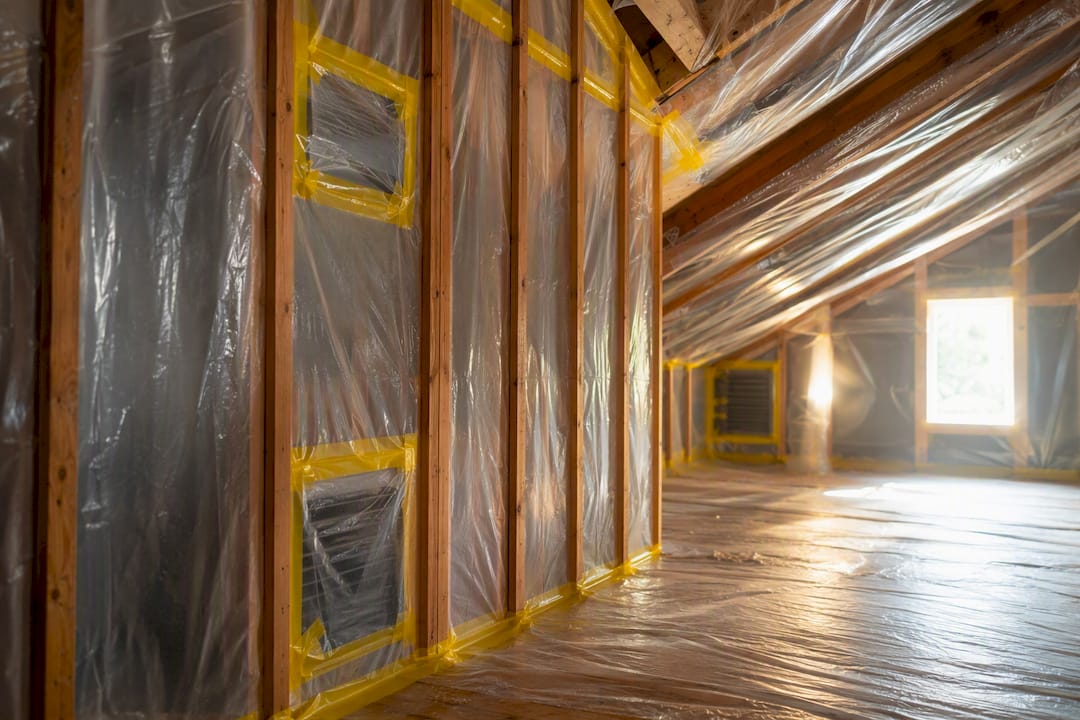
- Containment to seal off the attic from living spaces before any disturbance begins.
- Negative pressure and HEPA filtration to keep spores from migrating into the house during work.
- Removal of unsalvageable materials, including insulation or sheathing that’s been wet too long to save.
- Mechanical cleaning, using abrasion, dry-ice blasting, or media blasting on structural wood where scrubbing alone won’t cut it.
- Drying and repairs to bring the space back to a stable moisture level.
- Post-remediation verification to confirm the job actually worked.
Insulation or roof sheathing usually needs to come out when:
- The material has been wet long enough to lose structural integrity.
- Mould has penetrated deep into the wood grain rather than sitting on the surface.
- The contaminated area is large and contiguous rather than a small isolated patch.
A trustworthy quote should be itemized by task, not a single lump sum, and should name the crew’s certifications up front. Look for IICRC-trained technicians, proof of insurance, and a written scope of work before you sign anything.
Pro Tip: Ask any contractor how they’ll verify the job worked. A visual re-inspection plus moisture readings is a reasonable answer. “Trust us” is not.
Can you clean small areas of attic mould yourself?
Health Canada’s threshold gives you a workable rule: patches under a moderate-sized area are generally considered manageable for a careful homeowner, while anything larger or recurring calls for a professional. If you’re in that smaller category, the process is straightforward but not casual.
- Isolate the work area from the rest of the attic and the house below.
- HEPA-vacuum loose surface mould before you introduce any liquid.
- Clean with plain unscented detergent and water, never bleach or off-the-shelf fungicides, which can mask a problem without solving it.
- Dry the area completely before closing it back up.
Health Canada is direct on this point: detergent and water is the recommended cleaning method for small mould areas, and bleach is not necessary and not advised.
Wear an N95 respirator and eye protection throughout, and stop the moment you find contamination spreading into ductwork or insulation you can’t fully access. That’s your signal to call it in.
What building fixes stop attic mould from coming back?
Cleaning without fixing the cause just buys time before the same stain reappears in the same spot. The ventilation and air-sealing work is what actually breaks the cycle, and it comes down to three fronts.
- Seal the ceiling interface. Weatherstrip the attic hatch, caulk around recessed lights, and seal gaps around plumbing stacks, wiring, and the chimney fire-stop.
- Restore balanced airflow. CMHC guidance recommends continuous soffit intake paired with ridge exhaust, with rafter baffles keeping insulation from blocking the path between them.
- Manage indoor humidity at the source. Vent kitchen and bathroom fans all the way outside (never into the attic), run a dehumidifier if your home runs damp, insulate exposed ductwork, and repair whatever is causing ice dams or roof leaks.
Pro Tip: If your attic mould keeps returning every winter despite cleaning, the problem almost certainly isn’t the cleaning. It’s an air leak or ventilation gap you haven’t found yet.
What do attic mould remediation costs and timelines look like?
Price depends heavily on how much material has to come out and how hard the attic is to access, especially in winter when scheduling gets tighter. The biggest cost drivers are the size of the affected area, whether insulation needs full replacement, any structural repairs to sheathing or framing, and the containment and HEPA equipment the job requires.
Most projects move through four phases:
- Inspection and planning, where the scope and quote get finalized.
- Remediation, covering containment, removal, and mechanical cleaning.
- Drying and repairs, restoring insulation and any structural material.
- Verification, confirming the fix held before the crew leaves.
Small, contained jobs move faster than large ones involving full insulation replacement or sheathing repairs. When you’re comparing quotes, look for:
- A written, itemized scope rather than a flat estimate.
- Certified technicians and documented insurance coverage.
- A clear post-job report showing what was done and verified.
HMJ Contracting builds every attic mould quote around these same expectations: transparent line items, certified abatement crews, and documentation you can keep for insurance or resale purposes down the line.
Why moisture control has to come before cleanup
Cleaning up visible mould feels like progress, and it is, but it’s the smaller half of the job. The building-science side, sealing the air leaks and restoring proper venting, is what determines whether that cleanup actually sticks. Homeowners who skip straight to a fix are often surprised when the same stain shows up eighteen months later. HMJ Contracting’s crews work Ottawa and Renfrew County attics regularly, and an itemized remediation plan that names both the cleanup and the building fix tends to be the difference between a permanent solution and a repeat call next winter.
Get a certified attic mould inspection from HMJ Contracting
HMJ Contracting is the straightforward alternative to guessing your way through a mould problem: certified abatement crews, transparent itemized quotes, and a process built to catch the moisture source, not just the stain on the sheathing.

A free estimate starts with an on-site inspection of the affected area and the likely moisture source, followed by a written scope that spells out containment, removal, and repair costs before any work begins. There’s no guessing what you’re paying for and no vague line items to question later. If you’ve spotted staining, frost, or a musty smell in your attic, book a mould remediation inspection with HMJ Contracting and get a clear plan instead of a lingering question mark over your head.
Frequently asked questions about attic mould remediation
Is attic mould always dangerous to health? Not always to the same degree. Healthy adults may notice only mild irritation, but people with asthma, infants, and immunocompromised individuals face higher risk, which is why Health Canada emphasizes moisture control over waiting to see how bad symptoms get.
Can I paint over attic mould instead of removing it? No. Paint or sealant traps moisture underneath and does nothing to address the underlying cause, so the mould keeps growing beneath the surface even though it’s out of sight.
Does homeowners insurance cover attic mould remediation? Coverage varies by policy and by whether the mould resulted from a sudden covered event, like a burst pipe, versus long-term neglect, like an unaddressed ventilation issue. Check your specific policy wording or ask your contractor for documentation that supports a claim.
How long does attic mould remediation take? A small, contained job might wrap in a day or two, while projects involving full insulation removal, sheathing repair, or extensive containment can take a week or more depending on access and the season.
Will attic mould come back after remediation? It will if the moisture source and ventilation problem aren’t fixed alongside the cleanup. That’s why building fixes like air sealing and balanced venting are treated as part of the remediation, not an optional add-on.
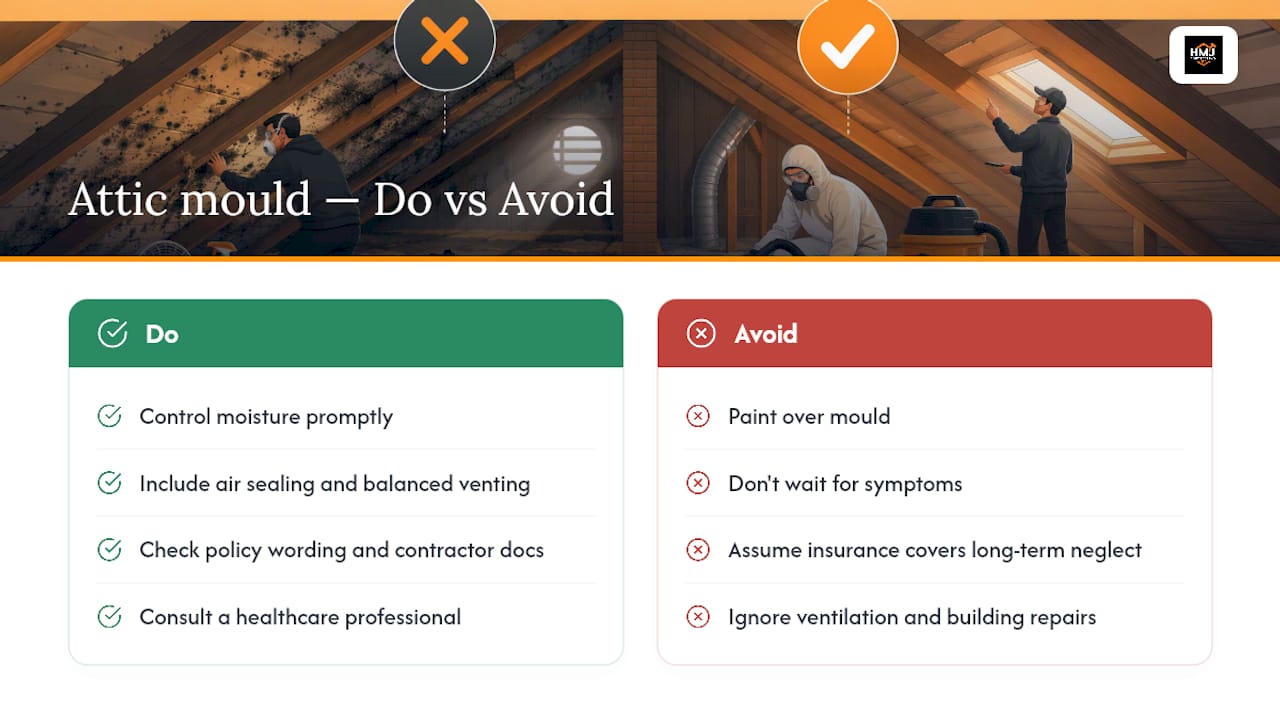
This article is general information, not a substitute for advice from a qualified doctor. Consult a qualified healthcare professional about your own circumstances before acting on anything here.
Sources
- Addressing moisture and mould in your home — Health Canada
- Attic venting, attic moisture and ice dams — CMHC (publication)
- Attic mold removal: complete guide — Mold Action Plan
- Mold remediation in attics — National Mold Remediation Authority