
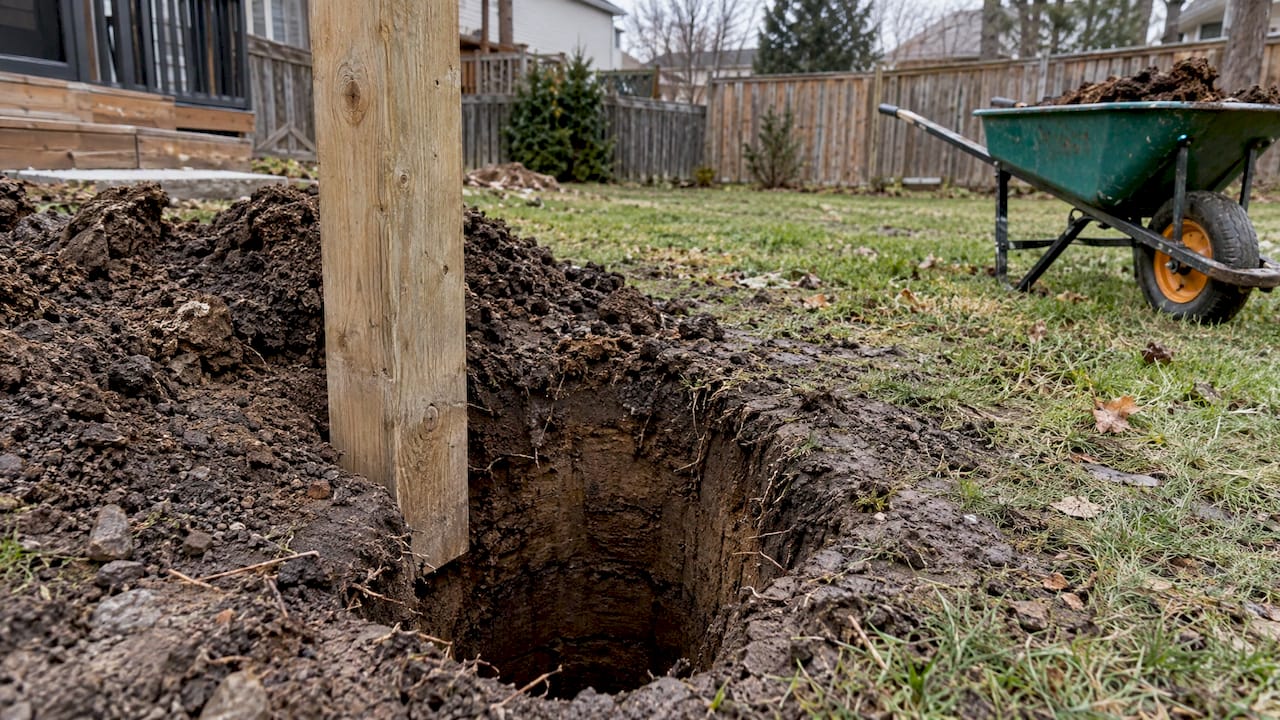
For most Ottawa fences, set posts about 1.2 m (4 ft) deep, and go toward 1.5 m (5 ft) for gate posts, tall fences and anything on wet clay. Ottawa winters push frost deep into the ground. A post set above that depth gets lifted a little every year, and the fence leans, racks and pulls away from its gates. This guide explains the depth, the reasons behind it, how to set the post, and what the City of Ottawa requires before you dig.
TL;DR
- Ottawa has no single official fence-post depth. The building code sets a minimum of 1.2 m (4 ft) for unheated footings on clay, and the City’s own sample deck plan shows 1.5 m (5 ft). Most fence posts are set between those two figures.
- Roughly one third of a post’s length belongs underground, and a 6 ft fence on a 10 ft post is a common combination.
- Gate posts, corner posts and pool enclosure posts carry more load and need extra depth and a wider footing.
- No building permit is needed for a standard residential fence, but you must follow the Fence By-law and call Ontario One Call before any digging.
- We build pressure-treated and cedar fences across Ottawa and give free estimates.
Table of Contents
- Why Ottawa posts need to go deep
- What the code says, and what it does not
- Recommended depths by fence height
- Gate posts and corners take more load
- Soil, concrete and gravel
- How a post is set, step by step
- Pool enclosures are different
- Permits and rules to check before you dig
- Looking after the fence once it is up
- What a fence costs in Ottawa
- Have us build the fence
- FAQ
- Sources
Why Ottawa posts need to go deep
Water in the soil freezes in winter and expands. That expansion lifts anything the frozen soil grips, including fence posts. In spring the ground thaws unevenly and the post does not settle back to where it started. After a few winters, a fence that was straight is leaning and the gates no longer latch.
Ottawa is a hard case for this. Its soil is often Champlain Sea clay, which holds water and heaves strongly, and the Ottawa Valley takes Arctic air. One technical summary of the climate data notes a -25°C January design temperature and 4,440 heating degree-days for the city, and treats about 1,800 mm as a conservative frost depth for unheated foundations. That is the cautious end of the range. The same source notes that the City’s current sample deck plan shows 1,500 mm.
The practical result is that a shallow post can fail in a way you do not see until the second or third winter. Digging deeper once costs far less than resetting a whole fence line.
What the code says, and what it does not
No Canadian code publishes one frost depth for Ottawa. A summary of the National Building Code 2020 and the Ontario Building Code explains that unheated footings on clay or undefined soil must go at least 1.2 m (4 ft) and not less than the local depth of frost penetration. The same page notes that Ottawa’s sample sundeck plan shows 5 ft (1.5 m) footings, as a sample rather than a stated rule.
Two things follow from this:
- Those figures are written for building and deck footings. A fence is a lighter structure, and a standard residential fence does not need a building permit in Ottawa, so no inspector checks your post depth.
- Because nobody inspects it, the depth is a matter of workmanship. The code figures are the sensible benchmark, because they describe how deep the frost reaches in the same ground.
If you are also planning a deck, the footing rules are stricter. Our guide to deck footing depth in Ottawa and across Canada covers them.
Recommended depths by fence height
The rule of thumb is that about one third of the post should be underground, with the depth never less than the frost allowance for your site. The table below turns that into Ottawa-sized numbers. These are working guidelines, not City requirements.
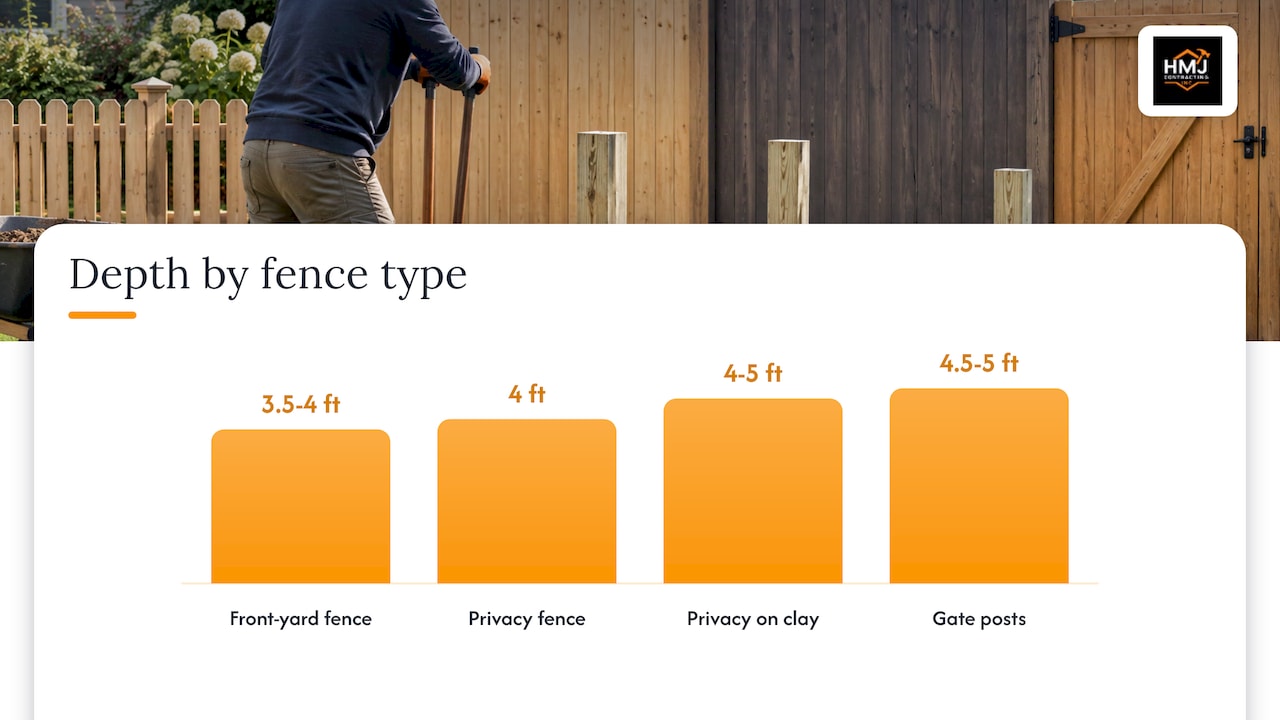
| Fence | Typical post length | Depth in ground | Notes |
|---|---|---|---|
| 4 ft front-yard fence (1 m maximum height) | 8 ft | 3.5 to 4 ft | Light load, but frost still lifts a shallow post |
| 6 ft privacy fence | 10 ft | 4 ft | Solid boards catch wind like a sail |
| 6 ft privacy fence on clay or a wet lot | 10 ft | 4 to 5 ft | Go to the deeper end of the range |
| Gate posts | 10 ft or longer | 4.5 to 5 ft | Wider hole, heavier footing |
| Pool or hot tub enclosure | Per City guide | Per City guide | Non-frost-susceptible posts required |
One installer-side source gives a regional example: a 6 ft fence with 48 in. of post in the ground uses a 10 ft post, and it places Ottawa in the 60 in. frost band for Ontario, with most installers digging a hand below it. That agrees with the cautious end of the range above.
The maximum height matters here too. Under the City’s Fence By-law, residential fences may be at most 1 m high in a front yard and 213 cm in any other yard. A fence built to the full 213 cm is exactly the one that needs the deepest posts, because it has the most surface for the wind to push on. Our article on Ottawa fence height rules goes through the limits in detail.
Gate posts and corners take more load
A line post only has to hold up its share of the panels. A gate post holds a swinging weight that pulls sideways every time the gate opens, and a corner post is pulled from two directions at once. These are the posts that sag first.
For these positions:
- Set the post deeper than the line posts, by about 6 in. or more.
- Dig a wider hole so the footing is thicker around the post.
- Use a heavier post than the rest of the run, since the gate hangs from it.
- Keep the gate’s own width and weight in mind: wide gates need the strongest footing on the whole fence.
The By-law allows gates in side and rear yards to exceed the height limit by up to 30 cm, which also means a taller gate post and a larger lever arm on the footing.
Soil, concrete and gravel
Depth is only half of a stable post. What surrounds the post decides how well it resists both frost and wind.
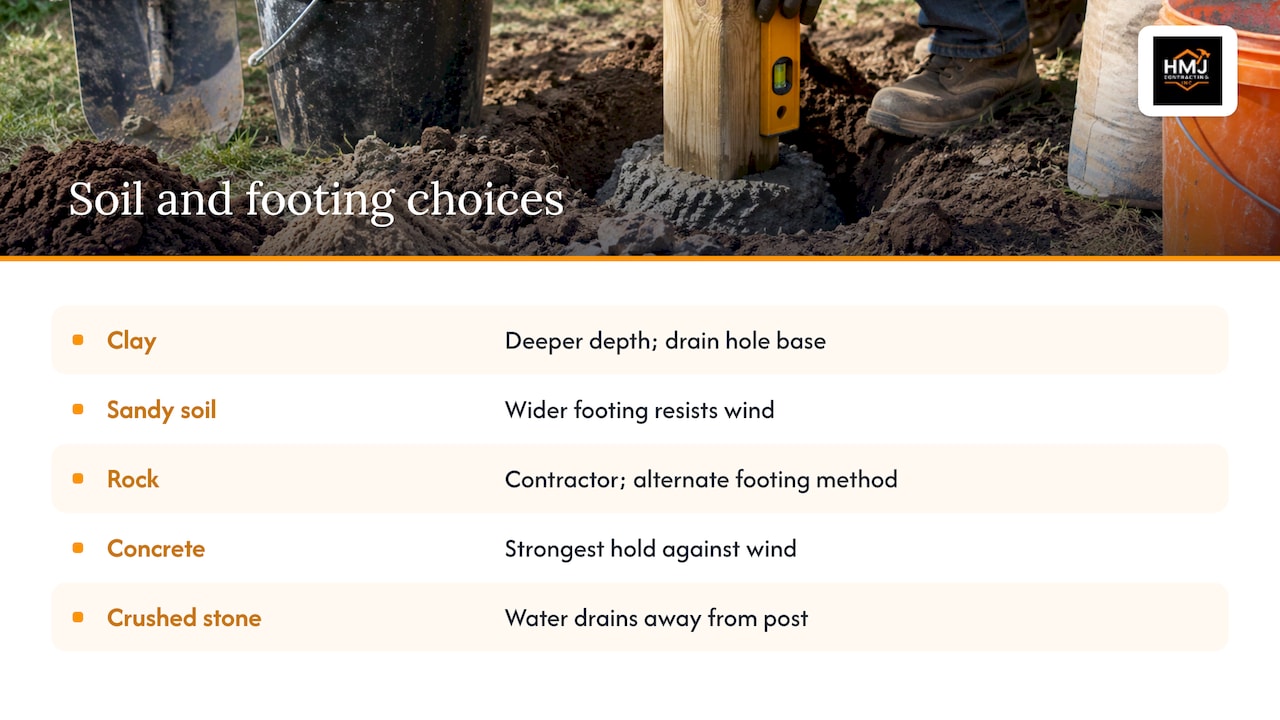
Clay. Ottawa’s clay holds water, so frost grips the post harder. Clay needs the deeper end of the depth range and good drainage at the base of the hole. A bed of crushed stone under the post lets water drain away from the bottom of the post rather than sitting against it.
Sandy or well-drained soil. Frost heave is less aggressive, but a post in loose sand needs a wider footing to resist wind.
Rock or boulders. On shallow bedrock you cannot reach full depth. This is a job for a contractor, who can plan the layout and use another footing method where the ground will not allow a full-depth hole.
Concrete or gravel. Concrete around the post gives the strongest hold against wind and is the usual choice for gate posts and tall privacy fences. Compacted crushed stone lets water escape and is often used for line posts on lighter fences. Whichever you use, slope the top of the concrete away from the post so water runs off rather than pooling at the wood.
Hole width matters as much as depth. A common sizing is a hole about three times the width of the post, which leaves room for a solid collar of concrete or stone all round.
How a post is set, step by step
This is the sequence a careful installer follows. Each step is a place where a rushed job goes wrong.
- Check the property line and the rules. Confirm where your lot ends and which height limit applies to each yard. No fence may be built on City property.
- Call before you dig. The City’s Landscaping Education Guide says you must call Ontario One Call at 1-800-400-2255 to locate underground utilities before digging, even with a hand shovel. Posts that are 4 to 5 ft deep reach well into the zone where gas, electrical and telecom lines run.
- Mark the layout with string. Measure post spacing along a straight line. Errors made here show up as uneven panels at the end of the run.
- Dig to the full depth. Measure the hole, do not guess. Holes that get shallower as the digger tires are a common cause of leaning sections.
- Add a base of crushed stone. A layer of several inches under the post helps drainage and gives the post something firm to sit on.
- Set and plumb the post. Check it with a level on two adjacent faces, and brace it before anything goes in the hole.
- Fill and compact. Concrete or compacted stone goes in layers, not all at once, so there are no voids around the post.
- Let the footing cure before loading. A post with panels or a gate hung on it too early can shift while the concrete is still setting.
- Finish the top of the footing. Slope it away from the wood so water drains.
At step 2 and step 4, a professional crew earns its keep. Locating utilities and digging a consistent four to five feet in clay is heavy work, and mistakes are buried where you cannot see them. Our fence crews handle the layout and the digging, and the price is quoted per linear foot, so you know the cost of the whole run before work begins.
Pool enclosures are different
If the fence encloses a pool, hot tub or pond that can hold 600 mm or more of water, it is a different job. The City’s pool enclosure guide says such enclosures must be at least 1.5 m high with non-frost-susceptible posts, and that a permit is required when you reuse an existing yard fence or replace an enclosure. Because frost movement can open gaps beneath or between the boards, the posts for these enclosures are specified differently from a standard fence. Check the City’s guide and apply for the pool enclosure permit before building.
Permits and rules to check before you dig
The good news is that no building permit is needed for a standard residential fence in Ottawa. You still have to follow Fence By-law No. 2003-462:
- A maximum of 1 m in front yards and 213 cm in side and rear yards.
- A maximum of 75 cm in visibility triangles at corners.
- The finished side facing the street.
- No barbed wire, chicken wire or electric fences on residential property.
- No fence on City property.
- The fence must be stable, vertical and kept in good repair.
The Landscaping Education Guide, published in March 2026, also notes that heritage-designated properties are not covered by the permit exemption. On a corner lot, a 6 m visibility triangle applies, where nothing over 0.75 m is allowed unless it is see-through. If you store materials on the roadway, boulevard or sidewalk during the build, a Temporary Construction Related Encroachment Permit is needed.
For the full picture, see our guide to the fence permit in Ottawa.
Looking after the fence once it is up
A fence set at the right depth still deserves a look each spring. After thaw, walk the line and check each post for lean, sit a level against it, and test gates for rubbing or sagging. Early movement is easy to correct. We list the checks in our guide to fence maintenance after the spring thaw.
Green film on boards in a shaded yard is usually algae and is a surface problem, not a structural one. A guide to safe fence algae removal explains how to clean it without damaging the wood.
What a fence costs in Ottawa
The depth of the posts is one reason a professional fence costs what it does: digging, concrete and hauling spoil are a large part of the labour. Our published prices are:
- Pressure-treated fence: $30 to $60 per linear foot.
- Cedar fence: $60 to $100 per linear foot.
The final figure depends on height, gates, soil and access. To budget for the whole yard, multiply by the run length and add gates.
Perspective
A fence is judged in its third spring, not on the day it is finished. Most of what decides whether it is still straight then is under the ground: the depth of the hole, what was packed around the post, and whether the gate posts were treated as the heavy-duty posts they are.
Over 25 years working on Ottawa properties, we have come to treat the frost line as the starting point for every fence quote, not a line item to trim. Ottawa’s clay does not forgive shortcuts, and a post that is an extra foot deeper costs very little against the price of resetting a run.
That is why we give line-by-line quotes. You can see what goes into the fence, and you can compare it with the depth and footing method you expected. A fence also sits next to other work: if a yard needs old structures demolished, junk hauled away or a deck rebuilt on proper footings, we do that too, so one crew handles the whole yard.
Jason
Have us build the fence
If you would rather not dig four to five feet into Ottawa clay yourself, we install pressure-treated and cedar fences, and decks, across the Ottawa area. We are licensed and insured, we give free estimates, and we aim to get an estimate to you within 24 hours. We can also take away the old fence and any debris.

See our fence and deck installation services for the full range, or visit our main site to ask for an estimate.
FAQ
What is the frost line in Ottawa?
There is no single official figure. The building code requires unheated footings on clay to go at least 1.2 m (4 ft) down, and the City’s sample deck plan shows 1.5 m (5 ft). More cautious sources use up to about 1.8 m. For fences, 4 to 5 ft is the practical range.
Do I need a permit to build a fence in Ottawa?
Not for a standard residential fence, but the fence must follow the Fence By-law on height, materials and location. A pool, hot tub or pond holding 600 mm or more of water needs a pool enclosure permit, even if you reuse an existing fence. Heritage-designated properties are not covered by the exemption.
Do I need to call before digging post holes?
Yes. The City asks homeowners to call Ontario One Call at 1-800-400-2255 to locate underground utilities before any digging, including with a hand shovel. Do this before you mark the post positions.
Should fence posts be set in concrete or gravel?
Concrete gives the strongest hold and suits gate posts, corners and tall privacy fences. Compacted crushed stone drains well and suits lighter line posts. In either case, add a base of crushed stone under the post and slope the top of the footing away from the wood.
Sources
- City of Ottawa Landscaping Education Guide
- City of Ottawa Fence By-law No. 2003-462
- City of Ottawa Pool Enclosure Guide
- Frost depth in Canada by province
- Ontario frost line depth by city
- Regional Ontario frost depths and post length