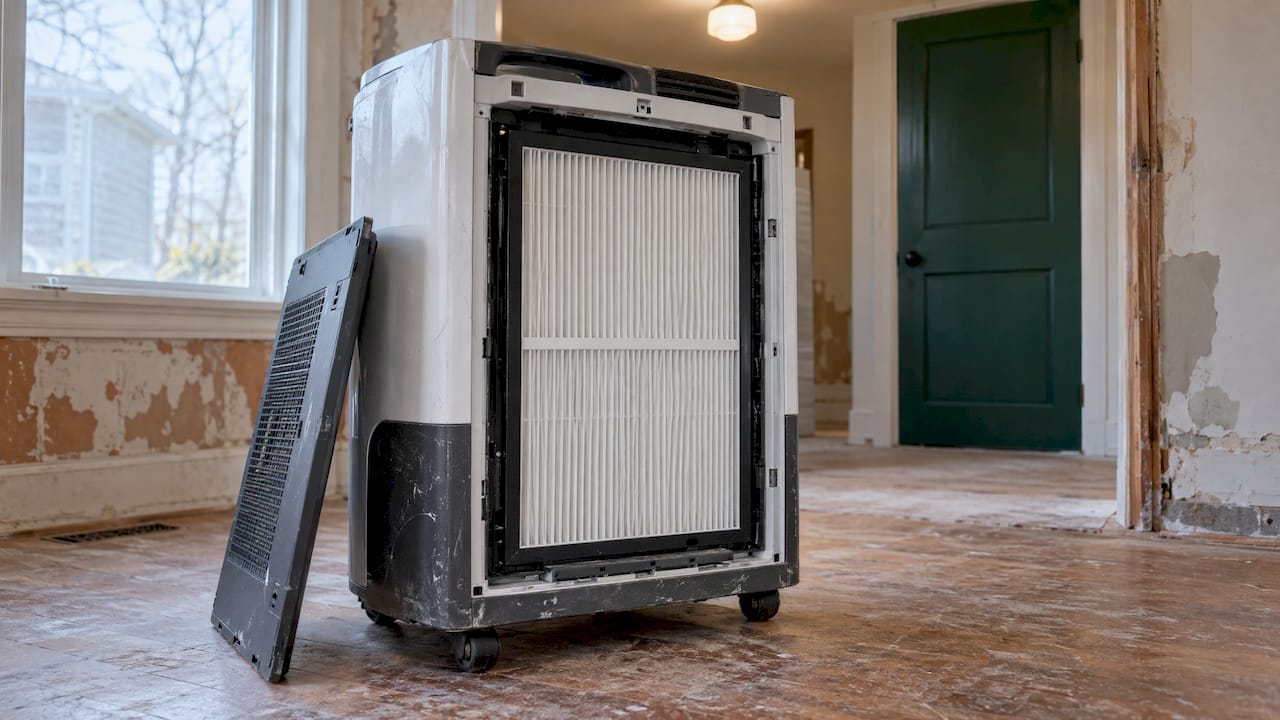
HEPA stands for high-efficiency particulate air. A certified HEPA filter captures at least 99.97% of particles at 0.3 microns under standard test conditions, according to Public Health Ontario. That makes it the standard filter for fine dust, mould spores and other airborne particles. During renovation and abatement it is one part of a larger system of containment, negative pressure and clean-up. If your older Ottawa home may contain asbestos, lead paint or mould, the filter matters, but the planned work zone around it matters just as much. That is the part a licensed abatement contractor, such as our team at HMJ Contracting, takes on.
TL;DR
- A HEPA filter is a pleated mat of fine fibres that traps particles as air is pulled through it. The 99.97% figure is measured at 0.3 microns, the hardest particle size to catch.
- It handles particles such as dust, spores and virus-sized particles. It does not remove gases or odours.
- During renovation and abatement, HEPA filtration works together with barriers, negative air, wet methods and HEPA vacuum clean-up.
- A portable HEPA air cleaner suits everyday indoor air. It is not a substitute for a planned containment setup on a dusty job.
- Suspect asbestos, lead or mould in an older home: get it assessed before anything is disturbed.
Table of Contents
- What a HEPA filter is
- How a HEPA filter traps particles
- What it removes, and what it does not
- HEPA air purifiers for everyday air
- HEPA filtration during renovation and abatement
- Why the filter housing and upkeep matter
- Where this applies to your project
- Our perspective
- What the work costs in Ottawa
- Getting started
- FAQ
- Sources
What a HEPA filter is
A HEPA filter is a mechanical filter. Public Health Ontario describes it as a pleated filter, and it is made of a dense mat of glass or synthetic fibres. Nothing is added to the air and nothing is created. Air is forced through the mat, and the particles stay behind in it.
To carry the name, a filter must meet a tested efficiency. The commonly quoted benchmark is at least 99.97% capture of particles at 0.3 micrometres (a micron is one thousandth of a millimetre; a human hair is roughly 70 microns across). The Institute of Environmental Sciences and Technology maintains a recommended practice for HEPA and ULPA filters used in clean-air devices and in contaminated exhaust systems that need very high particle efficiency.
Why 0.3 microns
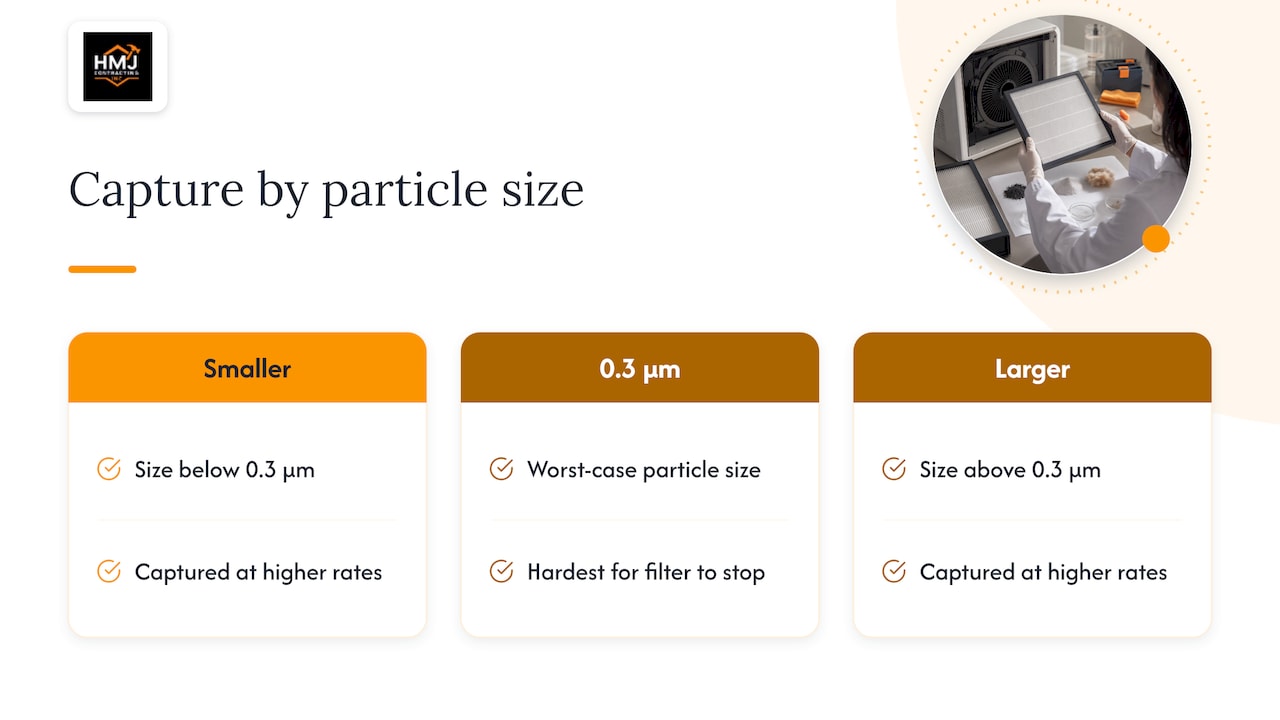
It is easy to read 0.3 microns as the smallest particle a HEPA filter can catch. That is the wrong reading. The US EPA explains that 0.3 microns is the worst-case particle size, the one the filter finds hardest to stop. Larger particles and smaller ones are caught at higher rates.
How a HEPA filter traps particles
A HEPA filter is not a sieve with tiny holes. According to Donaldson’s HEPA filtration facts, particles are captured by four mechanisms as air passes through the media:
- Impaction: larger, heavier particles cannot follow the air as it bends around a fibre and hit it directly.
- Interception: mid-sized particles follow the airstream but brush against a fibre and stick.
- Diffusion: the smallest particles move erratically, collide with fibres and are held.
- Sieving: particles too large to fit between fibres are stopped at the surface.
The same source reports that HEPA filtration removes virus particles. Public Health Ontario also says portable HEPA cleaners can remove virus-sized particles and reduce their concentration in a room over time.
What it removes, and what it does not
HEPA filtration is built for particles: construction dust, drywall dust, pollen, pet dander, mould spores and fine debris. For a homeowner with an older house, those are the contaminants that matter in a renovation, because dust from disturbed material can carry asbestos fibres, lead or spores.
It has limits you should know. The filter works on particles, not gases or odours. Public Health Ontario says a HEPA cleaner should be one layer of protection and not a replacement for ventilation or other measures. And the 99.97% figure describes particles passing through the filter. It is not a promise that a room’s air will be 99.97% cleaner.
Airflow counts as much as the filter
Public Health Ontario notes that a portable cleaner’s performance depends on both its particle-removal efficiency and its airflow. A highly efficient filter moving very little air may have little effect on a room’s particle levels. Its guidance is to choose a unit with a clean-air delivery rate (CADR, a rating of how much filtered air the machine delivers) that suits the room. It also notes that noise at higher airflow can lead people to switch a unit off, so a machine you will actually run is part of the choice.
HEPA air purifiers for everyday air
For day-to-day indoor air, Health Canada’s guidance for indoor air quality professionals lists a suitable portable HEPA air cleaner as one possible measure against indoor particulate matter. It sits alongside reducing the source, controlling dust and adequate ventilation filtration. The same guidance points to HEPA-filter vacuuming rather than sweeping carpets, which only throws fine dust back into the air.
Ventilation is part of the picture too. If you want to see how airflow through a building shell affects what builds up inside, this look at roof ventilation in mountain homes explains the principle, even though the climate differs from Ottawa’s.
HEPA filtration during renovation and abatement
This is where HEPA filtration does its heaviest work, and where a single purifier in the corner of a room is not enough. Renovation and abatement release large amounts of fine dust in a short time. Public Health Ontario treats portable cleaners as a localized, supplementary measure. Renovation or abatement calls instead for a planned work-zone containment and dust-control system, which can include negative pressure, HEPA exhaust and HEPA vacuum clean-up.
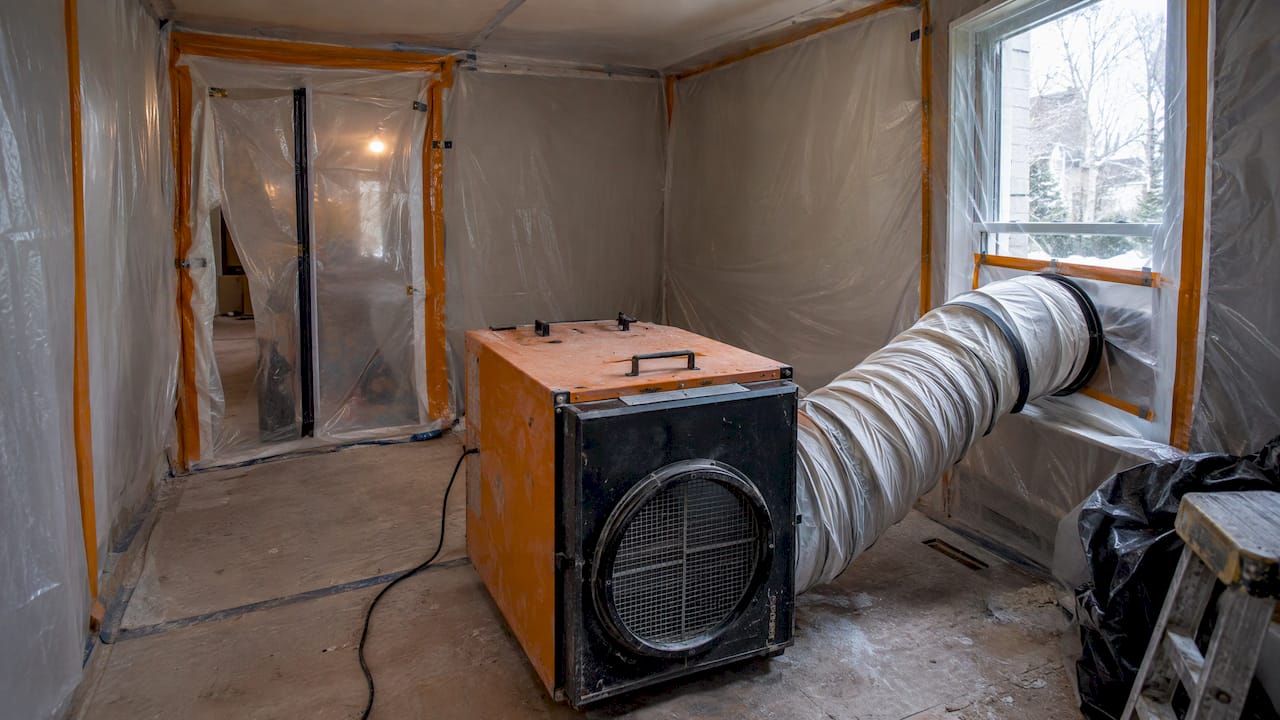
The Canadian Centre for Occupational Health and Safety (CCOHS) says abatement controls vary with the hazard and the risk assessment. They can include isolation barriers, HEPA-filtered exhaust ventilation, wet dust suppression, air monitoring and housekeeping.
The pieces of a controlled work zone
- Isolation barriers. Poly sheeting and sealed openings keep dust inside the work area. Health Canada’s office-building guidance recommends isolating renovation areas and using barriers to keep dust out of air-handling systems. Our guide to preventing cross-contamination during a renovation covers what that means in a house.
- Negative air. CCOHS describes negative-air machines and air scrubbers as filtration devices used inside negative-pressure enclosures. The machine draws air out through a HEPA filter, so air leaks inward through gaps rather than dust leaking outward. We explain the setup in our negative air containment guide and the difference between the two machines in negative air versus a scrubber for Type 3 work.
- Wet methods. Wetting material keeps dust from becoming airborne in the first place, so the filter has less to catch.
- HEPA vacuuming and damp clean-up. The federal asbestos technical guideline specifies HEPA vacuuming, damp-mopping or wet-sweeping for asbestos dust and debris at frequent intervals, at shift end and immediately after work. That guideline covers federal workplaces, and it shows the accepted practice.
- Air monitoring. Measuring the air confirms the work zone did its job. Our article on asbestos air monitoring and the 0.01 f/cc clearance explains how results are read.
What the rules say
The same federal guideline states that air from asbestos-control equipment must not be recirculated into the workplace. It also says some medium-risk and all high-risk activities require HEPA-filtered ventilation inside the enclosure.
Public Services and Procurement Canada’s Asbestos Management Standard shows how much the filter changes the risk category. Power-tool work on non-friable asbestos (material that does not crumble easily) is moderate risk when the tools are attached to HEPA-equipped dust collection. Without it, the listed power-tool work is high risk. The standard also requires suspect material that may be disturbed in renovation to be tested before work, unless earlier comprehensive testing showed it was asbestos-free.
The standard applies to federal properties. For a private Ottawa home, Ontario’s rules apply, and a licensed contractor works to them. One example: Ontario Regulation 833 says a respirator for asbestos protection must use a HEPA filter or specified N100, R100 or P100 particulate filters. The official page records a 2026 amendment, so a licensed contractor works from the current text.
Why the filter housing and upkeep matter
A HEPA filter only performs as rated if the air is forced through it. The Infrastructure Health and Safety Association (IHSA) stresses that bypass leakage or incorrect installation can undermine a filter’s nominal performance. Its guidance includes:
- Follow the manufacturer’s instructions.
- Use certified filters that are correctly fitted and secured.
- Inspect housings for leaks around the filter.
- Replace clogged or damaged filters.
- Handle used filters in a controlled place, with protective equipment and contaminated-waste disposal.
- Never clean a filter with compressed air or by striking it.
The Saskatchewan Asbestos Abatement Manual states that HEPA filters in the applications it describes must have at least 99.97% efficiency. It also recommends a coarse prefilter upstream to extend filter life. The federal guideline adds that, in its covered context, filter effectiveness is assessed after replacement, before high-risk work and at least annually.
How many machines a job needs
CCOHS says a qualified person should assess the work, design the containment, decide how many air-filtration devices are needed and decide whether decontamination showers are required. The number of devices depends on the volume of the treated area and the equipment’s airflow. CCOHS cites five air changes per hour as a NIOSH guideline, and it makes clear this is not a guarantee of completely safe air. This is why a single machine bought at a hardware store does not stand in for a designed setup on an abatement job.
Where this applies to your project
Different jobs bring different dust, and each one calls for a different level of control.
| Situation | Main airborne concern | Role of HEPA filtration |
|---|---|---|
| Vermiculite attic insulation | Possible asbestos fibres | Contained work zone with filtered exhaust and air monitoring |
| Basement or flood-related mould | Spores and damp debris | Containment and filtered air during removal |
| Interior strip-out or demolition | Plaster, drywall and old paint dust | Dust control and filtered clean-up; see demolition dust control |
| Old paint disturbed by sanding or demolition | Lead dust | HEPA vacuuming; see lead dust cleanup |
| Cutting or drilling concrete | Fine silica dust | See concrete dust hazards |
In a building with shared air handling, dust also travels through the ductwork. Our guide to HVAC contamination risk is written for building managers who need to keep it contained.
Our perspective
We work in Ottawa houses and buildings that were built when asbestos, lead paint and vermiculite insulation were ordinary materials. When an owner asks about HEPA filtration, the question behind it is almost always whether the air in their home will be safe once the work starts.
The honest answer is that the filter is a very good component and it is never the whole answer. Its efficiency is measured on the filter. What protects your family is the full plan: what is in the material, how the work area is sealed, how air is moved and filtered, how dust is cleaned up, and how the result is checked. That is why we offer licensed, insured abatement together with air quality testing, permit management, debris hauling and post-job documentation.
Owners also get surprises when abatement is separate from the renovation that follows. We handle abatement, demolition and renovation under one roof, so one team plans the dust control from the first quote to the last day. Our quotes are itemized line by line, and we give estimates within 24 hours, so you see what each stage involves before you sign.
Twenty-five years of local work taught us that most homeowners do not want to learn filtration engineering. They want to know the house is safe and the job is done properly. That is the job we do.
Jason
What the work costs in Ottawa
Because materials and conditions vary, we publish ranges and price firm after an assessment. These are our published ranges:
- Testing and lab analysis: $300 to $600
- Small Type 1 or 2 abatement jobs: $1,500 to $3,500
- Vermiculite attic removal: $5,000 to $15,000
- Small contained mould area: $500 to $1,500
- Single room or bathroom mould remediation: $2,000 to $6,000
- Whole-home or Type 3 abatement, and basement or flood-related mould: priced after assessment
Testing comes first because identifying the material decides how much containment and filtration the work needs.
Getting started
If you own an older Ottawa-area home, or manage a property, and you are planning a renovation or you have found suspect material, we start with an assessment and testing, then give you an itemized quote. Our abatement services page lists the job types and published ranges, and our mould remediation page does the same for mould. If your project includes demolition or a rebuild, the renovations page shows that side of our work.

We hold a 5.0-star Google rating and our estimates come within 24 hours. You can reach us through hmjcontracting.com.
FAQ
What is HEPA filtration in simple terms?
HEPA filtration forces air through a dense, pleated mat of fine fibres that traps particles. A certified filter captures at least 99.97% of particles at 0.3 microns, the size that is hardest to catch. Larger and smaller particles are captured at higher rates.
Does a HEPA air purifier work?
Yes, for particles. Health Canada lists suitable portable HEPA cleaners as one measure for indoor particulate matter. Public Health Ontario advises matching the unit’s clean-air delivery rate to the room, and treating it as one layer alongside ventilation. It does not remove gases or odours.
Is HEPA filtration used during renovation?
Yes. CCOHS lists HEPA-filtered exhaust ventilation among abatement controls, and negative-air machines and air scrubbers as the filtration devices used in negative-pressure enclosures. HEPA vacuums handle clean-up. The set-up is designed around the specific hazard and the size of the area.
Can a HEPA filter make asbestos or mould work safe on its own?
No. The filter is one control among several, including barriers, wet methods, air monitoring and clean-up. CCOHS says a qualified person should assess the work and design the containment. That is the planning we do on our abatement projects in Ottawa.
Sources
- Public Health Ontario: Use of Portable Air Cleaners and Transmission of COVID-19
- US EPA: What is a HEPA filter?
- IEST-RP-CC001: HEPA and ULPA Filters
- Donaldson: HEPA Filtration Facts
- Health Canada: Guidance for Indoor Air Quality Professionals
- Health Canada: Guidance for office buildings
- CCOHS: Abatement of Hazardous Materials
- ESDC: Technical Guideline to Asbestos Exposure Management Programs
- PSPC Standard on Asbestos Management
- Ontario Regulation 833
- IHSA: HEPA filters safety talk
- Saskatchewan Asbestos Abatement Manual
- Roof ventilation in mountain homes