
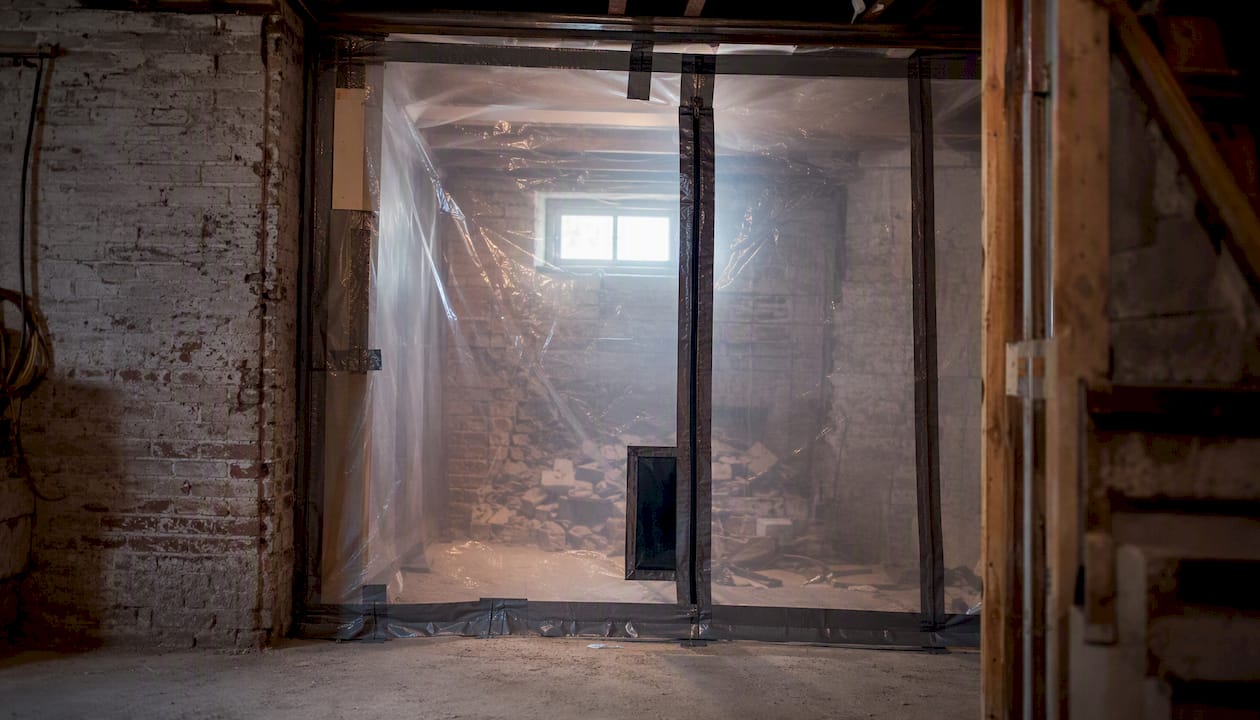
Undiscovered hazardous materials are the single largest avoidable cause of renovation stop-work orders. The fix is straightforward: commission a certified pre-renovation hazardous materials survey at least 4–6 weeks before mobilisation, embed the written report in your tender documents, and schedule abatement as a discrete phase before any intrusive work begins. Skipping these steps does not save time. It trades a predictable two-week abatement window for an unpredictable shutdown that can stretch into months.
Before you tender or mobilise, complete these steps:
- Order a certified pre-renovation hazardous materials survey 4–6 weeks before your scheduled start date to allow lab turnaround and abatement scheduling.
- Include the survey report in all tender documents so contractors price the work accurately from day one.
- Schedule abatement as a standalone pre-mobilisation phase with a 14-day contingency buffer built into the critical path.
- Confirm permit and notification requirements with your provincial authority before any contractor sets foot on site.
Pro Tip: An invasive survey and fixed-price abatement contract typically cost a fraction of what emergency remediation and idle crew fees add up to once work is stopped mid-project.
Key takeaways
Undiscovered hazardous materials cause stop-work orders that add weeks or months to renovation schedules; a certified pre-renovation survey, fixed-price abatement, and clearance documentation before mobilisation are the most reliable way to prevent them.
| Point | Details |
|---|---|
| Survey timing matters | Commission a certified hazardous materials survey 4–6 weeks before mobilisation to allow lab turnaround and abatement scheduling. |
| Legal duties are non-negotiable | Ontario O. Reg. 278/05 and similar provincial rules require owners to provide a written hazardous materials report to all prospective constructors before tendering. |
| Mid-project discovery is costly | A single asbestos find can add 4–10 weeks and significant emergency costs; planned abatement in a defined pre-mobilisation window avoids this outcome. |
| Clearance documentation is required | No trade should re-enter an abated zone without a signed clearance report from an accredited hygienist — make it a contractual requirement. |
| Hmjcontracting integrates both phases | Hmjcontracting handles licensed abatement and full renovation under one agreement, eliminating the 10–14 day hand-off gap between abatement and renovation mobilisation. |
Table of Contents
- How do hazardous materials delay renovation projects?
- Which hazardous materials most often cause renovation delays?
- What are the typical delay lengths and cost impacts you should budget for?
- What are your legal duties as an owner before renovation work begins?
- What does a pre-renovation hazardous materials survey actually involve?
- What does the abatement process look like, and where do delays occur?
- A five-step roadmap to prevent hazardous material delays
- How do you choose a certified abatement contractor?
- What to do when hazardous materials are discovered during active work
- How Hmjcontracting prevents hazardous material delays on Ottawa projects
- The mistake most owners make, and how to stop making it
- Hmjcontracting’s abatement and renovation services for Ottawa property owners
- Sources
How do hazardous materials delay renovation projects?
The mechanism is straightforward, and it repeats on job sites across the country. A contractor cuts into a wall, ceiling, or floor and encounters a material that may be hazardous. Work in the affected area stops immediately. The site manager notifies the owner and the applicable health and safety authority. No other trade can re-enter the zone until testing confirms what the material is and abatement, if required, is completed and cleared.
That sequence alone can cost you two to four weeks. But the downstream effects compound quickly.
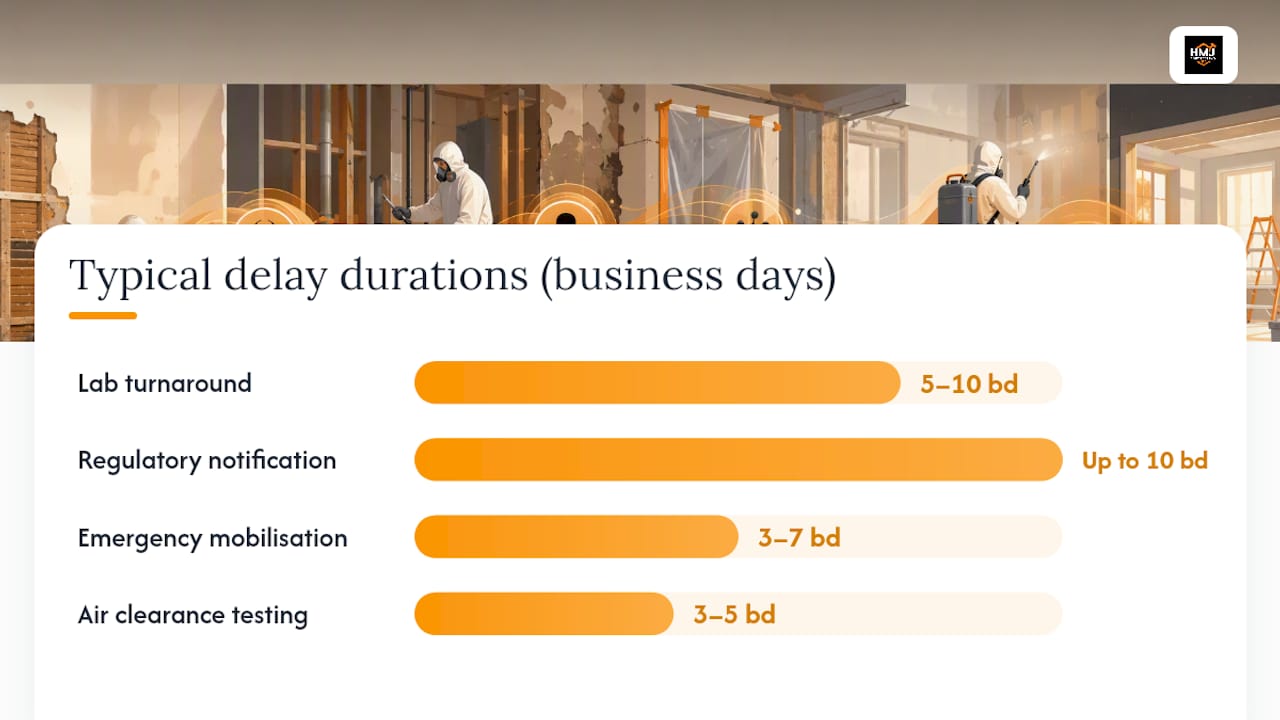
Once a stop-work order is in place, every trade scheduled behind the affected scope loses their window. Electricians, plumbers, and drywall crews who were booked weeks in advance must be rescheduled, often at premium rates. Equipment sitting on site accumulates rental charges. Landfill bookings for hazardous waste require advance notice and may not be available immediately. Lab results for bulk samples typically take 5–10 business days, and air clearance testing after abatement adds another layer before re-entry is permitted.
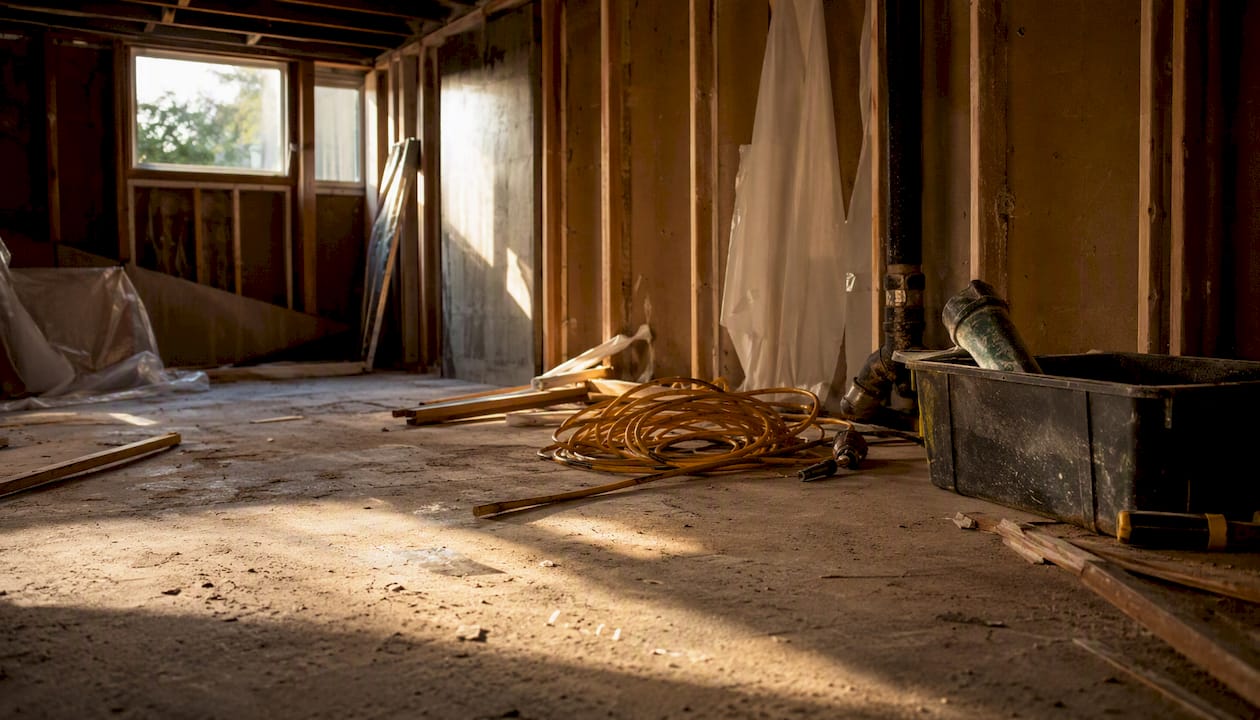
A WorkSafeNB stop-work order that halted renovations at a community centre illustrates the pattern clearly: work resumed only after testing confirmed the material type and regulatory clearance was obtained. The delay was not caused by the asbestos. It was caused by the absence of prior testing.
Common downstream schedule impacts owners see after a mid-project hazardous material discovery:
- Mandatory stop-work in the affected zone, often extending to adjacent areas pending assessment
- 5–10 business day lab turnaround before the material type is confirmed
- Emergency abatement mobilisation at premium rates (often 30–50% above planned abatement costs)
- Mandatory notification windows of up to 10 working days before abatement can begin in some jurisdictions
- Trade remobilisation fees and rescheduling delays of 1–3 weeks
- Failed air clearance tests that restart the clearance clock
The demolition of a Belleville building shows how quickly a single asbestos find can move a projected completion date by months while abatement and reassessment proceed.
Which hazardous materials most often cause renovation delays?
Most renovation delays tied to hazardous materials involve a short list of substances. Knowing which ones to look for, and where, lets you prioritise testing before work begins.
- Asbestos (friable and non-friable): Found in insulation, floor tiles, ceiling tiles, pipe wrap, drywall compound, and roofing materials commonly used in buildings built in previous decades. Friable asbestos — material that crumbles easily — triggers the most stringent abatement requirements and the longest regulatory notification windows.
- Lead paint: Common in many older buildings. Sanding, cutting, or demolishing lead-painted surfaces generates hazardous dust that requires containment, personal protective equipment, and regulated disposal. Renovation work that disturbs lead paint without controls can trigger regulatory orders.
- Mould: Often found behind walls, under flooring, and in attic spaces. Mould remediation requires containment, removal of affected materials, air quality testing, and clearance before re-enclosure. For guidance on mould removal safety practices, homeowners should review established best practices before any work begins.
- PCBs (polychlorinated biphenyls): Present in older electrical equipment, caulking, and some fluorescent light ballasts. PCB-containing materials require specialized disposal under federal regulations, which adds both cost and scheduling complexity.
- Mercury: Found in older thermostats, fluorescent lamps, and some switches. Breakage during demolition triggers an immediate hazmat response.
- Refrigerants: HVAC systems in older buildings may contain regulated refrigerants that must be recovered by a certified technician before equipment is disturbed or removed.
- Silica and regulated dusts: Cutting, grinding, or demolishing concrete, brick, or stone generates respirable crystalline silica. Silica exposure is regulated under occupational health rules and requires dust controls and respiratory protection.
A building’s modern or renovated appearance is not a reliable indicator that these materials are absent. As BC Housing’s builder guidance notes, asbestos and lead persisted in many products across several decades, and renovation layers can conceal original materials beneath newer finishes. Heritage buildings are particularly high-risk: heritage renovation projects commonly uncover asbestos, lead, and mould in unexpected locations during invasive testing. For a practical overview of what to look for, the guide to hidden renovation hazards in older Canadian homes covers the most common concealed materials by building era.
What are the typical delay lengths and cost impacts you should budget for?
Realistic expectations matter when you are building a project schedule. The table below shows common delay scenarios tied to hazardous material discovery and the calendar time each typically adds.
| Delay scenario | Typical calendar impact |
|---|---|
| Lab turnaround for bulk samples | 5–10 business days |
| Mandatory regulatory notification window | Up to 10 working days (jurisdiction-dependent) |
| Emergency abatement mobilisation | 3–7 business days (premium rates apply) |
| Abatement work (small to mid-size scope) | 1–3 weeks |
| Air clearance testing and lab confirmation | 3–5 business days |
| Trade remobilisation after clearance | 1–2 weeks |
| Full abatement + clearance + remobilisation | 4–10 weeks total in moderate cases |
A comprehensive hazardous materials assessment typically takes 10–14 days including on-site sampling and lab analysis, with physical inspection alone running 3–5 business days for many commercial structures. That timeline is why the recommended lead time is 4–6 weeks before mobilisation.
Cost impacts fall into several categories beyond the abatement work itself:
- Emergency abatement premiums (often 30–50% above planned rates)
- Idle crew and equipment costs during the stop-work period
- Trade remobilisation fees and rescheduled booking premiums
- Regulatory permit and notification fees
- Hazardous waste disposal and manifesting charges
- Potential redesign or re-sequencing costs if the abatement scope changes the structural plan
For a detailed look at how these costs accumulate, the guide on avoiding renovation cost overruns covers the financial mechanics that property owners most commonly underestimate.
What are your legal duties as an owner before renovation work begins?
Owner responsibilities under Canadian occupational health and safety legislation are specific and non-negotiable. Ontario’s O. Reg. 278/05 is one of the clearest examples: it requires owners to examine their buildings for asbestos-containing materials before requesting tenders or arranging demolition, alteration, or repair work. The owner must prepare a written report stating whether materials are asbestos-containing, describing their condition and friability, and mapping their location. That report must be provided to every prospective constructor before tendering.
Failing to meet these duties does not just create legal exposure. It creates the conditions for a stop-work order. When a contractor discovers asbestos that the owner’s report did not identify, work stops, regulators are notified, and the owner bears the cost and liability.
The Ontario guide to O. Reg. 278/05 confirms that providing the report to prospective constructors is not optional before tendering in that jurisdiction. Similar requirements exist across other provinces, and the consequences of non-compliance are significant.
WorkSafeBC issued a $624,051 administrative penalty against a hotel after inspectors found asbestos, lead, and mould exposures during a renovation, with failures including no negative-pressure containment and a missing project notice to WorkSafeBC. That penalty reflects what regulators treat as a serious, preventable failure.
Before tendering any renovation, owners should confirm the following:
- A certified hazardous materials survey has been commissioned and the written report is on file
- The report identifies all asbestos-containing materials by location, condition, and friability
- The report has been provided to all prospective constructors as required by applicable regulation
- Permit and notification requirements have been confirmed with the provincial authority
- An abatement budget and contingency have been included in the project estimate
- Clearance criteria (air testing standards, lab certification requirements) are specified in the abatement scope
Numbered pre-tender checklist:
- Commission a certified pre-renovation hazardous materials survey.
- Obtain the written report with material identification, location drawings, and lab certificates.
- Provide the report to all prospective constructors before requesting tenders.
- File for required permits and submit regulatory notifications.
- Include abatement as a priced, scheduled phase in the construction contract.
- Specify clearance testing requirements before re-mobilisation of other trades.
What does a pre-renovation hazardous materials survey actually involve?
A credible pre-renovation survey is not a visual inspection. It is a structured, multi-phase process that produces a documented report owners can rely on in tender packages and regulatory submissions.
The survey typically proceeds in four phases:
- Document review: The assessor reviews building records, previous renovation permits, and any existing hazardous materials reports to identify likely problem areas before site work begins.
- Intrusive sampling: Where finishes, insulation, or building materials may conceal hazardous substances, the assessor takes physical samples. This is the step that distinguishes a reliable survey from a surface-level walkthrough.
- Lab analysis: Samples are submitted to an accredited laboratory. Turnaround typically runs 5–7 business days for standard analysis, which is why the recommended lead time is 4–6 weeks before scheduled mobilisation.
- Report preparation: The assessor compiles findings into a written report that the owner can provide to contractors and regulators.
The report must include specific elements for it to be usable in a tender package:
| Report element | Why it matters |
|---|---|
| Material identification by type | Confirms what substance is present and which regulations apply |
| Friability classification | Determines abatement method and regulatory notification requirements |
| Location drawings or maps | Allows contractors to price and sequence abatement accurately |
| Recommended abatement scope | Gives the owner a basis for fixed-price abatement procurement |
| Chain-of-custody documentation | Confirms lab samples were handled correctly and results are defensible |
| Lab certificates and accreditation | Required for regulatory submissions and clearance documentation |
For practical signs that a survey and possible abatement are needed before you start, the checklist of asbestos removal signs before renovating is a useful starting point for owners assessing their risk.
Pro Tip: Request an invasive survey, not just a visual assessment. A visual-only inspection misses materials concealed beneath finishes and is not sufficient for regulatory compliance in most jurisdictions.
What does the abatement process look like, and where do delays occur?
Abatement follows a defined sequence. Understanding each step helps owners identify where float should be added and where the schedule is most vulnerable.
- Mobilisation and containment setup: The abatement contractor establishes negative-pressure containment around the work zone, installs HEPA filtration, and sets up decontamination facilities. This typically takes 1–2 days for a standard residential or small commercial scope.
- Removal or remediation: Hazardous materials are removed or encapsulated according to the approved abatement plan. Duration depends on the volume and type of material: a small asbestos floor tile removal may take one day; a full mechanical room insulation removal may take 1–2 weeks.
- On-site air monitoring: A third-party hygienist conducts air monitoring during removal to confirm containment is working. Readings outside acceptable limits require work to stop and containment to be re-established.
- Waste handling and disposal: Hazardous waste is packaged, manifested, and transported to a licensed disposal facility. Landfill acceptance windows are not always immediate, and some facilities require advance booking.
- Final clearance testing: After removal, a clearance air sample is collected and submitted to an accredited lab. Results typically take 3–5 business days. A failed clearance test restarts this step.
- Clearance documentation: The hygienist issues a written clearance report confirming the zone meets re-entry standards. This document is required before other trades can re-enter.
Delays most commonly arise at three points:
- Mobilisation availability: Certified abatement contractors with the right equipment are not always available on short notice. Emergency mobilisation carries premium fees.
- Landfill acceptance: Some hazardous waste facilities require advance booking or have restricted acceptance windows for certain materials.
- Failed clearance tests: A single failed air clearance test adds 3–5 business days minimum and may require additional removal work before re-testing.
Building a 5–7 day float around the clearance testing phase is standard practice for owners who want to protect the rest of the project schedule.
A five-step roadmap to prevent hazardous material delays
Property owners and managers who follow this sequence before mobilisation avoid the majority of hazardous material-related schedule disruptions.
- Commission a certified pre-renovation survey during the design phase. Do not wait until tender. Ordering the survey during design gives you time to incorporate abatement costs and scheduling into the base contract, not as a change order.
- Embed the hazardous materials report in all tender documents. Every contractor pricing the work should see the report before submitting a bid. This eliminates the “we didn’t know” conversation mid-project and ensures abatement is priced into the contract.
- Procure fixed-price abatement before any intrusive renovation work begins. A fixed-price abatement contract, scoped from the survey report, protects you from emergency pricing and gives the project schedule a defined abatement window.
- File regulatory notifications and build a 14-day float into the critical path. Notification windows of up to 10 working days are required in many jurisdictions before abatement can begin. Build that window into the schedule before mobilisation, not after a discovery.
- Require written clearance reports before re-mobilising other trades. No trade should re-enter an abated zone without a signed clearance report from an accredited hygienist. Make this a contractual requirement, not an informal agreement.
Pro Tip: Contracting an integrated abatement and renovation package with a single provider eliminates the hand-off gap that typically causes a 10–14 day idle period between abatement completion and renovation mobilisation. Industry guidance identifies this gap as one of the most common and preventable sources of schedule overrun.
A contingency budget of 10–15% of the total project cost is a reasonable baseline for projects in buildings constructed before 1990. For heritage properties or buildings with known renovation layers, 15–20% is more appropriate.
How do you choose a certified abatement contractor?
The right abatement contractor keeps your project on schedule and your regulatory exposure to a minimum. The wrong one creates the delays you were trying to avoid.
Trust signals to verify before signing a contract:
- Valid provincial abatement licence and any required trade certifications
- General liability insurance and workers’ compensation coverage, confirmed in writing
- In-house or contracted air monitoring and clearance testing capacity
- Documented safety plan and site-specific hazard assessment process
- References from comparable projects, with contact details you can actually call
- Itemized, written abatement scope tied directly to the survey report
Questions to ask during pre-qualification:
- What licences and certifications does your team hold, and can you provide copies?
- How do you conduct air monitoring during removal, and who performs clearance testing?
- What is your landfill disposal plan, and which facilities do you use?
- What are your emergency mobilisation terms and lead times?
- Can you provide an itemized abatement quote broken down by material type and location?
- Can you provide references from projects where you managed both abatement and renovation?
For mould-specific projects, the checklist of questions to ask a mould removal company covers additional due diligence points worth reviewing before hiring.
Red flags that predict delay risk:
- No written abatement scope or a scope that does not reference the survey report
- Vague or verbal clearance criteria (“we’ll let you know when it’s clean”)
- Unwillingness to provide references or licence documentation
- No mention of third-party air monitoring or clearance testing
- A quote that is significantly lower than others without a clear explanation
What to do when hazardous materials are discovered during active work
Even with a thorough pre-renovation survey, unexpected discoveries happen. The response in the first hour determines how much of the schedule you recover.
- Stop work in the affected area immediately. Do not attempt to contain or remove the material without a certified abatement contractor. Disturbing it further increases exposure risk and regulatory liability.
- Isolate and secure the zone. Restrict access to the area and post clear signage. Other trades must not re-enter until testing confirms the material type and clearance is granted.
- Notify the owner, health and safety representative, and applicable regulatory authority. Notification requirements vary by jurisdiction and material type. Document the time and method of every notification.
- Commission emergency testing. Contact an accredited hygienist to collect samples and submit them for expedited lab analysis. Confirm the lab’s turnaround time before submitting.
- Engage your abatement contractor for interim containment. While lab results are pending, a certified contractor can establish temporary containment to prevent spread to adjacent areas and protect other trades.
- Revise the critical-path schedule. Once the material type is confirmed, update the project schedule to reflect the abatement window, clearance testing period, and trade remobilisation timeline. Communicate the revised schedule to all affected parties in writing.
Pro Tip: Designate a single point of contact to coordinate between the abatement contractor, demolition crew, and other trades during the recovery phase. Fragmented communication is the most common reason a manageable delay becomes a prolonged one.
Transparent recordkeeping from the moment of discovery protects you in permit submissions, insurance claims, and any subsequent regulatory review. Keep copies of all notifications, lab reports, clearance certificates, and revised schedules in a single project file.
How Hmjcontracting prevents hazardous material delays on Ottawa projects
Hmjcontracting operates an integrated service model that addresses the most common source of renovation schedule overruns: the gap between abatement completion and renovation mobilisation. Rather than treating abatement and renovation as separate contracts managed by separate teams, Hmjcontracting handles pre-renovation assessment, licensed abatement, air clearance testing, permit management, and full renovation work under a single agreement. That structure eliminates the coordination delays that typically add 10–14 idle days between abatement and the start of renovation.
The practical proof points:
- Licensed abatement services covering asbestos, lead, and mould, with transparent, itemized quotes tied directly to the survey findings
- Air quality testing and clearance documentation provided as part of the abatement scope, not as a separate engagement
- Permit and notification management handled by the Hmjcontracting team, reducing the administrative burden on owners
- A 5.0-star Google rating reflecting consistent, documented delivery across hundreds of Ottawa projects
- Published resources and blog guidance that help owners understand their regulatory obligations before work begins
For owners managing heritage properties or buildings with multiple renovation layers, Hmjcontracting’s approach of completing a thorough pre-renovation assessment before any intrusive work begins has consistently prevented the multi-week shutdowns that mid-project discoveries cause. The combination of licensed abatement capacity and full renovation follow-through means the project does not stall between phases.
The mistake most owners make, and how to stop making it
The most common mistake is treating the pre-renovation survey as optional. Owners see it as an added cost at the front of the project and skip it to save time. What they get instead is a stop-work order at the worst possible moment, usually when multiple trades are on site and the schedule has no room to absorb a two-week shutdown.
The second most common mistake is setting a contingency budget that reflects optimism rather than the building’s actual age and history. A 5% contingency on a pre-1980 building is not a contingency. It is a placeholder that disappears the moment the first unexpected material is found.
The cultural shift that actually prevents delays is simple: treat abatement as a scheduled project phase, not a reactive crisis. When abatement is planned, priced, and sequenced before intrusive work begins, it takes roughly the same amount of time as emergency abatement. The difference is that planned abatement does not stop the rest of the project. It runs in a defined window, clears on schedule, and hands off to the renovation crew without idle time.
Owners who have been through a mid-project discovery once almost always commission a pre-renovation survey on every subsequent project. The lesson is not complicated. The cost of prevention is predictable. The cost of discovery is not.
Hmjcontracting’s abatement and renovation services for Ottawa property owners
Hmjcontracting offers Ottawa property owners a direct path from pre-renovation survey to project completion, with licensed abatement, air clearance testing, and full renovation services managed by a single experienced team.

The services most relevant to owners managing hazardous material risk include licensed asbestos, lead, and mould abatement; air quality testing and clearance documentation; permit and regulatory notification management; debris hauling and hazardous waste disposal; and full residential and commercial renovation follow-through. Every abatement project begins with a transparent, itemized quote tied to the survey findings, so there are no surprises when work begins.
For Ottawa property owners who want a certified team to handle the survey, abatement, and renovation under one agreement, HMJ’s licensed abatement services are the starting point. Contact Hmjcontracting for a free estimate and find out how the integrated approach keeps your project on schedule from the first assessment to the final walkthrough.
Sources
The following primary sources and guidance documents support the regulatory and technical claims in this article. Owners should keep copies of any clearance lab reports, permit receipts, and notification confirmations as part of their permanent project records.
- Ontario
- Avoiding Project Delays Due to Hazardous Materials: A 2026 Management Guide – TSIAC International
- Reborn heritage buildings contain deadly hazardous materials
- Demolition delayed by asbestos discovery in Belleville project
- Asbestos testing halts Lakeland Ridges municipal office relocation
This article is general information, not a substitute for advice from a qualified lawyer. Consult a qualified legal professional about your own circumstances before acting on anything here.