
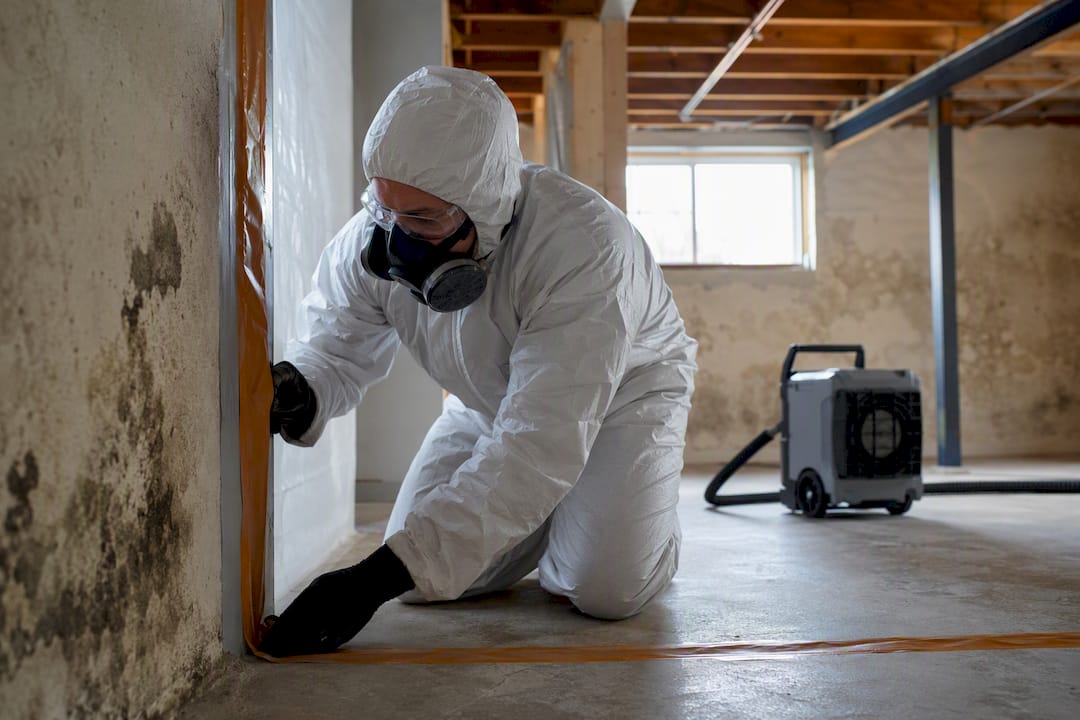
Mold remediation is a full, safety-driven process that fixes the moisture cause and restores safe mould levels; “mold removal” usually means visible cleaning alone. If the patch is smaller than a piece of paper and the cause is obvious, cleaning may be enough. Anything bigger, hidden, or recurring calls for remediation, and often a licensed contractor.
TL;DR:
- Hiring a professional ensures mold remediation includes moisture source detection, containment, proper disposal, and verification, reducing the risk of mold returning.
- Visual inspection and moisture fixing are preferred over routine air testing unless there is a legal or insurance requirement, as testing adds little to direct work.
- Small mold patches under one square meter may be manageable for homeowners, but larger or hidden problems require trained crews and proper safety procedures.
- Skipping the moisture source check before demolition often results in recurring mold issues, making comprehensive assessment essential.
- DIY cleanup is cost-effective only for very small, obvious patches; larger issues typically lead to higher costs if unfinished or improperly handled.
Table of Contents
- Mold remediation vs removal: what “removal” actually means
- What is mold remediation, step by step?
- Do you need mold testing before remediation?
- Should you DIY it or call a professional?
- How does HMJ Contracting handle certified abatement?
- What legal and insurance issues come with mold damage?
- How long does mold remediation actually take?
- Why does mold exposure actually matter for your health?
- Is DIY mold cleanup actually cheaper than hiring a pro?
- What conventional mold advice gets wrong
- Ready for an estimate? Here’s what to expect from HMJ
- Sources
Mold remediation vs removal: what “removal” actually means
When most homeowners say “mold removal,” they mean wiping down a visible patch on drywall or grout until it disappears. That’s cleaning, and it has real limits. Mould spores exist in outdoor and indoor air everywhere, all the time, so no contractor can promise a spore-free home. Any company that guarantees “complete removal” or “100% mould-free” is making a claim that doesn’t hold up against basic microbiology.
Removal on its own also skips the reason mould showed up in the first place. Scrub a bathroom ceiling clean, leave the leaky exhaust fan unfixed, and the stain returns within weeks. That is the core weakness of treating mould as a surface problem instead of a moisture problem.
Watch for these red flags when a company pitches “removal” instead of remediation:
- Absolute guarantees (“we eliminate all mould” or “spore-free certified”)
- No mention of containment, plastic sheeting, or negative air pressure
- A quote that skips inspecting for the moisture source
- Advice to simply paint over affected drywall instead of removing it
What is mold remediation, step by step?
Remediation treats mould as a symptom of a moisture problem, not an isolated stain. The process laid out by Health Canada’s guidance for indoor air quality professionals moves through distinct phases, and skipping any one of them is usually why mould comes back.
- Assessment. A technician identifies the extent of the growth and, critically, the moisture source behind it. Professional crews often use moisture meters and thermal imaging to find hidden leaks inside walls before any demolition starts, since a missed leak is the most common reason remediation fails.
- Containment. Plastic sheeting seals off the work area to stop spores from travelling through the rest of the house or the HVAC system.
- HEPA filtration and negative air pressure. Air scrubbers pull contaminated air through HEPA filters while negative pressure keeps spores from drifting into clean zones.
- Removal or replacement of damaged materials. Porous materials like drywall, insulation, and carpet are usually discarded rather than cleaned, per BNQ 3009-600, while non-porous surfaces like tile or metal framing can often be cleaned and kept.
- Cleaning. Remaining surfaces get scrubbed with detergent and HEPA-vacuumed.
- Drying. Industrial dehumidifiers and air movers bring moisture levels back down before anything gets closed up again.
- Verification. A final walkthrough confirms no visible mould, no odour, and a fixed moisture source.
The scope of that process scales with the size of the job. Small, isolated patches need less containment than a mould problem spreading behind a shower wall or into HVAC ductwork, and EPA guidance treats these as genuinely different scopes of work, not the same job done bigger.
Pro Tip: If a contractor skips straight to demolition without checking for the moisture source first, ask where it came from. If they can’t answer, they’re removing mould, not remediating it.
Do you need mold testing before remediation?
Usually not. Health Canada’s guidance treats routine air sampling as a lower priority than a visual inspection and a moisture-source fix. Sampling adds cost and time without changing the actual work: if you can see or smell mould, you already know it needs to be addressed.
That guidance extends to cleaning products, too. Chlorine bleach is widely used but generally discouraged on porous materials, according to the Canadian Centre for Occupational Health and Safety. Bleach can’t penetrate drywall or wood the way mould’s roots do, and it adds moisture and fumes without solving the underlying contamination. Detergent-based cleaning combined with HEPA vacuuming is the safer, more effective standard.
Lab identification and specialist air testing still have a place:
- Medico-legal disputes, such as a landlord-tenant disagreement over exposure
- Insurance claims requiring documented proof of contamination type or extent
- Cases where the mould source genuinely can’t be located through visual inspection alone
Outside those situations, the money is usually better spent fixing the leak than testing the air around it.
Should you DIY it or call a professional?
Size is the clearest signal. Guidance aligned with Health Canada and CCOHS breaks remediation into rough tiers: small patches under roughly 1 square metre, medium areas between 1 and 3 square metres, and large contamination beyond that. A homeowner cleaning a small, isolated patch on a bathroom tile can typically manage with an N95 respirator, gloves, and detergent. Medium and large jobs need higher-grade PPE, containment, and usually a trained crew.
Certain conditions push any job into professional territory regardless of size:
- The mould involves HVAC ductwork or has spread behind walls.
- The moisture source is sewage or contaminated water, not clean water.
- Someone in the household has asthma, a compromised immune system, or is very young or elderly.
- Mould has returned after a previous cleaning attempt, which usually means the moisture source was never actually fixed.
Before hiring anyone, ask these questions:
- Do you set up containment and negative air pressure for this size of job?
- What PPE does your crew wear, and does it change based on contamination level?
- How do you find the moisture source before starting demolition?
- What does your final walkthrough or verification look like?
- Are you licensed and insured for abatement work in this province?
A contractor who answers all five clearly is remediating. One who dodges the moisture-source question is probably just removing.
How does HMJ Contracting handle certified abatement?
Hmjcontracting builds every mould job around the same sequence outlined above: assessment, containment, HEPA filtration, and full documentation from start to finish. That structure isn’t optional add-on service. It’s the baseline for any project the company takes on in Ottawa’s older housing stock, where hidden moisture damage behind original plaster and masonry is common.
Verification happens before a job is called finished. Crews perform a post-remediation inspection against a “white-glove” cleanliness standard and provide a written report homeowners can keep for their own records or hand to an insurer.
What that looks like in practice:
- A documented moisture-source investigation before any demolition begins
- Sealed containment with negative air pressure on medium and large jobs
- Written, itemized reporting instead of a verbal “all clear”
- Licensed, insured crews working to compliance standards rather than a generic cleaning checklist
That combination of documentation and verification is what separates a remediation contractor from someone offering a quick surface clean.
What legal and insurance issues come with mold damage?
Insurance coverage for mould damage depends heavily on cause. Most homeowner policies cover mould that results from a sudden, accidental event, like a burst pipe, but exclude damage from long-term neglect, such as an ongoing roof leak nobody addressed for a year. That distinction is why documentation matters from the first sign of a problem, not after a claim gets denied.
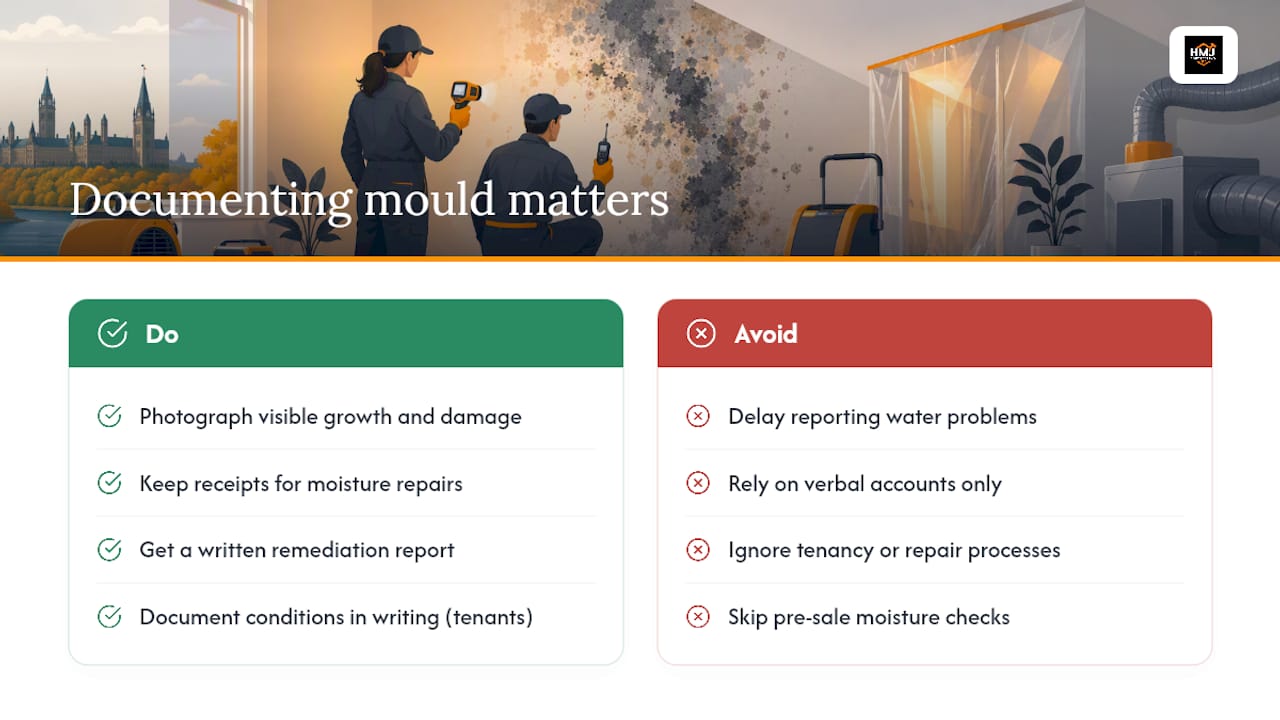
Photograph visible growth and water damage as soon as you spot it, and keep receipts for any moisture-related repairs, even small ones. A written remediation report from a licensed contractor, the kind that includes before-and-after documentation and a description of the moisture source, gives an insurer something concrete to evaluate rather than a verbal account.
Landlords carry additional exposure. Provincial and municipal property standards generally require rental units to be free of conditions that threaten tenant health, and mould from a landlord-neglected leak can trigger repair orders or liability claims. Tenants dealing with unaddressed mould should document conditions in writing and understand their local tenancy board’s process, since remedies vary by province.
Real estate transactions raise a separate issue: undisclosed mould damage discovered after a sale can lead to disputes over what the seller knew and didn’t disclose. A pre-sale inspection that includes a moisture check is cheap insurance against that kind of dispute showing up months later.
None of this replaces legal advice for a specific dispute, but the pattern is consistent: the better documented the moisture problem and its fix, the stronger your position with an insurer, a landlord, a tenant, or a buyer.
How long does mold remediation actually take?
A small DIY cleanup, one bathroom corner or a windowsill, can be done in an afternoon: identify the moisture source, clean with detergent, dry the area, and monitor for a week or two to confirm it doesn’t return.
Professional remediation runs longer because the process has more steps and each one needs to be done properly. A typical timeline looks like this:
- Assessment and quote: usually 1 to 3 days from initial call to a written estimate
- Containment setup: a few hours to a full day, depending on the area affected
- Removal and cleaning: 1 to 5 days for medium jobs, longer for large or HVAC-related contamination
- Drying: often the longest single phase, sometimes 3 to 7 days with industrial dehumidifiers running continuously
- Verification and final walkthrough: typically same-day once drying is confirmed complete
A moderate basement remediation, say a finished wall affected by a slow foundation leak, commonly takes one to two weeks from first inspection to final sign-off. Larger jobs involving structural materials or HVAC contamination can stretch to three or four weeks, particularly if permits or structural repairs are part of the scope. Rushing the drying phase is the most common way homeowners end up calling a contractor back a month later.
Why does mold exposure actually matter for your health?
Mould exposure symptoms range from mild to genuinely serious, which is part of why “just paint over it” is bad advice. Common reactions include nasal congestion, throat irritation, coughing, and skin irritation from direct contact with contaminated surfaces.
People with asthma or existing respiratory conditions face a sharper risk. Mould exposure can trigger asthma attacks or worsen chronic respiratory symptoms, and reactions tend to escalate the longer exposure continues. Children, older adults, and anyone immunocompromised are more vulnerable to complications from prolonged exposure than a generally healthy adult.
The tricky part is that symptoms are often mistaken for seasonal allergies or a lingering cold, especially when the mould source is hidden behind a wall or under flooring where nobody’s looking for it. A household that keeps cycling through unexplained congestion or coughing every winter, especially in rooms with humidity problems, has reason to check for hidden growth rather than assuming it’s just allergy season again.
This health dimension is exactly why remediation’s moisture-first approach matters more than a quick wipe-down. Fixing the cause stops ongoing exposure; cleaning the surface without fixing the leak just resets the clock until symptoms return.
Is DIY mold cleanup actually cheaper than hiring a pro?
On paper, DIY looks like the budget option: a respirator, gloves, detergent, and a weekend nets you a clean bathroom corner for the cost of supplies. For a genuinely small, isolated patch with an obvious, fixable cause, that math holds up fine.
The comparison shifts once the job is bigger than it first appears, which happens more often than homeowners expect. A stain on drywall that looks contained can extend inside the wall cavity, meaning a DIY wipe-down treats a fraction of the actual contamination while leaving the rest to keep spreading. Professional remediation costs more upfront specifically because it includes the assessment work, containment, and material disposal that a DIY clean skips entirely.
The real cost comparison isn’t remediation versus removal. It’s paying once for a properly diagnosed and contained job versus paying for a DIY clean now and a full remediation later once the mould returns with the wall cavity, subfloor, or HVAC system involved. Homeowners who’ve been through a repeat mould problem consistently describe the second contractor bill as far more painful than if they’d called a professional the first time.
Getting an itemized quote before work starts is the best protection either way. A detailed breakdown showing containment, material replacement, and labour separately lets you see exactly what you’re paying for and compare it against a competing bid on equal terms.
What conventional mold advice gets wrong
Most homeowner advice on mould treats it as a cleaning problem: kill it, wipe it, move on. That framing is backwards. Mould is a moisture problem that happens to show up as a visible cleaning problem, and treating the symptom while ignoring the cause is exactly why so many homeowners fight the same stain twice.
The conventional wisdom that testing is always a smart first step also deserves pushback. It sounds cautious and thorough, but Health Canada’s own guidance puts moisture correction ahead of sampling for a reason: a lab report doesn’t fix a leaky pipe, and most homeowners don’t need a certificate to know they have a problem. Save that money for the actual fix.
If there’s one thing worth prioritizing above all else, it’s finding the moisture source before touching anything else. A contractor who leads with that question, rather than a quote for demolition, is the one worth hiring. That’s the standard I’d hold any remediation company to, including the one this site is published by.
— Jason
Ready for an estimate? Here’s what to expect from HMJ
Hmjcontracting is the alternative to guessing your way through a mould problem: a licensed crew that investigates the moisture source first, documents every step, and hands you a written report instead of a verbal “it’s fine now.” For Ottawa homeowners dealing with older housing stock where hidden leaks are common, that documentation is worth more than a quick, unverified wipe-down.

A typical estimate starts with a visit to inspect the affected area and check for the moisture source behind it, not just the visible patch. Before that visit, it helps to have a few things ready: photos of when the mould first appeared, a rough timeline of any leaks or water events, and clear access to the affected area, whether that’s a basement, bathroom, or attic space.
From there, you’ll get an itemized quote covering containment, removal, and material replacement so there are no surprises once work begins. If you’re seeing recurring mould, water stains, or a musty smell that won’t quit, get in touch through HMJ Contracting’s mould remediation service page to book an assessment.
This article is general information, not a substitute for advice from a qualified doctor. Consult a qualified healthcare professional about your own circumstances before acting on anything here.
Sources
- Guidance for indoor air quality professionals - Health Canada
- CCOHS: Indoor air quality - moulds and fungi
- Mold contamination of residential buildings — BNQ 3009-600
- Mold remediation in schools and commercial buildings guide — US EPA