
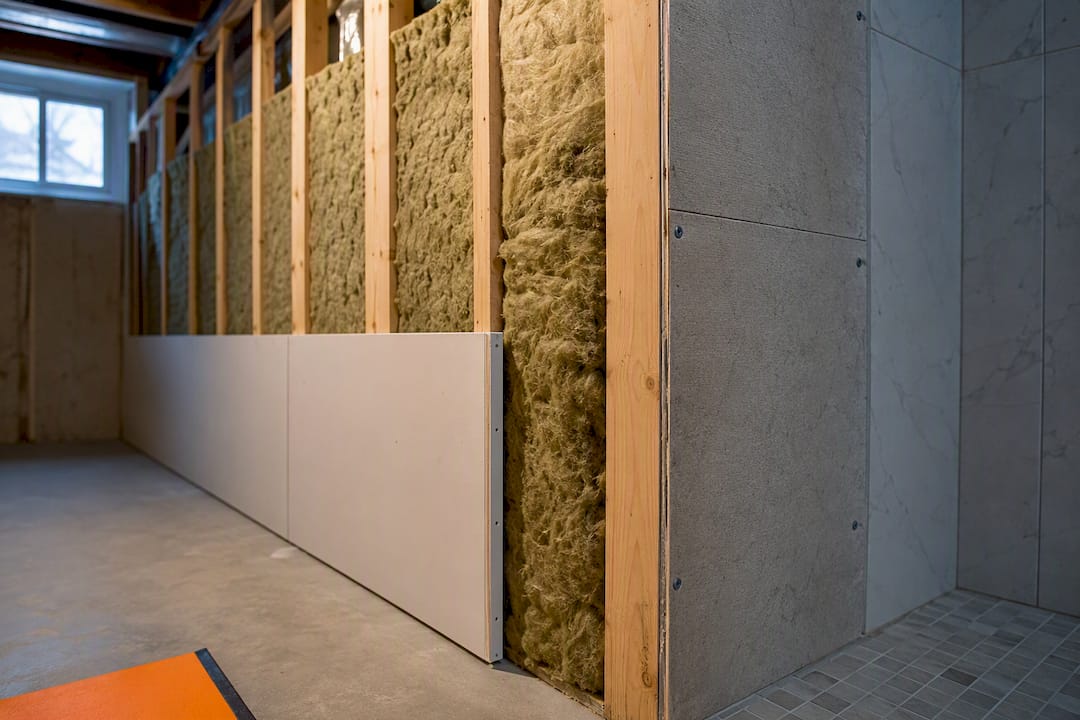
No material on the market is mould-proof, so the real strategy pairs moisture control with materials built to tolerate incidental water and dry out fast. Prioritise mould-resistant gypsum or cementitious boards in wet zones, non-organic insulation like mineral wool, moisture-tolerant flooring, and low-VOC mould-resistant finishes applied only after a surface is clean and dry. The rest of this guide walks through category picks, room-by-room assemblies, and when the job needs a licensed abatement contractor instead of a weekend renovation.
TL;DR:
- Choosing moisture-tolerant assemblies and proper drying methods is more effective at preventing mold recurrence than relying solely on mold-resistant materials.
- Proper ventilation, vapour barrier placement, and assembly permeance ratings play a critical role in allowing structures to dry and prevent mold growth over time.
- Premium mold-resistant boards are most cost-effective and beneficial in high-moisture areas like bathrooms, basements, and laundry zones, not in dry spaces.
- Inspection and maintenance of ventilation systems, sealant joints, and vapour barriers are vital for long-term mold prevention after installation.
- Professional assessment and abatement are necessary for any significant mold presence or suspected hidden contamination before starting renovation work.
Table of Contents
- Why material choice matters after remediation and in renovations
- The best mould-resistant materials, category by category
- Room-by-room material choices that actually hold up
- Spending smartly: where mould-resistant upgrades actually pay off
- When the job needs a licensed abatement contractor
- Cost and availability of mould-resistant materials
- Standards and building-code considerations you should know
- Keeping mould resistance working over the long term
- What years of rebuild work actually teaches you
- Get a certified assessment before you buy a single board
- Sources
Why material choice matters after remediation and in renovations
Mould needs three things to establish itself: moisture, an organic food source, and time. Drywall paper, wood sheathing, and carpet backing all qualify as food. Take away any one of those three and growth stops. That is the entire logic behind mould-resistant renovation materials: they either remove the food source (inorganic cores), shed water faster than organic boards do, or both.
Time matters more than most homeowners realize. Mould can begin colonizing a wet organic substrate within 24 to 72 hours, and drying the material within the first 24 to 48 hours usually prevents growth from starting at all. That window is why the drying step almost always outweighs the product choice on the invoice.
It also helps to separate two jobs that get lumped together on a renovation quote. Water mitigation, defined under IICRC S500, is extraction and drying. Mould remediation, defined under IICRC S520, is the separate scope of physically removing colonized material, containing the work area, and confirming clearance afterward. Rebuild material choices only enter the picture once remediation is finished and the space has passed clearance. Choosing the wrong materials at that stage, or rushing the rebuild before the structure is genuinely dry, is how homeowners end up paying for the same repair twice.
Assemblies that allow ongoing drying reduce recurrence risk more reliably than any single “resistant” product. A wall that can release trapped vapour through a properly placed, code-compliant vapour barrier behaves differently over five years than one sealed with the wrong permeance rating in the wrong spot. Building-code guidance on vapour permeance and material placement exists precisely because a wall that cannot dry will eventually grow something, regardless of what brand of board is behind the drywall.
What “drying potential” means in practice:
- Assemblies with permeable interior finishes let residual moisture escape rather than get trapped between layers.
- Insulation placement relative to the vapour barrier determines whether condensation forms inside the wall cavity.
- Ventilation rate in a room determines how fast surface moisture from showers or cooking actually leaves the space.
- Flooring underlayment choice affects whether a slab or subfloor can wick and release moisture without trapping it under an impermeable layer.
The best mould-resistant materials, category by category
Every category below trades off differently between cost, moisture tolerance, and how forgiving it is of installation mistakes.
Moisture and mould resistant gypsum panels
This is the workhorse category for most renovation budgets. Panels like CGC Sheetrock Brand UltraLight Mold Tough panels use a treated core and facing designed to resist water absorption, with manufacturer data reporting average water absorption at or below 5% by weight after a two-hour immersion test. CGC also makes a Firecode X Mold Tough panel that adds a fire-resistance rating to the same moisture-resistant core, which matters in basements or laundry rooms where code may require fire-rated assemblies near mechanical equipment. CertainTeed’s M2Tech drywall is a comparable Canadian-market option, built to score well under ASTM D3273 mould-resistance testing while targeting the same moisture-prone applications.
The important caveat, straight from the manufacturer: these panels resist moisture better than standard drywall, but they are not designed to sit in standing water or behind a leaking pipe indefinitely. Treat “mould tough” as “more forgiving of a splash or a humid room,” not “immune to a plumbing failure.”
Cementitious and magnesium oxide boards
Cement board and MgO board contain no organic paper facing at all, which makes them the right substrate behind tile in showers, tub surrounds, and steam rooms. They cost more than mould-resistant gypsum and are heavier to handle, but they tolerate direct, repeated water contact in a way gypsum boards, treated or not, were never built for. Use them wherever tile meets water directly; use treated gypsum where the wall is merely in a humid room but not in the splash zone.
Insulation that will not become the problem
Mineral wool (rock wool) is inorganic, does not wick water the way fiberglass batts can, and dries without losing its insulating value if it does get damp. Closed-cell spray foam resists moisture intrusion effectively but is harder to remove cleanly if a future leak requires demolition, since it bonds to framing. For basements and below-grade walls, mineral wool’s combination of moisture tolerance and removability usually wins on long-term practicality.
Flooring for wet-prone zones
Tile over a cementitious substrate remains the most water-tolerant flooring option available. Sealed vinyl plank is a reasonable mid-cost alternative if every seam and edge is properly sealed, since water travels sideways under flooring far more than people expect. Polished or densified concrete works well in basements and utility spaces where a hard, monolithic surface with no seams at all removes the weak points other flooring types depend on.
Finishes, sealants, and getting the order right
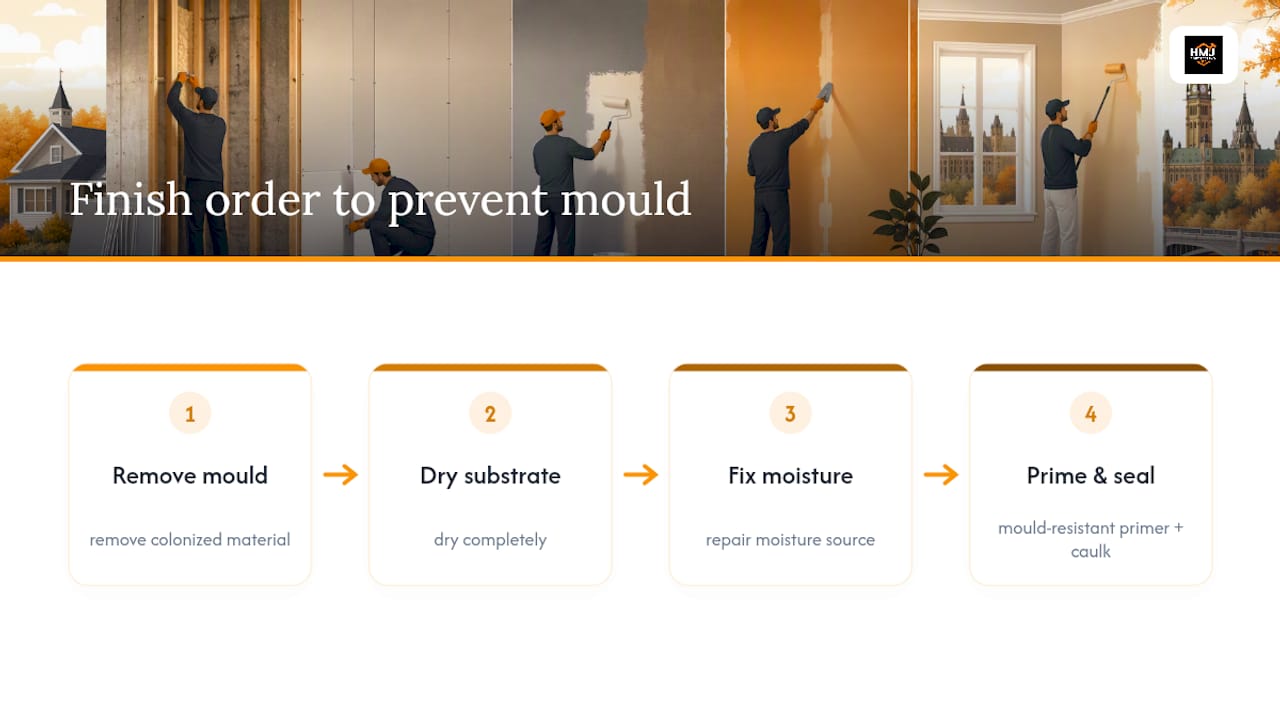
This is where most renovation mistakes happen, and public-health guidance is blunt about it: painting or caulking directly over existing mould does nothing to stop it, because you are sealing the food source in place rather than removing it. The CDC’s mould cleanup guidance and Health Canada’s own guidance on preventing mould both stress the same sequence: remove the mould, dry the substrate completely, fix whatever caused the moisture, and only then apply a mould-resistant primer followed by a compatible caulk or sealant. Skipping the drying step and going straight to primer is the single most common shortcut that brings mould back within a year.
Pro Tip: Store mould-resistant boards flat, off the slab, and under cover until installation day. A pallet of “resistant” drywall left outside in the rain before it even goes up defeats the entire purpose of buying it.
Room-by-room material choices that actually hold up
-
Bathrooms. Use cement board or MgO board directly behind tile in the tub or shower surround, and reserve treated mould-resistant gypsum for the rest of the bathroom walls and ceiling. Pair either with a proper waterproofing membrane behind the tile, not caulk alone, and size the exhaust fan to the room’s volume rather than defaulting to whatever came with the last renovation.
-
Basements. Basements run higher relative humidity, get less airflow, and sit against ground-contact walls that wick moisture, which makes finished materials like standard drywall and carpet the most vulnerable in the house. Favour water-managed framing details, place insulation according to the vapour-permeance rules that apply to your assembly, and choose flooring that can tolerate occasional dampness rather than trapping it. Our basement mould remediation guide covers the step-by-step process if you are rebuilding after a known moisture event.
-
Kitchens and laundries. Appliance pans under washing machines and dishwashers catch slow leaks before they reach the subfloor. Backsplash assemblies should use the same waterproofing logic as a shower wall wherever they sit behind a sink. Choose cabinet baseboards and toe kicks that do not trap standing water against wood, since this is a common hidden wet pocket that goes unnoticed for months.
-
Crawl spaces. Encapsulation with a proper vapour barrier on the ground and a raised subfloor, rather than framing sitting in direct contact with damp soil, cuts trapped moisture significantly. Our crawl space mould removal guide explains the difference between a DIY vapour barrier job and a case that needs professional encapsulation.
-
Common mistakes across all four zones. Installing finish materials before the substrate has fully dried, using the wrong vapour barrier position for the climate zone, and skipping mechanical ventilation sizing calculations in favour of “whatever fits” are the three errors that show up again and again in call-backs.
Spending smartly: where mould-resistant upgrades actually pay off
Fixing the moisture source always outranks every material upgrade on this list. A premium mould-resistant board installed over an active leak still fails, just more slowly than standard drywall would. After the source is fixed, the next-highest-impact dollar goes toward choosing a tolerant substrate specifically in wet zones, followed by ventilation and drying strategy, with cosmetic finish upgrades a distant fourth priority.
Premium boards and closed-cell insulation earn their cost in bathrooms, basements, and laundry rooms, where moisture exposure is frequent or severe. In a dry, well-ventilated bedroom or hallway, standard materials installed correctly with good ventilation will perform just as well, and the money is better spent on the fan or dehumidifier that keeps humidity down in the first place.
Before signing off on any material order, confirm these with your supplier or contractor:
- Vapour permeance rating and whether it matches your assembly’s climate-zone requirement
- Fire rating, if the material is going near mechanical rooms or shared walls
- Finish compatibility, especially whether the primer and caulk you plan to use are rated for the substrate
- Storage and handling requirements before installation, including humidity and temperature limits on-site
When the job needs a licensed abatement contractor
Some situations move past what a renovation crew should handle without a licensed mould abatement team involved first. If visible mould covers more than roughly one square metre, if the contamination falls into IICRC’s Category 3 (sewage or grossly contaminated water), if occupants have ongoing respiratory symptoms tied to the space, or if you suspect hidden contamination inside a wall cavity or subfloor, stop the renovation and get a professional assessment. Our breakdown of remediation versus removal thresholds covers this decision point in more detail.
Licensed abatement covers containment, HEPA filtration, certified removal of contaminated material, and clearance testing before a rebuild starts. Renovation contractors typically pick up the project only after that clearance is documented. A licensed abatement contractor holds certification for asbestos, lead, and mould abatement, provides transparent, itemized quotes so homeowners know exactly what containment, testing, and disposal cost before work begins.
Cost and availability of mould-resistant materials
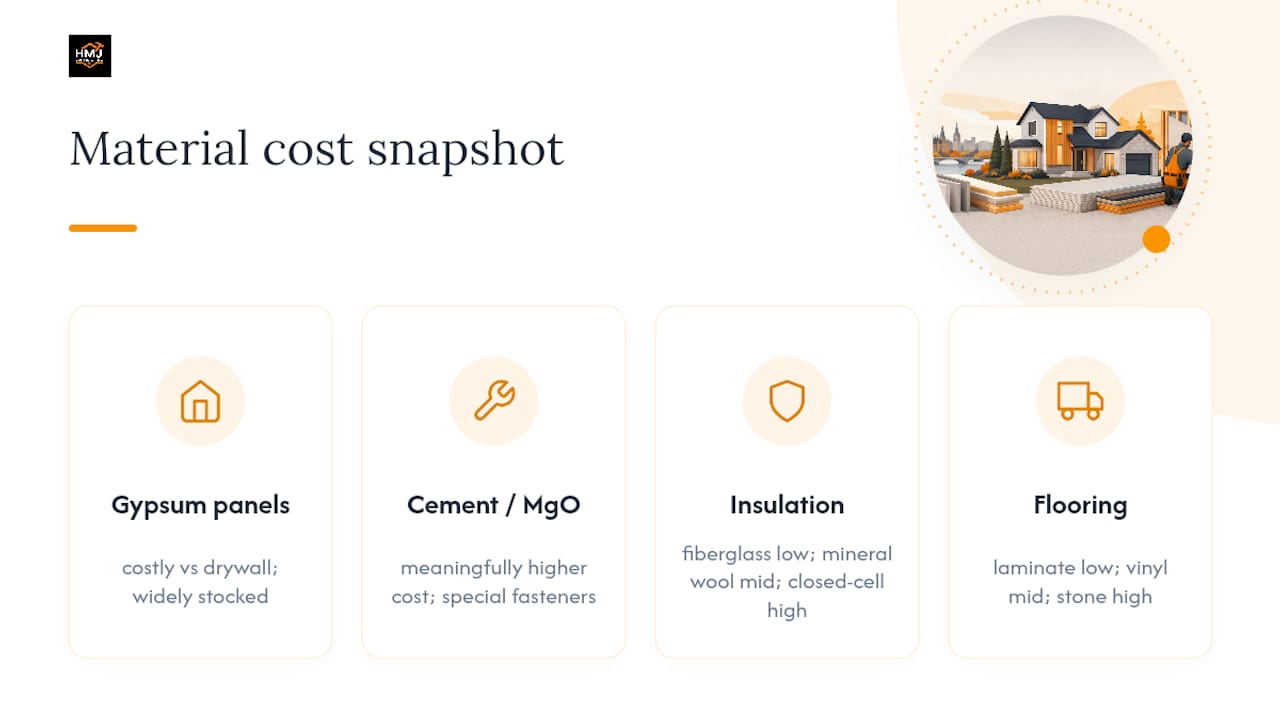
Mould-resistant gypsum panels typically cost more per sheet than standard drywall, though the gap has narrowed as big-box retailers and lumber yards carry them as standard stock in most Canadian cities, including Ottawa. Cement board and MgO board sit meaningfully higher again, both in material cost and in labour, since they cut and fasten differently than gypsum and often need carbide blades or specific screws.
Mineral wool insulation costs more than fiberglass batts per square foot but less than closed-cell spray foam, which remains the most expensive insulation option on this list once installation labour is included. Sealed vinyl plank flooring sits in the middle of the flooring cost range, well below natural stone tile but above basic laminate, while polished concrete’s cost depends heavily on whether it is a new pour or a resurfacing of existing slab.
Availability is rarely the bottleneck. What causes delays is usually the specialty trim, membrane, or sealant that has to match a specific board system, since not every supplier stocks every manufacturer’s full line. If a renovation is happening on a timeline, confirm availability of the specific board, membrane, and compatible sealant together, not just the drywall itself. A mismatched membrane or the wrong caulk can undercut the moisture resistance of an otherwise good board.
Standards and building-code considerations you should know
A few standards and code references come up repeatedly once a renovation touches moisture-prone areas. ASTM D3273 is the standard test method manufacturers use to rate a panel’s resistance to mould growth under controlled fungal exposure, and it is the figure to ask for when comparing board options. ASTM C1396 governs standard gypsum board specifications more broadly, which matters when confirming a “mould tough” product still meets base gypsum board requirements.
On the code side, vapour barrier placement is not optional or a matter of taste. Code guidance on vapour permeance and material placement sets permeance limits and specifies where low-permeance materials belong within a wall assembly to avoid trapping condensation. Getting this backwards, for instance installing a low-permeance vapour barrier on the wrong side of insulation in a given climate zone, can create the exact moisture trap that mould-resistant materials are supposed to prevent. If your renovation involves reframing or re-insulating an exterior wall, this is worth confirming with whoever pulls the permit, since inspectors do check it.
Keeping mould resistance working over the long term
A mould-resistant material installed correctly on day one does not stay protected forever without upkeep. Bathroom exhaust fans lose efficiency as ductwork accumulates dust and lint, so check airflow at the grille annually and clean or replace the fan if it has slowed noticeably. Caulk and grout joints around tub surrounds and sinks should be inspected yearly and re-caulked at the first sign of cracking, since a failed seal lets water behind a cement board substrate that was otherwise doing its job.
Basement dehumidifiers need their reservoirs and filters cleaned on a schedule, not just when they stop working, and crawl space vapour barriers should get a visual check after any major storm season for tears or displacement. Kitchen and laundry appliance connections, particularly supply lines to dishwashers and washing machines, are worth a quick look every few months since a slow drip under a cabinet can run for weeks before anyone notices a stain.
None of this maintenance is expensive or technical. It is mostly a matter of putting a recurring reminder on the calendar, because the materials in this guide reduce risk, they do not eliminate the need for someone to notice a problem early.
What years of rebuild work actually teaches you
The lesson that surprises people most often is how a wall can look perfectly dry on the surface while a cavity behind it stays wet for weeks. A drywall face can pass a moisture meter reading at the surface while insulation packed against an uninsulated pipe or a poorly flashed window stays saturated underneath, and that hidden pocket is exactly where recurrence starts. The fix is not a better board. It is opening the cavity, confirming it is dry all the way through, and correcting whatever is feeding it moisture before any new material goes up.
If you take one habit from this into a contractor interview, make it this: ask specifically how they confirm a cavity is dry before closing it up, not just how they test the surface. A contractor who has a real answer, moisture meter readings at multiple depths, a set drying period, documented before closing, is telling you something true about how they work.
If you already suspect hidden contamination behind a wall or under a floor that looks fine on top, that is worth a proper site assessment before any renovation materials get purchased at all.
— Jason
Get a certified assessment before you buy a single board
Hmjcontracting gives Ottawa homeowners something most renovation crews cannot: a licensed abatement team and a full-service rebuild crew under one roof, so the handoff between “removing what’s contaminated” and “rebuilding it properly” does not fall through the cracks between two separate contractors. If you are rebuilding after a water event or a known mould problem, Hmjcontracting’s mould remediation services start with air quality testing and a clearance-focused process, so you know the space is genuinely safe before any mould-resistant materials go up.

A first visit typically means walking the affected area, identifying the moisture source, and explaining whether the scope is abatement, renovation, or both. You get an itemized quote broken down by task, not a vague lump sum, so you can see exactly what containment, testing, disposal, and rebuild materials cost. If the project also involves hazardous materials like asbestos or lead alongside mould, Hmjcontracting’s abatement services handle certified removal before the rebuild crew ever picks up a board. Once clearance is confirmed, the same team can carry the project through to a finished renovation, including bathroom door and trim choices suited to high-humidity rooms, an area where partners like One Day Doors & Closets offer useful guidance on material selection. Book a consultation to get a written, itemized estimate before you commit to a single material order.
Sources
- Homeowner’s and renter’s guide to mold cleanup after disasters (CDC)
- CodeIndex — excerpts on material placement and vapour control (Ontario/NBC)