
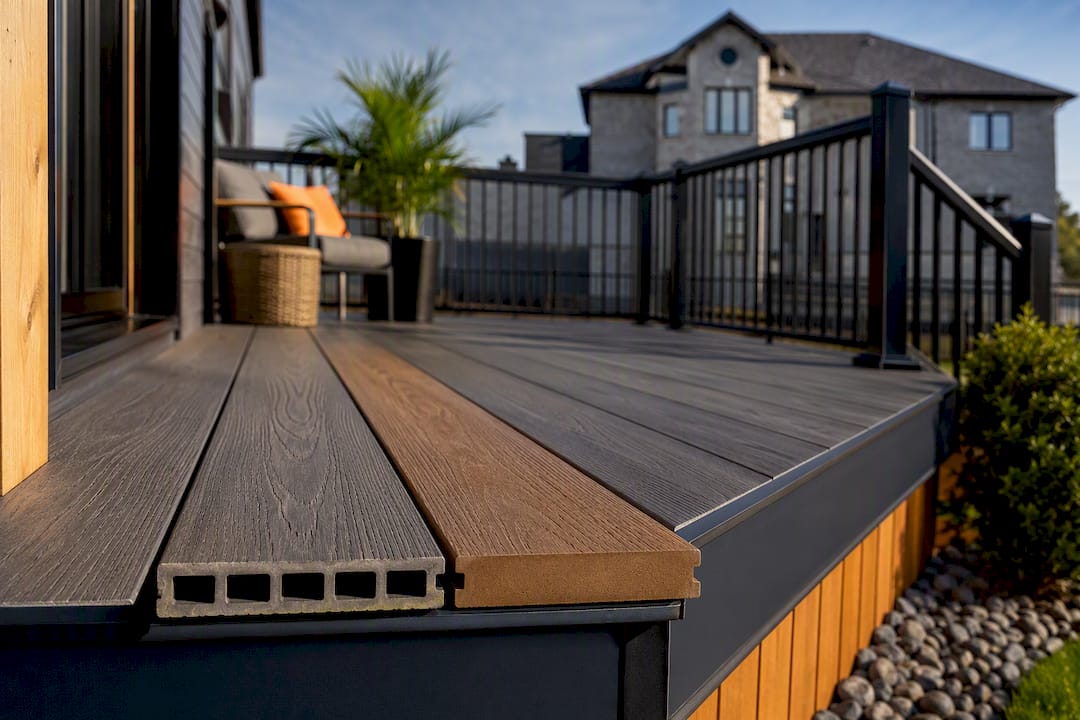
Choose PVC decking if you want maximum durability, minimal upkeep, and a deck that shrugs off wet locations near pools or waterfronts. Choose capped composite decking if you want a warmer, wood-like look at a lower upfront cost. PVC costs more and moves more with temperature swings; composite feels cooler to the wallet but carries a small moisture risk if the capping fails.
TL;DR:
- PVC decking offers a 50+ year warranty, higher upfront costs, and is fully immune to moisture, rot, and insect damage, making it ideal for wet or waterfront locations.
- Capped composite decking typically costs less initially, features a wood-like appearance, and is suitable for shaded areas, but risks moisture damage at unprotected cut ends or ground level.
- Proper installation matters; expansion gaps must account for temperature changes, and quality capping on all sides reduces moisture infiltration and extends deck lifespan.
- PVC remains cooler underfoot, especially in light colors, and requires minimal maintenance, mainly rinsing and annual inspections, compared to composite’s periodic cleaning and cap checks.
- The choice depends on priorities: water exposure and durability favor PVC, while budget and natural look lean towards fully capped composite, with warranty length serving as a performance indicator.
Table of Contents
- PVC vs composite decking: what makes PVC decking different?
- PVC vs composite decking: how does composite perform in real yards?
- Composite vs PVC decking: side-by-side on the criteria that matter
- What does PVC vs composite decking actually cost over time?
- How does installation affect PVC and composite decking performance?
- How do you choose between PVC and composite decking for your home?
- How HMJ Contracting applies these choices on Ottawa-area projects
- How HMJ Contracting can help you build a deck that lasts
- Sources
PVC vs composite decking: what makes PVC decking different?
PVC decking is built from 100% polyvinyl chloride with no wood fibres mixed in at all. That all-synthetic makeup is the whole story behind its reputation: no wood means no rot, no insect damage, and no mould feeding on organic material inside the board.
Manufacturers back that confidence with warranty periods that often stretch past 50 years, a figure composite rarely matches. You pay for it up front, though. PVC boards run higher per square foot than composite, and the trade-off shows up on your first invoice, not your tenth year of ownership.
Underfoot, PVC tends to run cooler than darker composite boards in direct sun, a detail that matters more than most homeowners expect around pools where bare feet meet decking all summer. Lighter-coloured PVC reflects more heat, which is why installers report a real comfort difference on hot afternoons.
Maintenance is close to a non-issue:
- Rinse with a garden hose two or three times a season.
- Use mild soap and water for stubborn stains; no staining, sealing, or sanding ever.
- Check fastener points annually for loosening from thermal cycling.
PVC vs composite decking: how does composite perform in real yards?
Composite decking pairs a wood-fibre and plastic core with a protective outer shell. That capping is where quality diverges. Four-sided capping wraps the entire board, including the cut ends and underside, while cheaper three-sided capping leaves the bottom exposed to whatever moisture collects underneath your deck.
The payoff for choosing composite is aesthetic. Wood-grain texture and colour depth read closer to real lumber than PVC typically manages, which is why so many homeowners lean composite for a natural backyard look. Warranties commonly land in the 25 to 30 year range, shorter than PVC but still well beyond a traditional pressure-treated deck.
Maintenance sits between PVC and wood: annual washing, occasional mildew treatment in shaded spots, and periodic checks for surface scratching on lower-grade capping. The real failure mode isn’t the surface. It’s what happens when a cut end or an unprotected underside lets moisture reach the wood-fibre core, a risk that grows in ground-level or shaded installations where boards never fully dry out.
- Wash boards seasonally with a composite-safe cleaner.
- Inspect cut ends and fastener holes for cap damage every year.
- Keep the area beneath the deck ventilated to help boards dry after rain.
Composite vs PVC decking: side-by-side on the criteria that matter
| Criteria | PVC decking | Capped composite decking |
|---|---|---|
| Moisture resistance | Immune, no organic material | Strong if 4-sided capped; weaker at 3-sided or cut ends |
| Typical lifespan/warranty | 50+ years commonly cited | 25 to 30 years commonly cited |
| Maintenance | Rinse occasionally, no sealing | Annual wash, watch for cap wear |
| Heat retention | Cooler underfoot, especially light colours | Warmer, especially dark tones |
| Slip resistance | Textured finishes perform well wet | Wood-grain embossing also grips well wet |
| Upfront cost | Higher | Lower |
Statistic Callout: Retailer and manufacturer pricing comparisons put PVC material costs around $8 to $15 per square foot versus roughly $5 to $10 per square foot for composite, though your installed price depends heavily on region and job complexity.
A quick ranked guide for common priorities:
- Poolside or waterfront decks: PVC wins on moisture immunity and cooler surface temperature.
- Budget-conscious projects: Capped composite wins on upfront material cost.
- Shaded or covered decks: Fully capped composite works well since sun exposure and heat are less of a factor.
Colour choice matters either way. Lighter tones stay cooler in both materials, and warranty length is a decent proxy for how confident a manufacturer is in long-term performance.
What does PVC vs composite decking actually cost over time?
Material price is only half the equation. Installed cost adds labour, and labour ranges depend on deck size, railing style, and whether your substructure needs repair before boards go down. A straightforward rectangular deck costs less per square foot to install than one with curves, multiple stair runs, or custom railing.
Where the real math happens is over 10 to 30 years. PVC’s higher purchase price often evens out because you’re not repainting, staining, or replacing boards mid-life. Composite’s lower entry cost can get eaten up if you’re dealing with premature cap failure on a lower-grade product, or if you picked three-sided capping for a ground-level application that stays damp.
Budgeting tips worth writing into your plan:
- Set aside contingency budget for substructure repair, since old joists rarely survive a material swap unscathed.
- Price stairs and railings separately. They’re often quoted per linear foot and add up faster than the deck surface itself.
- Ask for labour ranges in writing, not verbal ballparks, before signing anything.
How does installation affect PVC and composite decking performance?
Board spacing isn’t a fixed number. It changes with the temperature on installation day, because both materials expand in heat and contract in cold. Install with tight gaps on a cool spring morning and those same boards can buckle against each other by August.
Good installers widen the gap when it’s cold outside and narrow it when it’s warm, anticipating how far the material will move once summer arrives. Ventilation matters just as much. A substructure that traps moisture underneath the deck defeats even a premium capped composite board, so drainage paths and airflow under the joists deserve as much attention as the decking itself.
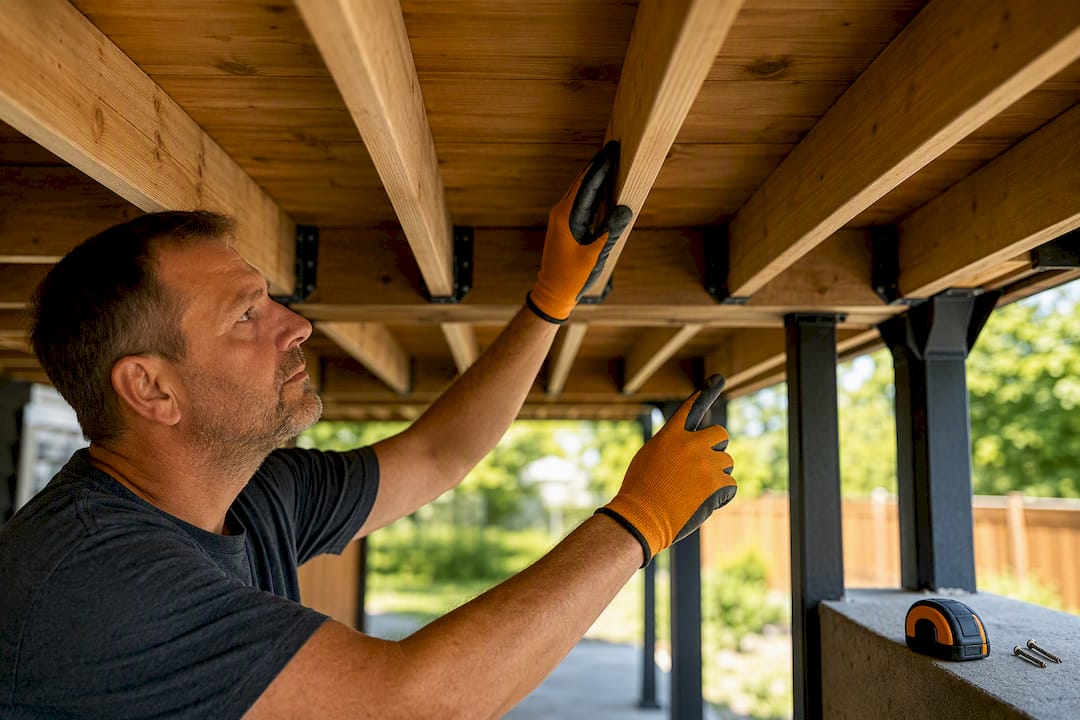
For moisture-prone sites, always specify a fully capped product rather than assuming “capped” means all four sides.
Pro Tip: Ask your contractor exactly what expansion gap they’ll use given the day’s temperature, and get that number written into your contract. If a warranty claim ever comes up, that record proves the installation followed manufacturer spec.
How do you choose between PVC and composite decking for your home?
Work through your priorities in this order, because the answer changes depending on what you rank first:
- Water exposure first. Pools, waterfront properties, and low-lying yards push you toward PVC or fully capped composite.
- Budget second. If upfront cost is the limiting factor, capped composite generally wins.
- Look third. Want a natural wood grain? Composite usually delivers it more convincingly than PVC.
- Maintenance tolerance last. If you want to never think about your deck again, PVC’s simplicity is hard to beat.
Questions worth asking any supplier or contractor:
- Is the composite board 4-sided capped, or only capped on top and sides?
- What warranty length applies, and does it cover fading, staining, or structural failure?
- What expansion gap will you use given today’s temperature, and will that be documented?
- Can I see a sample board that’s been outdoors for a full season, not a showroom cutout?
Red flags include vague warranty wording, no clear answer on capping type, reluctance to record the installation gap, or no local references you can actually call.
How HMJ Contracting applies these choices on Ottawa-area projects
HMJ Contracting typically steers high-exposure sites, pools, and waterfront properties toward PVC, where the long lifespan justifies the extra spend. Budget-conscious clients or those chasing a natural look usually land on fully capped composite instead. On one recent backyard project, switching a shaded, ground-level deck to 4-sided capped boards solved a moisture concern that a cheaper uncapped product would have hidden until it was too late. Licensed installers, transparent quotes, and years of local experience back every recommendation we make.
— Jason
How HMJ Contracting can help you build a deck that lasts
Choosing between PVC and composite is only half the job. The installation detail, correct expansion gaps, proper ventilation, and fully capped boards on moisture-prone sites, is what actually determines whether your deck lasts 10 years or 40. HMJ Contracting handles both sides of that equation as part of its deck and fence installation services, backed by transparent, itemized quotes so you know exactly what you’re paying for before work starts.

Working with a licensed installer protects your warranty, too. Most manufacturers require documented, correct installation to honour a claim, and that’s exactly the kind of paperwork a professional crew keeps as standard practice. If you’re still deciding between finishes or colours, HMJ’s Free Design Centre can help narrow that down before you commit. Ready to move forward? Request a free estimate and get an itemized quote for your project.
Sources
- Composite vs PVC vs PVC Composite: The definitive guide — Odin Agnuk Ltd.
- PVC vs Composite Decking: Key Differences and Costs — BTN Decks
- TimberTech decking: understanding the difference between PVC and capped composite products — Dunn Lumber
- Expert tips for cold-weather PVC installation — All Season Fencing