

A full-service contractor is a single firm that manages a construction or renovation project from initial design and permits through every trade and final handover, acting as your one point of responsibility throughout. In Canada, that role carries legal weight: under Ontario’s Occupational Health and Safety Act (OHSA) and equivalent provincial legislation, the party hired to manage all the work on a project is ordinarily designated the constructor, assuming overall site-safety responsibility. Hmjcontracting, for example, operates as a full-service provider in Ottawa, covering licensed abatement, renovations, demolition, and permit management under a single contract.
The term “full-service contractor” is not a regulated designation in Canada the way “constructor” or “prime contractor” is. It is a practical description of scope. A firm earns that label when it genuinely handles every phase of a project rather than handing off coordination to the owner between trades.
Key takeaways
A full-service contractor is the single firm responsible for every phase of a project, from design and permits through trades and final handover, and in Canada that role carries defined legal obligations under OHSA.
| Point | Details |
|---|---|
| Single point of responsibility | One firm holds the prime contract, the permit, and constructor liability for the entire project. |
| Scope includes abatement | On pre-1990 Canadian homes, certified hazardous-material removal is part of full-service scope and must be documented. |
| Verify four credentials | Confirm provincial trade licences, WSIB clearance, liability insurance, and abatement certifications before signing. |
| Fixed-price vs cost-plus | Fixed-price suits defined scopes; cost-plus suits projects where conditions are unknown; both require itemized change-order processes. |
| Hmjcontracting in Ottawa | Provides licensed abatement, full renovations, and permit management under one contract with itemized quotes and WSIB coverage. |
Table of Contents
- What services does a full-service contractor typically include?
- The real benefits of hiring a full-service contractor
- How does a full-service contractor differ from a general contractor in Canada?
- When is it worth hiring a full-service contractor?
- How do full-service contractors price their work?
- How do you choose a reputable full-service contractor?
- What does the project process look like from start to finish?
- Safety, hazardous materials, and abatement on Canadian projects
- When we recommend a full-service approach
- Hmjcontracting: Ottawa’s full-service contractor for renovations and abatement
- Sources
What services does a full-service contractor typically include?
The scope bundled under full-service contracting goes well beyond swinging a hammer. A true full-service firm handles the following:
- Concept and design coordination: working with designers or in-house design staff to translate your goals into a buildable plan
- Permit management: preparing and submitting applications, liaising with the municipality, and scheduling inspections
- Demolition and site preparation: interior demolition, debris hauling, and site protection before construction begins
- Structural and carpentry work: framing, load-bearing modifications, and finish carpentry
- Trades coordination: scheduling and supervising licensed electricians, plumbers, and HVAC technicians
- Finishes: flooring, tiling, painting, cabinetry installation, and fixture fitting
- Hazardous-material abatement: asbestos, lead, and mould removal with air-quality testing when the project disturbs older building materials
- Site cleanup and final handover: debris removal, punch-list completion, and documentation at closeout
The project-management layer is what separates a full-service firm from a trade contractor. Scheduling, procurement, quality control, and change-order management all sit with the contractor, not with you. Full turnkey renovation firms describe this as delivering a move-in-ready result without requiring the homeowner to hire separate designers and trades.
Pro Tip: Ask every contractor whether each service is performed in-house or through vetted subcontractors. Both models can work well, but you want written confirmation of who holds liability for each scope item and how subcontractors are qualified.
The real benefits of hiring a full-service contractor
The most practical benefit is a single point of accountability. When a plumber’s rough-in conflicts with the electrician’s schedule, that problem belongs to the contractor, not to you. Coordinating multiple independent trades yourself is a part-time job, and the gaps between them are where delays and cost overruns tend to appear.

Beyond scheduling, a full-service firm brings an established trade network. That means vetted subcontractors who show up, pricing relationships that can reduce material costs, and a quality-control process that covers every phase rather than just the work one trade performs.
Warranty management is another area where the model pays off. When a single firm holds the prime contract, warranty claims have a clear owner. You are not left negotiating between a tile installer and a waterproofing subcontractor over who is responsible for a leak.
For larger or multi-trade projects, delegating the full scope to an experienced contractor consistently reduces the risk of costly rework. The overhead that comes with a full-service firm is often offset by fewer delays and a lower chance of scope gaps between trades.
How does a full-service contractor differ from a general contractor in Canada?
In practice, the terms overlap considerably. A general contractor (GC) oversees a construction project end-to-end, coordinating trades, suppliers, and permits while acting as the owner’s main contact. A full-service contractor does the same and typically extends that scope to include design coordination and finish work, so the homeowner receives a complete result rather than a shell.
The more important distinction in Canada is the legal one. Under Ontario’s OHSA, every construction project has a constructor: the party responsible for overall compliance with the Act on that site. When you hire a single contractor to manage all the work, that contractor is ordinarily the constructor. Provincial OHS guidance confirms that duties flow to parties based on their authority and ability to discharge them, which means the firm holding the prime contract carries the heaviest safety obligations.
For a deeper look at how contractor types compare, including owner-managed models, the distinctions matter most when you are deciding who holds liability and who signs the permit applications.
Practical outcome: whichever title a firm uses, confirm in writing that they will act as constructor, hold the building permit, carry liability insurance, and maintain WSIB coverage. Those four items define where responsibility sits if something goes wrong.
When is it worth hiring a full-service contractor?
Not every project justifies the full-service model. A single-trade repair, a cosmetic refresh, or a straightforward deck installation can often be handled by a specialty contractor without the overhead of full project management. The calculus shifts when complexity increases.
- The project requires a building permit. Permit management, inspections, and code compliance are where coordination errors are most costly. A full-service firm owns that process.
- Multiple trades need to work in sequence. Kitchens, bathrooms, and basement conversions all involve electrical, plumbing, and finishing work that must be scheduled in the right order.
- Structural changes are involved. Load-bearing wall removal, additions, or foundation work require engineering sign-off and careful sequencing with other trades.
- Hazardous materials may be present. Homes built before 1990 in Canada often contain asbestos, lead paint, or mould. Disturbing those materials without certified abatement creates health and legal risk.
- Your schedule is fixed. A full-service firm controls the timeline. Owner-managed multi-trade projects routinely run longer because trade availability is unpredictable.
- Your budget is above roughly $25,000–$50,000. Below that threshold, a single skilled trade may be sufficient. Above it, the coordination complexity typically justifies a full-service approach.
- You cannot be on-site daily. Project managers, out-of-town owners, and busy homeowners benefit most from having a dedicated site supervisor accountable for daily progress.
How do full-service contractors price their work?
Three pricing models are standard in Canadian residential construction:
Fixed-price (lump-sum): The contractor quotes a single number for a defined scope. You know your cost upfront, and the contractor absorbs overruns within that scope. Changes to scope trigger a formal change order with a price adjustment.
Cost-plus: You pay actual costs (labour, materials, subcontractors) plus a contractor fee, usually a percentage or fixed management fee. This model suits projects where the scope cannot be fully defined at the start.
Allowances with contingency: Common in renovation contracts.
The main cost drivers on a full-service project are scope complexity, permit and engineering fees, material selections, labour availability, and abatement. Hazardous-material work adds discrete costs: containment, certified removal, air-quality testing, and disposal documentation. Projects that disturb asbestos, lead, or mould require those steps before any renovation work can proceed, and they must appear as separate line items in your quote.
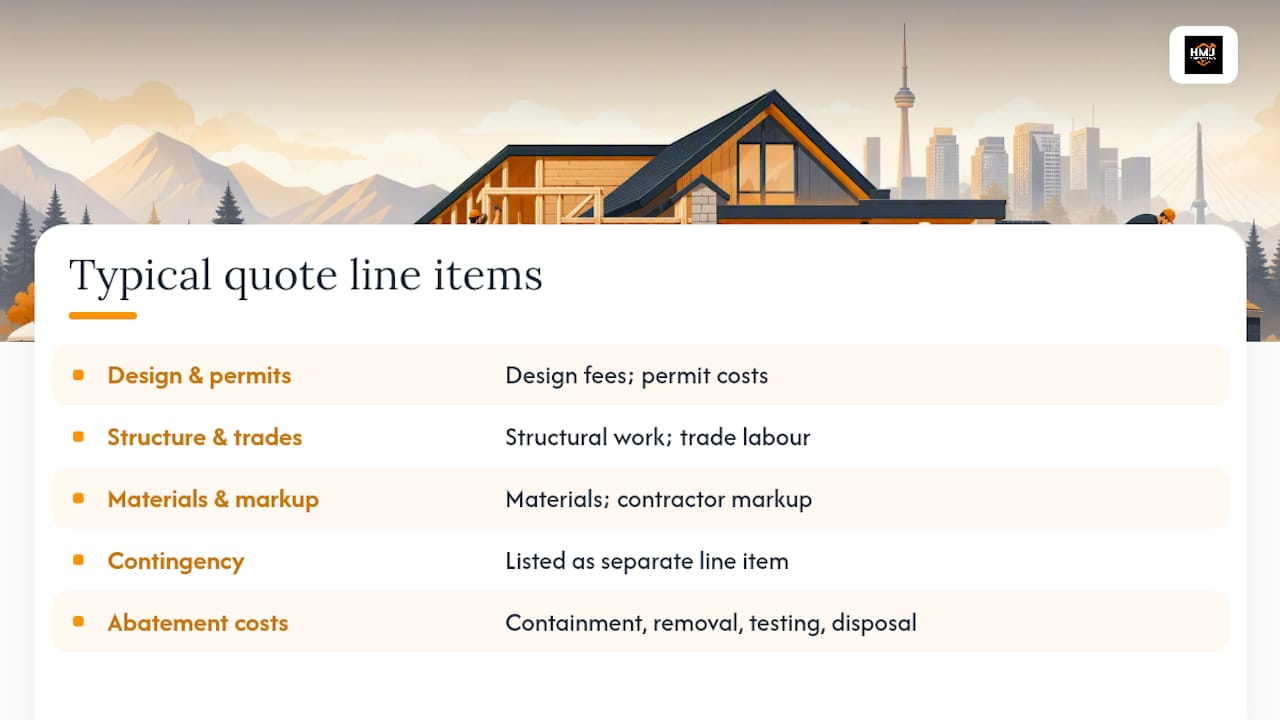
An itemized scope of work should show design fees, permit costs, structural work, trade labour, materials, contractor markup, and contingency as separate line items. A quote that bundles everything into one number makes it impossible to compare bids or track where overruns occur.
Pro Tip: Watch for vague allowances in quotes. An allowance listed as “tile — $2,000” with no specification means the contractor can argue any overrun is a change order. Ask for allowances to be tied to a specific product or grade, and confirm in writing how change orders are priced and approved.
How do you choose a reputable full-service contractor?
Vetting a full-service contractor takes more than checking online reviews. Here is a prioritized checklist:
- Verify provincial trade licences. In Ontario, electrical and plumbing work requires licensed tradespeople. Ask for licence numbers and confirm them with the relevant provincial college or authority.
- Confirm WSIB coverage. Request a WSIB clearance certificate dated within 90 days. Without it, you may be liable for workplace injuries on your property.
- Check liability insurance. Ask for a certificate of insurance showing general liability coverage of at least $2 million. Confirm the policy is current.
- Request abatement certifications. If your home was built before 1990, ask whether the contractor holds certifications for asbestos, lead, and mould abatement. Uncertified disturbance of those materials violates Ontario Regulation 278/05 and similar provincial rules.
- Review the written contract. A proper contract defines scope, schedule, payment milestones, change-order process, and warranty terms. Never proceed without one.
Beyond credentials, ask these questions during the estimate:
- Who manages permits, and will your firm be listed as constructor on the permit application?
- Who will be on-site daily, and how do I reach them?
- How are subcontractors selected and qualified?
- How are change orders initiated, priced, and approved?
- What does your warranty cover, and for how long?
Red flags to watch for:
- Vague scope with no line-item breakdown
- Refusal to provide proof of insurance, WSIB clearance, or licence numbers
- A bid significantly lower than others without a clear explanation
- No written contract, or pressure to sign before you have reviewed it
- Requests for large upfront cash payments
A first-time vetting checklist can help you structure those conversations and know what documentation to request before signing anything.
What does the project process look like from start to finish?
A full-service project follows a predictable sequence, though timelines vary by scope:
- Initial consultation and scope definition: The contractor assesses the site, discusses your goals, and produces a written scope and estimate. For older homes, this may include a hazardous-material assessment.
- Design and selections: Drawings are finalised, materials are selected, and any engineering is completed. Homeowner sign-off is required before permits are submitted.
- Permitting: The contractor submits applications and manages the municipal review process. This phase can take two to eight weeks depending on the municipality and project type.
- Demolition and site preparation: Interior demolition proceeds, with abatement completed first if hazardous materials are present. Debris is hauled and the site is prepared for construction.
- Rough-in construction: Structural work, framing, and mechanical rough-ins (electrical, plumbing, HVAC) are completed and inspected before walls are closed.
- Finishing: Insulation, drywall, flooring, tiling, cabinetry, painting, and fixture installation follow in sequence.
- Punch list and final walkthrough: Outstanding items are identified and corrected. The homeowner reviews the completed work against the original scope.
- Closeout documentation: You receive final invoices, warranty information, permit sign-off records, and, where abatement was performed, air-quality clearance reports and disposal documentation.
The project management responsibilities at each phase are what a full-service firm is paid to own. Your role is to make decisions at the defined approval points, not to manage the sequence between them.
Safety, hazardous materials, and abatement on Canadian projects
Safety responsibility on a Canadian construction site is not informal. Under Ontario’s OHSA, the constructor holds overall responsibility for compliance on the project site. Provincial OHS guidance confirms that contractor duties extend to the limits of their authority and ability to act, which means the firm managing your project carries real legal exposure if safety protocols are not followed.
Hazardous materials are a specific concern for Canadian homeowners with properties built before 1990:
- Asbestos was used in insulation, floor tiles, drywall compound, and roofing materials. Disturbing it without certified abatement is a regulatory offence in Ontario under O. Reg. 278/05.
- Lead paint is common in homes built before 1978 and requires controlled removal and disposal.
- Mould can develop from any moisture intrusion and must be remediated with containment and air-quality testing to confirm clearance.
Before any renovation work begins in an older home, ask your contractor whether a hazardous-material assessment has been completed. If abatement is required, it must be performed by a certified firm, documented, and cleared by air-quality testing before other trades enter the affected area.
Proof to request from any contractor performing abatement:
- Abatement licence or certification number
- Containment and disposal plan
- Air-quality test results (pre- and post-abatement)
- Waste-manifest documentation confirming regulated disposal
A health and safety plan is a standard deliverable on any project where hazardous materials are present or where the constructor designation applies.
Pro Tip: Abatement adds time and cost to a project, but skipping it is not an option. Certified abatement firms reduce both health risk and legal exposure, and their documentation protects you if you sell the property later. Build abatement assessment into your budget from the start on any pre-1990 home.

When we recommend a full-service approach
At Hmjcontracting, we recommend a full-service contractor for any project that involves permits, multiple trades, or the potential for hazardous materials. The reasoning is straightforward: the more moving parts a project has, the higher the cost of a coordination failure.
We see this most clearly on projects in Ottawa’s older housing stock, where a kitchen or basement renovation that looks straightforward on the surface turns up asbestos-containing floor tiles or mould behind a finished wall. When abatement, structural work, and renovation are all managed under one contract, the schedule adjusts cleanly. When they are split across separate firms, the homeowner ends up managing the handoffs, and those handoffs are where delays and disputes happen.
Hmjcontracting combines licensed abatement with full renovation services, which means the same team that removes the hazardous material also manages the rebuild. That continuity reduces timeline uncertainty and keeps documentation in one place. Over 25 years of Ottawa projects, the clients who have the smoothest experience are consistently those who contracted the full scope to a single accountable firm rather than managing trades independently.
Hmjcontracting: Ottawa’s full-service contractor for renovations and abatement

Hmjcontracting brings together licensed hazardous-material abatement and full renovation services under one contract for Ottawa homeowners and property managers. The team holds certifications for asbestos, mould, and lead abatement, carries full liability insurance and WSIB coverage, and provides itemized quotes so you can see exactly what you are paying for before signing anything. Every project includes permit management, a written contract with scope and payment milestones, and closeout documentation.
If you are planning a renovation in an older Ottawa home, or managing a property that requires certified abatement alongside construction work, request a free estimate from Hmjcontracting. When you call, ask for proof of abatement certification, WSIB clearance, and liability insurance. Any reputable full-service contractor will provide all three without hesitation.
Sources
The following sources are useful for verifying rules, understanding contractor roles, and planning your project:
Canadian homeowners planning a renovation should start with the Ontario.ca constructor guideline and confirm with their contractor in writing which party holds that designation before any work begins.
This article is general information, not a substitute for advice from a qualified lawyer. Consult a qualified legal professional about your own circumstances before acting on anything here.