
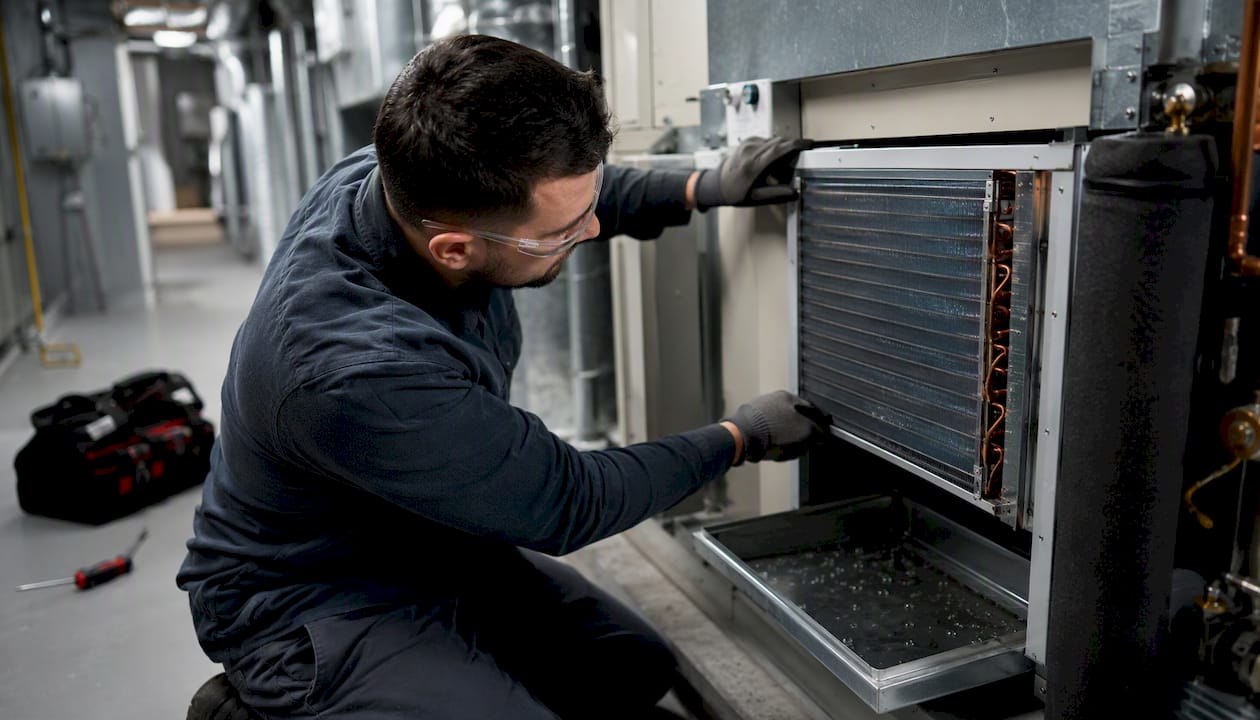
HVAC system contamination risk is the probability that dust, mould, bacteria, volatile organic compounds (VOCs), or other pollutants accumulate inside your heating, ventilation, and air conditioning system and then get distributed throughout your building. According to Health Canada’s guidance for indoor air quality professionals, common health consequences include respiratory allergic reactions, asthma exacerbation, and legionellosis. As a building or facilities manager, your first three actions when contamination is suspected are:
- Isolate the affected zone by shutting off distribution to that area if it can be done safely.
- Appoint or notify a qualified person to assess the situation and specify any testing required.
- Preserve evidence: photograph visible contamination, log occupant complaints with dates, and restrict access to affected mechanical spaces.
Under the Canada Occupational Health and Safety Regulations (COHSR), employers have a legal duty to investigate any workplace air quality situation that may endanger employee health. Acting quickly and documenting everything from the start protects both your occupants and your organisation.
Key takeaways
HVAC contamination risk is a building-wide concern that requires documented prevention, structured inspection, and licensed remediation when contamination exceeds 3 m² or involves Legionella or post-incident damage.
| Point | Details |
|---|---|
| Define the risk clearly | HVAC systems can distribute dust, mould, bacteria, VOCs, and combustion gases to every connected space. |
| Prioritise vulnerable components | Drain pans, cooling coils, AHU interiors, and cooling towers carry the highest contamination risk and need scheduled inspection. |
| Prevention beats remediation | Source control, MERV 13 filtration, and moisture management prevent most contamination from developing. |
| Know the escalation threshold | Mould that is visibly extensive, a positive Legionella test, or damage from flood or fire requires a licensed abatement contractor and documented clearance testing. |
| Hmjcontracting for Ottawa abatement | Hmjcontracting provides licensed mould and HVAC abatement in Ottawa with itemised quotes, clearance reports, and free estimates. |
Table of Contents
- What HVAC contamination actually includes
- Which HVAC components are most vulnerable to contamination
- Health symptoms and operational consequences from HVAC contamination
- How contaminants enter your HVAC system and which risk factors to watch
- How to detect and assess HVAC contamination
- Practical measures to reduce contamination risk
- What to do after a flood, fire, or other contamination incident
- Canadian regulations and standards to reference
- Typical cost drivers and timeline estimates
- When you need a licensed abatement contractor
- What field experience actually teaches you about HVAC contamination
- Hmjcontracting can assess and remediate your HVAC contamination
- Sources
What HVAC contamination actually includes
An HVAC system does not just heat or cool air. It moves air continuously through filters, coils, ducts, and fans, which means any contaminant that enters one part of the system can reach every occupied space connected to it. That redistribution effect is what makes contamination in HVAC components a building-wide concern rather than a localised maintenance problem.
The main contaminant categories to understand:
- Mould and mildew spores: Grow wherever moisture and organic debris meet. Cooling coils, drain pans, and duct lining are the most common sites; for homeowner checks and education on this issue, see Mold in HVAC Systems: What Every Homeowner Should Know. Spores become airborne the moment airflow disturbs them.
- Bacteria, including Legionella: Thrive in warm, stagnant water inside cooling towers, humidifiers, and condensate traps. Legionella is particularly serious because inhalation of contaminated aerosols can cause legionellosis, a potentially fatal form of pneumonia.
- Particulate matter and fibres: Includes outdoor PM2.5, construction dust, and fibres from degraded duct insulation. Fine particles bypass inadequate filters and deposit in airways.
- Volatile organic compounds (VOCs): Off-gas from building materials, cleaning products, and occupant activities. HVAC systems can concentrate and recirculate VOCs when ventilation rates are insufficient.
- Combustion gases: Carbon monoxide and nitrogen dioxide can enter through poorly located outdoor intakes near loading docks, parking garages, or generator exhausts.
- Odours and biological off-gases: Microbial metabolic by-products produce musty or chemical odours that signal active biological growth even before visible mould appears.
A practical signal that your HVAC is the source rather than just a bystander: occupant symptoms improve noticeably when the system is off, or complaints cluster in zones served by a single air handling unit (AHU). That pattern points directly at the distribution system.
Which HVAC components are most vulnerable to contamination
Knowing where to look first saves time during walkthroughs. These components carry the highest contamination risk and deserve priority attention:
- Cooling coils: Condensation forms on the fin surfaces during normal operation, creating a persistently moist environment. Dust and biofilm accumulate between fins, and airflow carries spores or bacteria downstream. Check for visible discolouration, slime, or unusual odour during filter changes.
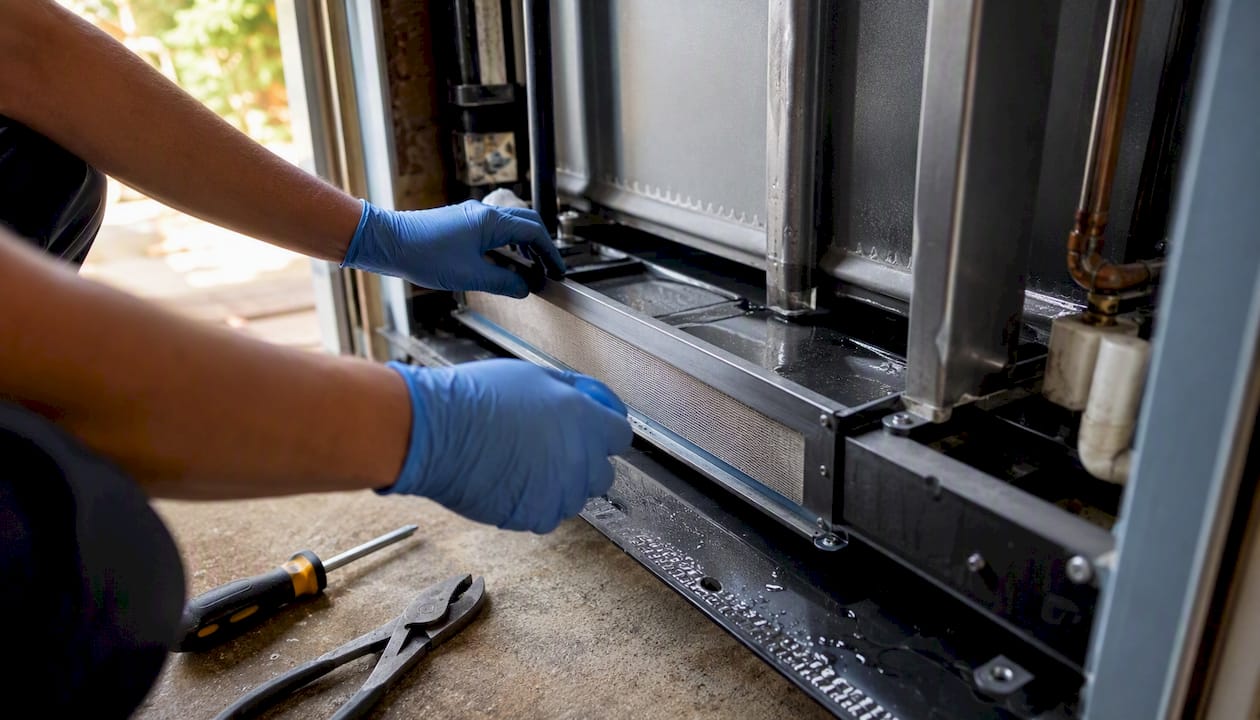
- Drip pans and condensate traps: Standing water in a pan that does not drain properly is one of the fastest routes to microbial growth. Inspect for standing water, slime, and scale at every scheduled maintenance visit. A pan that holds water between cycles needs immediate slope correction or drain clearing.
- Air handling units (fan chambers): The interior of an AHU is a low-pressure zone that can draw in contaminated air from the mechanical room if access panels are unsealed. Look for soiling on fan blades, biological growth on interior surfaces, and gaps around access doors.
- Filters and filter racks: A filter that fits poorly allows unfiltered air to bypass it entirely. Check the rack seal on every filter change. A loaded filter that is left in place too long becomes a nutrient source for mould rather than a barrier.
- Duct interiors, especially lined ducts: Fibrous duct liner absorbs moisture and is very difficult to clean once colonised. CCIAQ Module 5 notes that unsealed sheet metal joints and insulation failure are common drivers of microbial contamination and visible soiling. Use a borescope to inspect sections you cannot see directly.
- Humidifiers: Steam and evaporative humidifiers both create warm, wet conditions. Scale and biofilm build up quickly without a regular cleaning and disinfection schedule.
- Cooling towers: The highest Legionella risk in any building water system. Warm, aerated water is the ideal growth environment. Routine analytical testing and disinfection are not optional.
- Outdoor intakes and mixing plenums: Debris, bird droppings, and exhaust gases enter here. Inspect screens and dampers seasonally, and verify that intake locations are not drawing from contaminated areas such as loading docks or rooftop mechanical exhausts.
Health symptoms and operational consequences from HVAC contamination
The effects of HVAC system pollution fall into two categories: what it does to people, and what it does to your building’s performance and liability exposure.
Health impacts on occupants:
- Respiratory irritation, including coughing, throat irritation, and shortness of breath
- Allergy and asthma exacerbation, particularly in occupants with pre-existing sensitivities
- Headaches, fatigue, and difficulty concentrating (often described as “sick building” symptoms)
- Skin and eye irritation from VOC exposure or particulate matter
- Legionellosis: fever, pneumonia, and in severe cases, life-threatening illness from Legionella-contaminated water aerosols
COHSR requires employers to investigate and keep records of any air quality situation that may endanger health. Investigation records must be retained for at least five years in federal workplaces.
Operational and financial consequences:
- Persistent odours that affect occupant comfort and tenant retention
- Reduced heat transfer efficiency at contaminated coils, which increases energy consumption
- Accelerated wear on fan motors and coil fins from biological fouling
- Increased complaint volume, potential liability claims, and regulatory scrutiny
- Unplanned remediation costs that are typically far higher than the preventive maintenance they replace
When occupants report symptoms that correlate with time spent in the building, that pattern is a regulatory trigger, not just a comfort complaint. Document it and act.
How contaminants enter your HVAC system and which risk factors to watch
Understanding entry pathways lets you close gaps before contamination takes hold.
Common entry pathways:
- Outdoor air intakes drawing in vehicle exhaust, pollen, industrial particulates, or biological material
- Open windows, doors, and gaps in the building envelope that allow unfiltered air to enter occupied zones
- Mechanical room air infiltrating AHUs through unsealed access panels or test ports
- Occupant activities: cooking, printing, cleaning products, and renovation work all generate contaminants that the return-air system picks up
- Post-incident residues from fires (soot, char particles, chemical combustion products) or floods (sediment, sewage, mould spores)
Risk factors that elevate contamination probability:
- Standing water or poor drainage in drain pans and condensate lines
- Filters with an inadequate MERV rating for the building’s contamination load, or filters that fit poorly in their racks
- Maintenance intervals that have been extended beyond manufacturer or ASHRAE recommendations
- Proximity to pollution sources: parking garages, loading docks, or rooftop mechanical exhausts near intakes
- Renovation or demolition work occurring in or adjacent to the building without proper containment (see hidden renovation hazards in older Canadian homes for context on how construction activity affects indoor air quality)
- High humidity or condensation on cold surfaces, particularly in buildings with intermittent occupancy
A lower-frequency but high-consequence consideration: For critical buildings such as hospitals, data centres, or government facilities, a ventilation risk assessment should also verify the system’s capacity to isolate zones and respond to deliberate or accidental contamination events. Health Canada’s office building guidance recommends using system drawings and operational procedures to map isolation capabilities as part of that assessment.
How to detect and assess HVAC contamination
A structured inspection workflow produces better results than a reactive walkthrough. Work through these steps in order, and document findings at each stage.
Step-by-step inspection checklist:
- Visual check of accessible components: Inspect filters, drain pans, coil faces, AHU interiors, and duct openings for visible soiling, discolouration, slime, or mould growth.
- Odour mapping: Walk each zone with the system running and note where musty, chemical, or stale odours are strongest. Correlate with supply and return grille locations.
- Occupant reporting review: Compile complaint logs by date, zone, and symptom type. Clusters in one zone or time period are a strong diagnostic signal.
- Airflow checks: Hold a tissue or smoke pencil near supply and return grilles to confirm airflow direction and identify dead zones or reversed flow.
- Moisture mapping: Use a calibrated moisture meter on duct surfaces, AHU panels, and adjacent walls. Readings above material-specific thresholds indicate condensation or leak pathways.
- Borescope or camera inspection: For duct interiors, especially lined sections, a borescope provides visual confirmation without destructive access.
Testing types and when to use them:
| Test type | What it shows | When to use it | Who performs it |
|---|---|---|---|
| Air sampling (spore trap or culture) | Airborne mould spore species and counts | Visible mould, occupant respiratory complaints | Qualified IAQ professional |
| Surface swabs (microbial culture) | Biological growth on coils, pans, duct surfaces | Soiling or discolouration on HVAC components | Qualified IAQ professional or trained technician |
| Legionella water testing | Legionella concentration in water systems | Cooling towers, humidifiers, any water-using component | Accredited laboratory via qualified person |
| VOC screening | Specific VOC species and concentrations | Chemical odours, renovation activity, occupant complaints | IAQ professional with photoionisation detector |
| CO/CO₂ and humidity logging | Combustion gas levels, ventilation adequacy, moisture load | Persistent headaches, fatigue, high occupancy spaces | Trained technician with calibrated dataloggers |
When to escalate to a specialist:
- Visible mould covering more than 3 m² of any HVAC component or adjacent surface
- Any positive Legionella result in a water system
- Water damage affecting structural materials or duct insulation
- Persistent occupant illness that correlates with building occupancy
- Any situation where COHSR requires a qualified person to investigate
Practical measures to reduce contamination risk
Health Canada recommends prioritising source control, ventilation, and scheduled inspections over reactive deep cleaning. That order matters: cleaning a contaminated coil without fixing the moisture source that caused the growth will produce the same result within weeks.
Priority action list:
- Source control first: Identify and eliminate the moisture, drainage, or infiltration problem before any cleaning takes place.
- Verify ventilation rates: Confirm that outdoor air supply meets ASHRAE Standard 62.1 minimums for the occupancy type. Inadequate ventilation concentrates every contaminant the system picks up.
- Correct filtration: Install filters rated MERV 13 or higher in return-air systems where the equipment allows. Verify that filter racks seal properly and that no bypass gaps exist around the filter frame.
- Drain pan maintenance: Clear condensate drains at every scheduled visit. Correct any pan slope that allows standing water to accumulate.
- Humidifier and cooling tower management: Follow a documented disinfection schedule. For cooling towers, Legionella analytical testing by a competent person is the standard of care, not an optional extra.
- Secure mechanical rooms: Keep mechanical spaces free of stored chemicals, refuse, and standing water. Seal AHU access panels and test ports. A negative pressure zone inside an unsealed AHU can draw pollutant-laden mechanical room air directly into the supply stream.
Sample maintenance rhythm:
- Monthly: Inspect and replace filters as needed; check drain pans for standing water; log any odours or occupant complaints.
- Quarterly: Inspect coil faces and AHU interiors; verify condensate trap function; check outdoor intake screens and dampers.
- Semi-annually: Full coil cleaning; humidifier disinfection; borescope inspection of accessible duct sections; review and update maintenance records.
- Annually: Legionella risk assessment for any water-using HVAC component; full system airflow and ventilation rate verification; review filter MERV ratings against current occupancy and use.
Document every inspection, finding, and corrective action. COHSR requires investigation records to be retained, and documented maintenance history is your primary defence in any liability or regulatory review.
Pro Tip: Two small design fixes prevent a disproportionate share of recurring contamination: correcting drain pan slope so water cannot pool, and installing compression-fit filter frames that eliminate bypass gaps. Both are low-cost at the time of a scheduled maintenance visit and expensive to ignore.
What to do after a flood, fire, or other contamination incident
Post-incident response is where building managers most often underestimate the scope of the problem. Visible damage is rarely the full picture.
- Stop HVAC distribution to affected zones immediately if it can be done without creating a safety hazard. Running the system after a flood or fire spreads soot, spores, and chemical residues to every connected space.
- Secure access to affected mechanical spaces. Restrict entry to authorised personnel only and post clear signage.
- Notify occupants and appoint a qualified person. Do not wait for visible mould to appear before engaging a specialist. Mould can colonise wet porous materials within 24–48 hours.
- Document the incident thoroughly. Photograph all affected areas, log the timeline, and preserve any samples or materials that may be relevant to insurance or regulatory review.
- Do not attempt cosmetic cleaning before assessment. Wiping surfaces or running the system to “dry things out” can distribute contamination further and destroy evidence needed for a proper scope of work.
Simple cleaning is often insufficient after a flood or fire for three reasons. First, soot and chemical residues from fires penetrate porous duct insulation and cannot be surface-wiped. Second, flood water introduces sediment, sewage pathogens, and mould spores into duct interiors that are impossible to reach without destructive access. Third, persistent moisture in structural cavities adjacent to ductwork continues to drive mould growth long after surfaces appear dry.
When atmospheric testing, borescope inspection, insulation removal, or full duct replacement is likely required, that work falls within the scope of a licensed abatement contractor. A post-renovation cleanout process gives a useful reference point for what thorough post-incident air quality restoration actually involves.
Canadian regulations and standards to reference
These are the primary documents your compliance and maintenance programme should be built on:
- Health Canada — Guidance for Indoor Air Quality Professionals: Defines contaminant categories, health thresholds, and the role of the qualified person. The foundational reference for any IAQ investigation in Canada.
- Health Canada — Guidance on Improving Indoor Air Quality in Office Buildings: Covers ventilation rates, filtration recommendations (including MERV 13 guidance), and risk assessment methodology for office environments.
- COHSR (SOR/86-304): Sets employer obligations for federally regulated workplaces, including the duty to appoint a qualified person, investigate air quality hazards, and maintain records for at least five years.
- ASHRAE Standard 62.1: The technical standard for ventilation rates and indoor air quality in non-residential buildings. Referenced by Health Canada when manufacturer guidance is absent. Use it to verify that your system delivers adequate outdoor air per occupancy category.
- CCIAQ Modules (Canadian Committee on Indoor Air Quality): Module 5 covers HVAC hygiene and maintenance; Module 10 addresses mould and microbiological agents. Both include practical checklists and remediation thresholds.
- CSA Z94.4: The Canadian standard for respirator selection, use, and care. Relevant when maintenance staff or abatement contractors work in contaminated HVAC spaces. Ensures that personal protective equipment selection is defensible.
- Health Canada — Legionella in the Workplace: Covers Legionella risk assessment, water system management, and analytical testing requirements for cooling towers and other water-using HVAC components.
Practical documentation tip: Keep a single maintenance log that cross-references each inspection action to the relevant standard or regulation. When a regulator or insurer asks for evidence of due diligence, a log that names COHSR, ASHRAE 62.1, or a CCIAQ module alongside each action is far more defensible than a generic service record.
Typical cost drivers and timeline estimates
Cost and timeline vary considerably depending on system size, contamination type, and access conditions. The table below reflects the primary variables, not fixed prices, since every building is different and quotes should always be itemised.
| Scope | Primary cost drivers | Typical timeline |
|---|---|---|
| Routine inspection and filter service | System size, number of AHUs, travel | Half-day to full day |
| Microbiological testing (air/surface/water) | Number of samples, lab turnaround, specialist fees | 1–5 business days for results |
| Small mould remediation (under 3 m²) | Access difficulty, containment needs, disposal | 1–2 days |
| Larger mould or biological abatement (over 3 m²) | Extent of duct replacement, negative pressure containment, clearance testing | Several days to several weeks |
| Post-flood or post-fire HVAC restoration | Structural damage extent, insulation replacement, system component replacement | Weeks to months depending on scope |
Factors that push costs higher:
- Contamination in concealed duct sections requiring destructive access
- Positive Legionella results requiring full system disinfection and retesting
- Asbestos-containing insulation on older ductwork (requires licensed abatement before any duct work)
- Occupied buildings requiring after-hours work or phased isolation
- Regulatory requirements for third-party clearance testing before reoccupation
Getting quotes right: Always request an itemised scope of work that separates assessment, containment, remediation, disposal, and clearance testing as distinct line items. A single lump-sum quote makes it impossible to verify what is included or to compare proposals fairly. Ask specifically whether clearance testing and a written report are included in the price, because those are the items most often omitted from initial quotes.
When you need a licensed abatement contractor
Some contamination situations are beyond the scope of routine maintenance staff, regardless of how experienced they are. Knowing the thresholds protects both your occupants and your organisation.
Hire a licensed abatement contractor when:
- Visible mould covers more than 3 m² of any HVAC component or adjacent surface, as CCIAQ Module 10 sets this as the threshold requiring qualified specialists and documented procedures
- Any Legionella test returns a positive result in a cooling tower, humidifier, or other water system
- Structural water damage has affected duct insulation, AHU components, or adjacent building materials
- An occupant illness cluster is reported and the HVAC system is a plausible exposure pathway
- COHSR requires a qualified person to investigate and the investigation scope exceeds in-house capability
- Asbestos-containing materials are present in or adjacent to ductwork requiring remediation
What a qualified contractor delivers:
- A written hazard assessment identifying contaminant type, extent, and exposure pathways
- Containment setup with HEPA-filtered negative pressure to prevent cross-contamination during work
- Removal or replacement of contaminated components, with proper waste handling and disposal documentation
- Clearance testing by an independent qualified person before the system is returned to service
- A written remediation report suitable for regulatory, insurance, and liability purposes
What to include in your contract:
- Itemised scope covering each phase: assessment, containment, remediation, disposal, and clearance
- Specific clearance criteria (for example, post-remediation air sample results below a defined threshold)
- Timeline with milestones and occupant notification requirements
- Proof of licensing, liability insurance, and workers’ compensation coverage
- A written report delivered at project completion
For mould-related abatement in older Ottawa buildings, renovation red flags in older houses covers additional hazards such as asbestos-containing duct insulation that can complicate HVAC remediation scope.
What field experience actually teaches you about HVAC contamination
The most common oversight on contaminated HVAC jobs is not the mould itself. It is the conditions that allowed the mould to grow and that will allow it to grow again if they are not corrected. Drain pans with inadequate slope, filter racks with bypass gaps, and unsealed AHU access panels account for a disproportionate share of recurring contamination calls. These are not complex problems. They are maintenance details that get deferred until the consequence is expensive.
The second pattern worth naming: cleaning without fixing the moisture source is a temporary measure, not a solution. CCIAQ guidance is explicit on this point, and field experience confirms it. A coil that is cleaned but still sits in a drain pan that holds water will be contaminated again within a season. The fix is the pan slope and the drain, not the cleaning frequency.
Documented processes matter more than most managers expect. A written maintenance log, a signed inspection record, and a clear chain of custody for test results are what separate a defensible response from a liability exposure when a regulator or insurer asks what was done and when. HMJ Contracting’s approach to every abatement project includes that documentation from the first site visit to the final clearance report, because the paperwork is part of the protection.
Hmjcontracting can assess and remediate your HVAC contamination
When contamination in your HVAC system crosses the threshold for professional intervention, you need a contractor who can assess the full scope, contain the work properly, and deliver the documentation your organisation requires.

Hmjcontracting provides licensed mould remediation and abatement services for commercial and residential properties across Ottawa, including HVAC-related mould, biological contamination, and post-incident restoration. With over 25 years of local experience, a 5.0-star Google rating, and a process built around itemised quotes and written clearance reports, Hmjcontracting gives building managers the transparency and documentation they need to close out a contamination event with confidence. Free estimates are available, and every project includes a detailed scope of work before any work begins. Contact Hmjcontracting through the abatement services page to arrange a site inspection and get an itemised quote.
Sources
These are the primary references used throughout this article. Each is publicly available and free to access:
- Canada
- Canada
- Canada
- Canada Occupational Health and Safety Regulations SOR/86-304 - HVAC provisions
- Module 10 Management Strategies for Moulds and Microbiologic Agents - CCIAQ
This article is general information, not a substitute for advice from a qualified doctor. Consult a qualified healthcare professional about your own circumstances before acting on anything here.