
A multi-unit abatement project is a licensed hazardous-material removal operation covering two or more dwelling units in the same building, where asbestos, lead, or mould must be safely removed under Ontario's regulatory framework. Under O. Reg. 278/05, building owners and property managers have specific legal obligations the moment that work is triggered, and those obligations apply whether you own a duplex or a 40-suite apartment block.
If you are facing this situation right now, three steps come first:
- Pause any demolition or renovation that could disturb suspected hazardous materials until a qualified inspector has assessed and sampled the area.
- Secure a written inspection and testing report from a certified professional before any contractor touches the building.
- Notify the Ministry of Labour, Immigration, Training and Skills Development (MLITSD) in advance of Type 3 asbestos operations and certain Type 2 operations, as required under the regulation.
Hmjcontracting works with Ottawa property owners through every one of these steps, from initial testing through to final clearance documentation.
Pro Tip: Never assume a building is hazardous-material-free based on age alone. Many Ottawa properties built before 1990 contain asbestos-containing material (ACM) in floor tiles, pipe insulation, drywall compound, and ceiling texture, sometimes in multiple forms in the same unit.
Table of Contents
- Who needs a multi-unit abatement project in Ottawa?
- How are asbestos operations classified, and what does that mean for your project?
- Step-by-step: how a multi-unit abatement project runs
- What drives costs and timelines for multi-unit abatement?
- How do you choose a licensed abatement contractor in Ottawa?
- Hmjcontracting handles compliant multi-unit abatement in Ottawa
- Key takeaways
- What Ottawa property owners often get wrong about abatement projects
- Useful sources and further reading
Who needs a multi-unit abatement project in Ottawa?
The most common triggers are renovation and demolition work that disturbs shared or adjacent spaces. Replacing flooring across several suites, opening walls in a common corridor, or gutting a basement mechanical room can all expose ACM or lead paint simultaneously in multiple units.
Other frequent triggers include:
- Water or fire damage that affects two or more units and disturbs existing materials
- Positive material test results from a pre-renovation assessment
- Tenant health complaints that prompt an air quality investigation
- Planned building-wide demolition or major structural work
Building types covered include apartment blocks, multiplexes, and condo common areas. Signs of probable asbestos are worth checking before you tender any renovation.
There is one important exemption. O. Reg. 278/05 does not apply to a private residence occupied by its owner, or to certain owner-occupied residential buildings of four units or fewer. If your building falls outside that exemption, the full regulation applies.
Rushing demolition before a professional assessment is one of the most costly mistakes an Ottawa property owner can make. Discovering asbestos mid-project triggers mandatory notification procedures that can halt work entirely, requiring additional controls and causing delays that far exceed the cost of upfront testing. Avoiding this pitfall starts with assessment before the first tool is lifted.
How are asbestos operations classified, and what does that mean for your project?
Ontario classifies asbestos work into three types under the regulation's overview guide. The classification drives every downstream decision: who you hire, what controls go on site, and what paperwork you must file.
| Type 1 | Type 2 | Type 3 | |
|---|---|---|---|
| Scale of work | Small, low-disturbance tasks | Moderate removal, including all glove-bag operations | Large-scale removal across multiple areas or suites |
| Typical multi-unit example | Replacing a ceiling tile in one suite | Glove-bag pipe insulation removal in a mechanical room | Full floor or building-wide ACM removal |
| Notification required | No | Yes, for glove-bag work of 1 m² or more | Yes, always — advance notice to MLITSD |
| Training required | Basic awareness | Type 2 worker training | Type 3 worker training |
| Key controls | Wet methods, HEPA vacuum | Isolation, PPE, decontamination | Negative-pressure enclosure, full decontamination, air clearance testing |
For multi-unit projects, Type 2 and Type 3 are the most common classifications. All glove-bag operations are defined as Type 2, and glove-bag removal of 1 m² or more requires Ministry notification. Type 3 work always requires advance MLITSD notice, plus independent air clearance testing before the enclosure is removed.
The owner-occupied small-residence exemption does not eliminate the need for an asbestos management program. Even when no active work is planned, building owners with potential ACM must maintain a management program under the regulation — records, periodic inspections, and documentation are ongoing obligations, not one-time tasks.
Step-by-step: how a multi-unit abatement project runs
A well-managed project follows a clear sequence. Skipping steps or reordering them is where regulatory problems and cost overruns begin.
- Written management plan. Based on test results, a formal asbestos, lead, or mould management plan is prepared. This document governs the entire project and is required for tendering. How asbestos findings affect renovation sequencing is worth reviewing at this stage.
- MLITSD notification. For Type 3 operations and qualifying Type 2 work, file the required work notice with the Ministry before work begins. In some cases, a copy must be posted at the worksite. Build this lead time into your schedule.
Pro Tip: Build MLITSD notification lead times and lab turnaround windows into your project schedule from day one. These steps alone can add one to three weeks to a project if not planned in advance.
What drives costs and timelines for multi-unit abatement?
No two projects cost the same, but the variables are predictable. Understanding them helps you budget accurately and plan tenant logistics.
Primary cost drivers:
- Material type: friable ACM (pipe insulation, spray-applied fireproofing) costs more to remove than non-friable materials (floor tiles, textured ceilings) because of higher containment and disposal requirements
- Number of units affected and total surface area
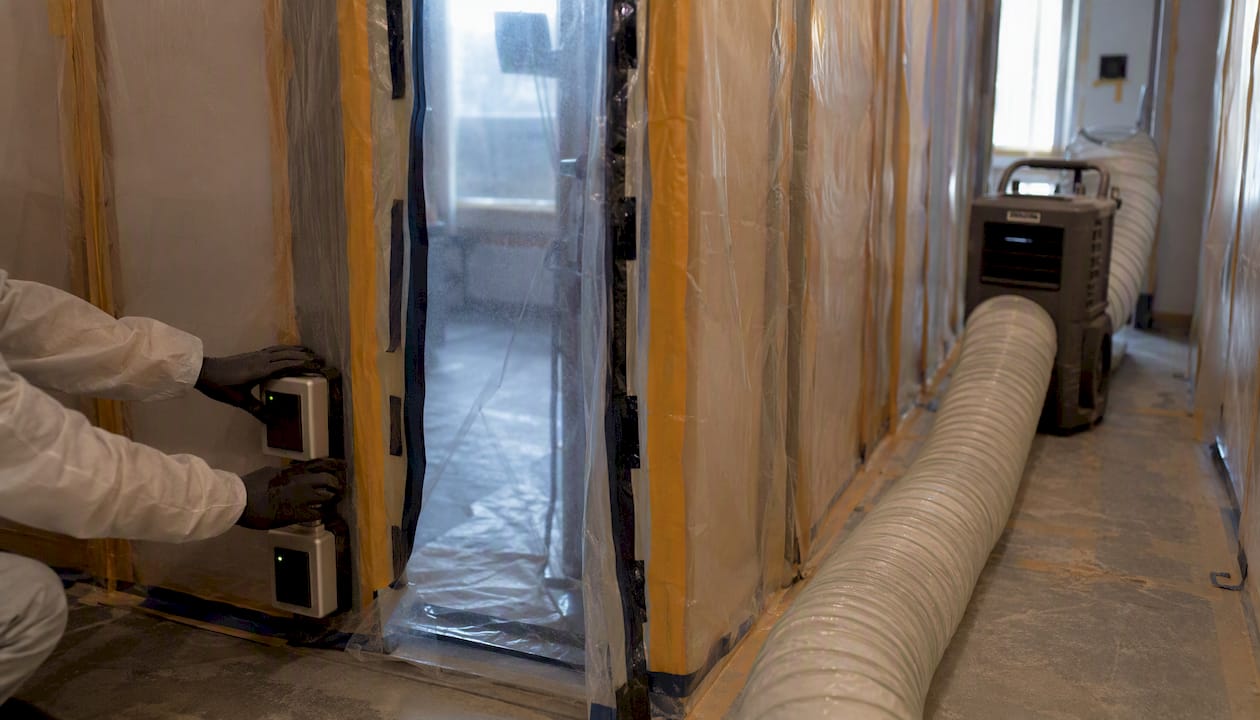
- Containment complexity: negative-pressure enclosures, decontamination facilities, and multi-zone setups add labour and equipment costs
- Independent air clearance testing and accredited lab fees
- Hazardous waste disposal and manifest costs
- Emergency or expedited work premiums
| Cost driver | Typical impact |
|---|---|
| Friable vs. non-friable ACM | Friable requires full Type 3 controls; significantly higher labour and equipment |
| Number of units | Each additional unit adds containment setup, testing, and disposal costs |
| Clearance testing | Independent hygienist and lab fees per clearance event |
| MLITSD notification lead time | Can delay project start by days to weeks if not filed early |
| Waste disposal manifests | Per-load cost; volume-dependent |
Timeline varies with scope. A single-suite removal may complete in two to five days once containment is established. Multi-suite or building-wide common-area abatement typically runs several weeks, with MLITSD notification adding lead time at the front end. Renovation disruption strategies can help you plan tenant relocation and minimise vacancy costs during the work.
How do you choose a licensed abatement contractor in Ottawa?
The contractor you hire determines whether your project is compliant, documented, and completed without regulatory interruption. Vetting licensed contractors takes a short checklist and a few direct questions.
Credentials to verify before signing anything:
- Provincial worker training certificates for Type 2 and Type 3 operations
- Valid business licence and WSIB coverage
- Liability insurance with adequate limits for multi-unit work
- Hazardous waste disposal manifests from previous projects
Questions to ask every contractor:
- Can you provide an itemised, written quote with a defined scope of work?
- Who conducts clearance testing, and is it an independent hygienist?
- What controls will be in place (enclosures, negative pressure, decontamination)?
- Do you handle MLITSD notifications, or is that the owner's responsibility?
- Will you provide copies of worker training certificates and work reports?
Red flags to watch for:
- Vague or verbal-only quotes with no line-item breakdown
- Reluctance to confirm who performs clearance testing
- No written asbestos management plan or disposal receipts offered
- Subcontracting plans that are unclear or undisclosed
Pro Tip: Request copies of worker training certificates and a recent clearance test report before work starts. A contractor who cannot produce these documents quickly is a contractor whose compliance you cannot verify.
Also check that any contractor you hire carries fire safety awareness for multi-unit properties, since abatement work in occupied buildings intersects with fire safety obligations that property managers must track separately.
Hmjcontracting handles compliant multi-unit abatement in Ottawa
Ottawa property owners dealing with asbestos, lead, or mould across multiple units need a contractor who understands the full regulatory picture, not just the removal work.

Hmjcontracting provides licensed asbestos, lead, and mould remediation for multi-unit residential and commercial properties across Ottawa. Every project includes itemised written quotes, verified worker training documentation, independent air clearance testing coordination, waste manifesting, and the complete project file your regulators and future tenants expect. Hmjcontracting's team has extensive local experience and a strong reputation; it knows Ottawa's building stock and the MLITSD notification process inside out.
Request a free estimate for your multi-unit abatement project and get a clear, documented scope before any work begins.
Key takeaways
A multi-unit abatement project requires licensed removal, Ontario regulatory compliance, and complete documentation from inspection through to disposal.
| Point | Details |
|---|---|
| Confirm project scope first | Determine whether two or more units are affected before engaging any contractor or starting demolition. |
| Testing before any work | A certified inspection and written report must precede all removal work and contractor tendering. |
| Follow O. Reg. 278/05 notification rules | File MLITSD notices for Type 3 and qualifying Type 2 operations before work begins, and build lead time into your schedule. |
| Hire licensed contractors only | Verify Type 2/3 training certificates, WSIB coverage, liability insurance, and disposal manifests before signing. |
| Keep complete records | Retain clearance test results, worker work reports, and disposal manifests for the full regulatory retention period. |
| Hmjcontracting for Ottawa projects | Hmjcontracting delivers licensed multi-unit abatement with itemised quotes, clearance testing, and full documentation. |
What Ottawa property owners often get wrong about abatement projects
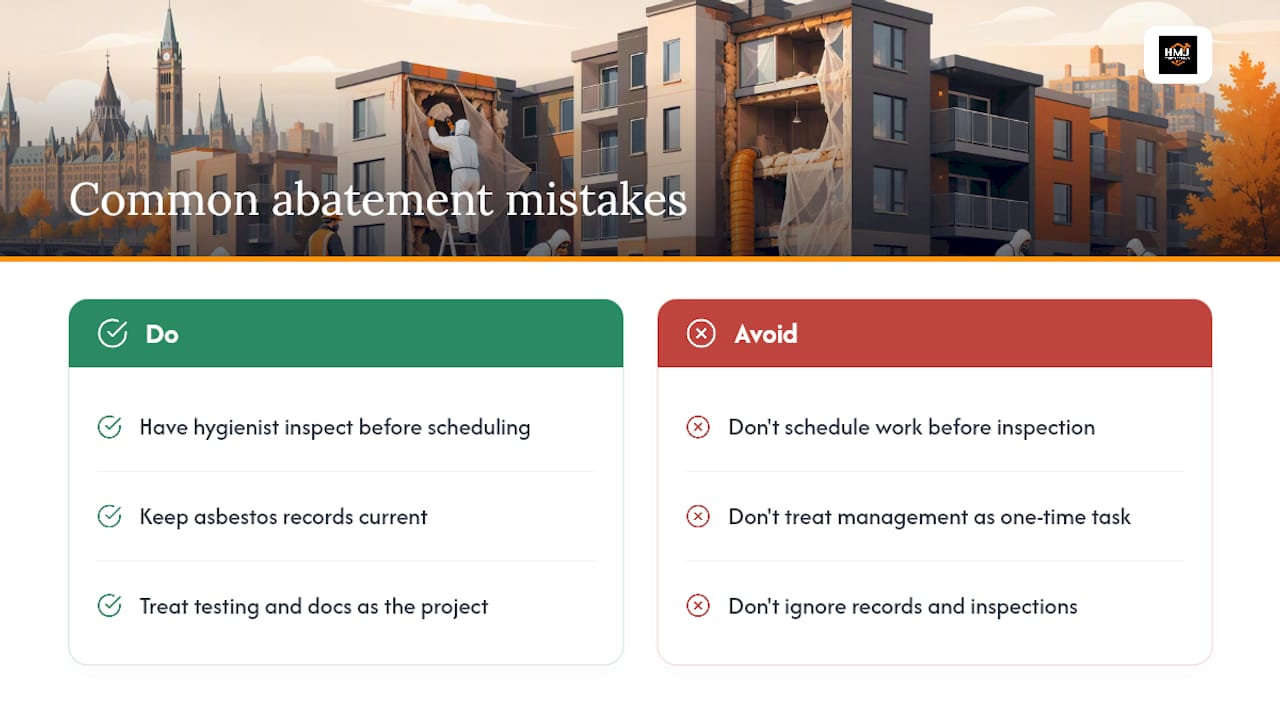
The biggest gap I see in multi-unit abatement projects is not a lack of willingness to comply. It is a lack of sequencing. Owners call a contractor, get a price, and schedule the work, all before a certified hygienist has set foot in the building. That order of operations creates the exact regulatory exposure the regulation is designed to prevent.
The second pattern is treating the asbestos management programme as a one-time task. O. Reg. 278/05's application requirements make clear that building owners with potential ACM carry ongoing obligations, not just project-specific ones. A dormant building with no active renovation still requires records, periodic inspections, and documentation ready for review.
The owners who avoid costly project shutdowns are the ones who treat testing, notification, and documentation as the project itself, not as paperwork that follows the real work. The removal is the easy part. The compliance record is what protects you.
Useful sources and further reading
The following Ontario sources are the authoritative references for multi-unit abatement compliance. Save copies of any forms you file and any guidance you rely on.
- Overview of the regulation | A guide to the Regulation respecting Asbestos on Construction Projects and in Buildings and Repair Operations | ontario.ca
- O. Reg. 278/05: DESIGNATED SUBSTANCE — ASBESTOS ON CONSTRUCTION PROJECTS AND IN BUILDINGS AND REPAIR OPERATIONS
- File a work notice | ontario.ca
- Asbestos in the workplace | ontario.ca
- Application | A guide to the Regulation respecting Asbestos on Construction Projects and in Buildings and Repair Operations | ontario.ca
Keep clearance test results, asbestos work reports, and disposal manifests on file for the full retention period the regulation recommends. These documents are your proof of compliance if an MLITSD inspector visits or a future buyer or tenant requests records.